
Emerging Altcoin Trends and Their Implications for Crypto Portfolios: Strategic Diversification and Risk-Adjusted Returns in a Maturing Market
The maturing cryptocurrency market of 2025 has ushered in a new era of investor behavior, where strategic diversification and risk-adjusted returns dominate decision-making. While BitcoinBTC-- remains the cornerstone of institutional portfolios, altcoins continue to play a dual role: as speculative assets and as vehicles for innovation. However, the broader altcoin market remains under pressure, with many tokens still down over 90% from their all-time highs. This article examines the evolving dynamics of altcoin trends, their implications for portfolio construction, and the critical role of active management in navigating a fragmented and volatile landscape.
The Maturing Market and Altcoin Realities
The 2025 crypto market is characterized by heightened scrutiny of fundamentals and real-world utility, driven by institutional adoption and regulatory clarity. Institutional investors now treat Bitcoin as a reserve asset, have shifted their focus to risk-adjusted returns, allocating capital to projects with defensible use cases. Yet, altcoins face structural challenges. Liquidity bottlenecks and market fragmentation-exacerbated by the proliferation of over 10,000 tokens-have diluted capital flows, favoring Bitcoin and tokens with strong narrative traction. This has delayed the anticipated "altcoin season," as speculative waves give way to a more analytical approach.
Strategic Diversification: The Barbell Approach
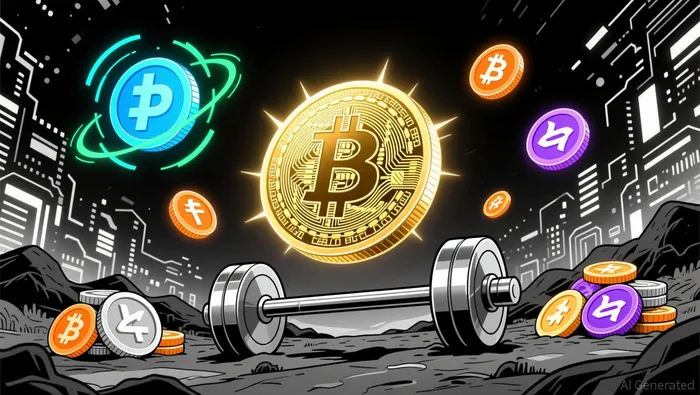
Amid this backdrop, a barbell strategy-balancing a core position in Bitcoin with satellite allocations to high-utility altcoins-has gained traction. This approach mitigates downside risk while preserving upside potential. For instance, tokens like RAIN on Arbitrum, which leverage AI-driven analytics for DeFi optimization, demonstrate the potential for growth in niche sectors. However, volatility remains a critical concern: 30-day price swings exceeding 127% for some altcoins underscore the need for rigorous risk management.
Institutional confidence in blockchain technology, with 94% of surveyed firms recognizing its long-term value, has further legitimized altcoins as strategic assets. Yet, the "musical chairs" risk-where only the most viable projects survive-demands active screening. Investors must prioritize projects with robust governance, user adoption, and tangible applications, such as Layer 2 solutions addressing Ethereum's scalability limitations.
Sector Analysis: DeFi, LayerLAYER-- 2, and Stablecoins
DeFi and Layer 2 solutions have emerged as key drivers of innovation in 2025. DeFi protocols, despite regulatory headwinds, continue to attract capital through yield-generating mechanisms and cross-chain interoperability. Meanwhile, Layer 2 networks like Arbitrum and Optimism are critical for reducing transaction costs and enhancing user experience. These sectors offer real-world utility, particularly in emerging markets where blockchain-based financial tools bridge gaps in traditional infrastructure.
Stablecoins, meanwhile, have become linchpins of systemic risk and diversification. With $232 billion in circulation and $27.6 trillion in annual transaction volume, stablecoins facilitate cross-border payments and DeFi liquidity. However, their role as "net absorbers of systemic return shocks" during market stress highlights the need for caution. Regulatory frameworks like the U.S. GENIUS Act, which mandate safe and liquid reserves for stablecoins, aim to mitigate risks but also underscore the sector's evolving complexity.
Risk-Adjusted Returns and Active Management
The dispersion of returns in 2025 has made active management indispensable. Governance tokens like MKR and UNI, which transmit risk during downturns, contrast sharply with Bitcoin's relative stability. This dynamic necessitates a nuanced approach: investors must balance exposure to high-risk, high-reward assets with hedging mechanisms. For example, stablecoins like DaiDAI-- can act as a buffer during market corrections, while DeFi tokens with strong user bases (e.g., Aave or Compound) offer growth potential.
Case studies from Q3 2025 illustrate this balance. Portfolios allocating 10–15% to altcoins with strong fundamentals-such as AI-integrated DeFi platforms or cross-chain bridges-achieved risk-adjusted returns outperforming broad crypto indices. Conversely, speculative tokens lacking utility underperformed, reinforcing the importance of due diligence.
Conclusion: Navigating the Future
As the crypto market matures, strategic diversification and risk-adjusted returns will remain central to portfolio construction. Altcoins, while volatile, offer opportunities for innovation and growth, particularly in sectors like DeFi and Layer 2 solutions. However, their inclusion requires rigorous analysis of fundamentals, regulatory alignment, and systemic risk. Investors who adopt a barbell strategy-anchoring portfolios in Bitcoin while selectively allocating to high-utility altcoins-will be best positioned to capitalize on the evolving landscape.
In this environment, active management is not optional but essential. The "musical chairs" phase of 2025 demands agility, as only the most resilient projects will thrive. By prioritizing real-world utility and leveraging regulatory clarity, investors can transform altcoins from speculative bets into strategic assets.







Comentarios
Aún no hay comentarios