
Emerging Aerospace Tech Adoption: STC Approvals Signal a Connectivity Revolution
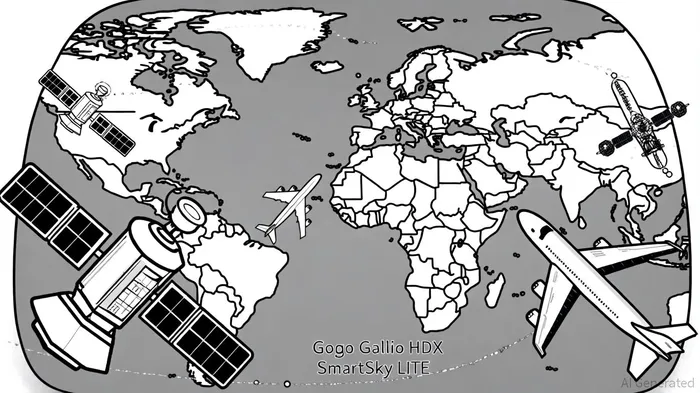
The aerospace industry is undergoing a transformative shift driven by the relentless demand for in-flight connectivity (IFC). As passengers increasingly expect seamless digital experiences during flights, airlines and manufacturers are accelerating the adoption of advanced technologies. A pivotal indicator of this trend is the surge in Supplemental Type Certifications (STCs), which enable the retrofitting of legacy aircraft with next-generation IFC systems. Recent approvals, such as Gogo's Galileo HDX for the Dassault Falcon 2000 family, underscore a broader industry pivot toward high-speed, low-latency connectivity solutions.
A Case Study in Connectivity: GogoGOGO-- Galileo HDX and the Dassault Falcon 2000
Gogo Business Aviation's recent FAA STC for the Galileo HDX terminal on the Dassault Falcon 2000 family marks a significant milestone. This certification, developed in collaboration with Dassault Falcon Jet, allows owners of Falcon 2000EX, EX EASy, DX, LX, LXS, and S models to access high-speed internet via Eutelsat OneWeb's Low Earth Orbit (LEO) satellite constellation [1]. The retrofit process requires only two line replaceable units (LRUs)—the HDX antenna and the AVANCE platform—enabling a streamlined upgrade path to future technologies, including Gogo's upcoming LTE network in 2026 [2].
This STC is particularly noteworthy because it represents the first HDX certification for a Dassault Falcon business jet. By targeting a wide range of Falcon variants used in government, executive, and private sectors, Gogo is addressing a critical gap in the premium aviation market, where high-speed connectivity is a competitive differentiator [1]. The collaboration also signals Dassault's commitment to staying at the forefront of technological innovation, a factor that could influence fleet modernization decisions for operators.
Broader Industry Trends: From Legacy Systems to Hybrid Solutions
The Dassault-Gogo partnership reflects a larger industry-wide migration from legacy air-to-ground (ATG) systems to hybrid and satellite-based solutions. For instance, Gogo's C1 LRU has received STCs for 42 aircraft models, including Gulfstream, Bombardier, and Hawker jets, ensuring compatibility with its LTE network upgrade [2]. Similarly, SmartSky Networks recently secured an STC for its LITE™ system on Cessna Citation 525B models, expanding high-speed Wi-Fi access to over 270 aircraft [3].
This shift is driven by two key factors: passenger expectations and operational efficiency. According to a 2025 report by Moment Tech, airlines are projected to deploy over 60,800 connected aircraft by 2033, with hybrid systems combining satellite and embedded services becoming the standard for wide-body aircraft requiring bandwidths exceeding 470 Mbps [4]. Additionally, regulatory efforts to streamline STC approvals and improve spectrum availability are accelerating the adoption of these technologies [4].
Investment Implications: A $19 Billion Opportunity
The financial stakes are substantial. The connected aircraft market is forecasted to reach $19 billion by 2033, fueled by the retrofitting of existing fleets and the integration of IFC systems into new aircraft [4]. Companies like Gogo, SmartSky, and Astronics—holder of over 90 international STCs—are well-positioned to capitalize on this growth. Gogo's $35,000 installation incentive for C1 LRU retrofits before December 31, 2025, further demonstrates the urgency to secure market share ahead of its LTE launch [2].
Moreover, the expansion of LEO satellite networks, such as Starlink and OneWeb, is reducing latency and increasing coverage, making IFC more viable for long-haul and transcontinental flights. This technological leap is not just a passenger convenience but a strategic asset for airlines seeking to differentiate their services in a competitive market [4].
Conclusion: A Connectivity-Driven Future
The aerospace sector's embrace of IFC technologies is no longer a niche trend but a strategic imperative. STC approvals like Gogo's Galileo HDX for the Dassault Falcon 2000 family are not isolated events—they are part of a systemic transformation toward digital-first aviation. For investors, this signals a compelling opportunity in companies that bridge the gap between legacy infrastructure and next-generation connectivity. As the industry races to meet passenger demands and operational goals, the firms that secure early STC approvals and scale their offerings will likely dominate the $19 billion market ahead.





Comentarios
Aún no hay comentarios