
The Emergence of ZKC Perpetuals and Its Strategic Implications for Automated Crypto Trading
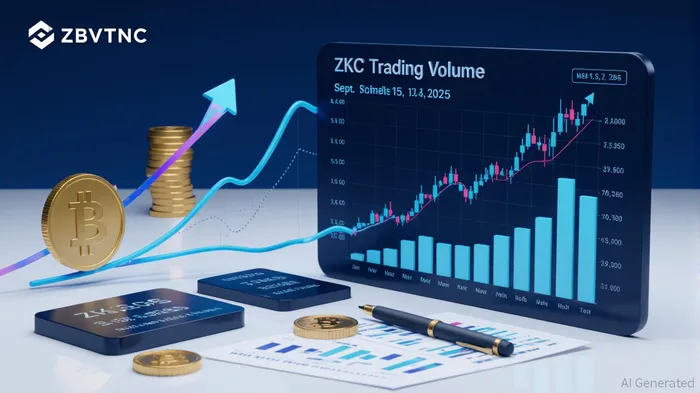
The emergence of ZKC Perpetuals—leveraged derivatives tied to the native token of the Boundless protocol—has introduced a novel asset class for algorithmic traders. As a universal zero-knowledge (ZK) proving layer, Boundless enables decentralized verification of computational work, creating a tradable market for ZK proofs [1]. This innovation, combined with 1–20x leveraged perpetual contracts, opens new avenues for automated strategies such as arbitrage, volatility harvesting, and market-making.
ZKC Perpetuals: A New Frontier for Leverage
ZKC Perpetuals operate on a decentralized infrastructure where provers compete to fulfill ZK computation requests via a reverse Dutch auction mechanism [2]. While specific margin requirements and liquidation thresholds for these perpetuals remain undisclosed, the protocol's Proof of Verifiable Work (PoVW) model—rewarding provers for actual computational output—suggests a system optimized for efficiency and liquidity [3]. This aligns with the needs of algorithmic traders, who rely on low-latency execution and deep order books to capitalize on fleeting market opportunities.
For instance, the ZKC/USDC pair on Pancakeswap V3 has already demonstrated robust liquidity, with a 24-hour trading volume of $32.16 million and $1.21 million in liquidity [4]. Such depth is critical for high-frequency strategies, where slippage can erode profitability. The 1–20x leverage offered by perpetuals further amplifies potential returns, enabling traders to deploy smaller capital bases while maintaining exposure to ZKC's price action.
Strategic Implications for Algorithmic Trading
Arbitrage Opportunities:
ZKC's dual listing on Binance Alpha and decentralized exchanges like Pancakeswap creates price discrepancies that arbitrage bots can exploit. For example, a bot detecting a $0.05 spread between Binance's ZKC/USDT pair and Pancakeswap's ZKC/USDC pair could use 10x leverage to magnify gains. The protocol's PoVW mechanism, which ensures efficient resource allocation, likely reduces latency in executing such trades [5].Volatility Harvesting:
ZKC's recent price volatility—swinging from $0.879 to $0.982 in a single week—makes it an attractive asset for volatility harvesting strategies. Traders using 20x leverage could deploy mean-reversion bots to capitalize on short-term swings, provided they manage risk through dynamic stop-loss algorithms. The token's inflationary model (starting at 7% in Year 1) adds a layer of predictability to its supply dynamics, aiding in volatility modeling [6].Market-Making:
The reverse Dutch auction in Boundless' Spot Market incentivizes provers to offer competitive prices for ZK proofs, indirectly fostering liquidity in ZKC perpetuals [7]. Algorithmic market-makers could exploit this by providing liquidity in perpetual contracts while hedging their positions in the Spot Market, profiting from the bid-ask spread.
Risks and Mitigations
While ZKC Perpetuals offer compelling opportunities, risks such as liquidation cascades and liquidity crunches remain. The protocol's requirement for provers to stake ZKC as collateral [8] suggests a robust risk management framework, but traders must still account for impermanent loss and funding rate fluctuations. Diversifying leverage ratios (e.g., using 5x for long-term positions and 20x for short-term trades) can balance reward and risk.
Conclusion
ZKC Perpetuals represent a convergence of ZK infrastructure and leveraged trading, offering algorithmic traders a powerful toolset. As the Boundless ecosystem matures—bolstered by Binance's airdrop initiatives and strategic partnerships—the integration of ZKC into automated strategies will likely deepen. However, success hinges on rigorous backtesting and adaptive risk management, ensuring that leverage amplifies gains without exposing portfolios to catastrophic losses.






Comentarios
Aún no hay comentarios