
The Emergence of Web3-Verified Messaging: EtherMail's Read2Earn on Telegram as a Disruptive Force in Decentralized Communication
The Tokenized Marketing Revolution
EtherMail's native token, $EMT (EMAIL Token), operates as the backbone of its ecosystem. Users earn $EMT by engaging with consensual marketing campaigns, where AI-driven algorithms analyze wallet activity to deliver hyper-personalized content, according to EtherMail's official blog. This model transforms passive users into active participants, incentivizing engagement with crypto-native projects through token rewards.
What sets EtherMail apart is its self-sustaining token economy. The platform reinvests at least 50% of its advertising revenue back into the ecosystem via $EMT distributions, creating a flywheel effect that benefits both users and advertisers, as noted in EtherMail's official blog. The token's utility extends beyond rewards: users can redeem $EMT for premium features, exclusive offers, or trade it on centralized and decentralized exchanges. Built on the Base chain and audited by Certik.io, $EMT's security and compliance further solidify its role as a credible asset, according to EtherMail's official blog.
Bridging Web2 and Web3: The Telegram Integration
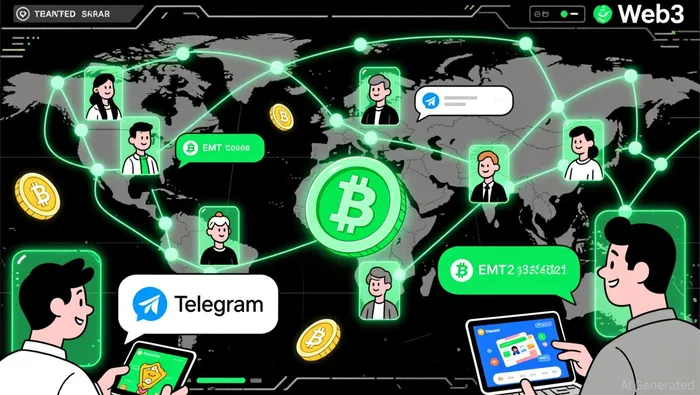
EtherMail's integration with Telegram marks a pivotal step in scaling decentralized communication. By enabling wallet-verified messaging, the platform allows projects, DAOs, and protocols to send authenticated messages directly to Telegram users-governance updates, airdrop announcements, or NFT minting events-without leaving the app, according to EtherMail's official blog. This integration leverages EtherMail's existing network of 49 million connected wallets and 2.7 million verified users, creating a scalable infrastructure for targeted outreach, as reported in EtherMail's official blog.
The Read2Earn mechanic is central to this strategy. Users earn $EMT for engaging with verified messages, incentivizing participation while reducing scam risks through on-chain verification, as noted in EtherMail's official blog. For example, a user opting into a DAO's governance campaign might receive $EMT for reading a proposal or voting, creating a value-driven loop that aligns user interests with project goals. This model not only enhances user experience but also provides advertisers with measurable ROI, a critical factor in attracting traditional marketing budgets to Web3.
Competitive Edge: EtherMail vs. Decentralized Marketing Rivals
In the crowded Web3 email space, EtherMail distinguishes itself through Email-as-a-Wallet (EaaW) and its incentivized engagement model. Competitors like Mailchain prioritize cross-chain compatibility and encryption, while iExec Web3Mail focuses on privacy and anonymous communication, according to EtherMail's official blog. However, EtherMail's integration with Telegram's massive user base and its Read2Earn framework create a unique value proposition: scalable, opt-in marketing that rewards users for their attention.
Data from EtherMail's case studies highlights its effectiveness. Brands leveraging the platform report higher engagement rates compared to traditional Web3 channels, driven by the dual incentives of personalized content and token rewards, according to EtherMail's official blog. For instance, an NFT marketplace using EtherMail's infrastructure saw a 300% increase in user participation during airdrop campaigns, attributed to the platform's targeted messaging and EMT-based rewards, according to EtherMail's official blog.
Investment Implications: A Scalable Flywheel
EtherMail's strategy aligns with two macro trends: the tokenization of user attention and the democratization of marketing infrastructure. By tokenizing interactions, EtherMail creates a liquid asset ($EMT) that rewards users for their time and data, a stark contrast to Web2's ad-driven models. Meanwhile, its integration with Telegram-a platform with 1 billion active users-provides a ready-made distribution network for crypto-native projects, reducing the friction of onboarding new audiences.
For investors, the key metrics to watch are connected wallet growth, EMT token velocity, and advertiser adoption rates. With 49 million wallets already integrated, EtherMail's network effect is accelerating, and its 50% revenue reinvestment model ensures continuous token circulation. If the platform maintains its current growth trajectory, $EMT could become a critical utility token in the Web3 marketing stack, with potential for both speculative and functional demand.
Conclusion
EtherMail's Read2Earn model on Telegram is more than a novel feature-it's a blueprint for the future of decentralized communication. By combining tokenized incentives, AI-driven personalization, and Web2-scale distribution, EtherMail is building a marketing infrastructure that is both user-centric and advertiser-effective. For crypto communities, this means a new era of trust-based engagement; for investors, it represents a high-conviction play on the convergence of blockchain and mainstream communication.
As the lines between Web2 and Web3 blur, platforms like EtherMail will define the next frontier of digital interaction. The question isn't whether tokenized marketing will succeed-it's how quickly it will dominate.







Comentarios
Aún no hay comentarios