
The Emergence of a Verified Gold Asset Class and Its Implications for Institutional Investors
The Infrastructure Revolution: Blockchain and Digital Twins as Catalysts
At the heart of this transformation lies blockchain technology, which has evolved from a speculative buzzword to a foundational infrastructure for supply chain integrity. By 2025, over 40% of mining companies have adopted blockchain-based systems to track gold from extraction to market, ensuring that every transaction is immutableIMX-- and verifiable. For example, Ghana Goldfields and the Oko Project have deployed blockchain networks to authenticate the ethical sourcing of gold, leveraging satellite data to monitor mining sites in real time. This level of transparency addresses long-standing concerns about conflict minerals and environmental degradation, creating a new standard for responsible investment.
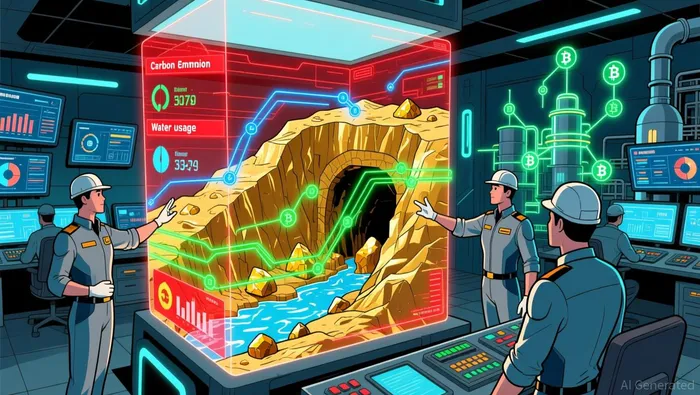
Complementing blockchain is the rise of digital twin technology, which creates virtual replicas of mining operations. These dynamic models integrate IoT sensors and satellite data to simulate everything from ore extraction efficiency to carbon emissions. Newmont Corporation's use of AI-driven drones in Nevada, for instance, has reduced environmental disturbance by 16% while improving ore detection accuracy. Such innovations are not just operational upgrades-they are strategic tools for ESG value capture. By 2025, 60% of mining companies are projected to use digital twins to optimize resource use and meet regulatory benchmarks.
ESG Value Capture: From Compliance to Competitive Advantage
The integration of these technologies is directly enabling measurable ESG outcomes. For instance, blockchain-verified supply chains have reduced carbon emissions by 12-16% in pilot projects, while digital twins have cut waste generation by up to 42%. These metrics are critical for institutional investors, who now demand granular data on environmental impact and social responsibility. The World Gold Council's Responsible Gold Mining Principles, which have become de facto benchmarks, are increasingly enforced through blockchain audits.
Consider the case of Responsible Gold, a company recognized as the Best ESG Blockchain Bullion Company in 2022. Its platform allows investors to trace gold from specific mines to refineries, ensuring compliance with labor standards and environmental protocols. This level of accountability is reshaping the industry: by 2025, 60% of gold mining companies aim to adopt greener technologies, driven by both regulatory pressure and investor demand.
Institutional Investment Strategies: The Rise of Blockchain-Verified ETFs
The financial infrastructure is evolving in tandem. Blockchain-verified gold ETFs, such as SPDR Gold Shares (GLD) and iShares Gold Trust (IAU), now manage over $150 billion in assets under management, with GLDGLD-- alone holding $102 billion as of mid-2025. These funds are not just passive vehicles; they are leveraging blockchain to ensure that the gold they hold is ethically sourced. The surge in demand is part of a broader "Debaser Trade", where investors hedge against fiat currency devaluation by allocating capital to both gold and BitcoinBTC-- ETFs.
BlackRock's iShares Bitcoin Trust (IBIT), for example, has surged to $86 billion in AUM, reflecting a paradigm shift in how investors perceive hard assets. The coexistence of gold and crypto ETFs in the top 10 most traded U.S. ETFs in October 2025 underscores a new era of diversification, where ESG-aligned gold bullion and digital assets are seen as complementary hedges against macroeconomic uncertainty.
Challenges and the Road Ahead
Despite these advancements, challenges persist. The 2024 Gold ESG Focus report notes that while total carbon emissions from leading producers have decreased slightly, emissions intensity per ounce has risen due to declining ore grades and higher energy demands. This paradox highlights the difficulty of balancing profitability with sustainability. However, the industry's adoption of hydrogen-based smelting and water recycling technologies offers a path forward.
For institutional investors, the key lies in aligning capital with companies that demonstrate both technological agility and ESG rigor. The rise of ESG-focused gold bullion funds is a testament to this shift. As the World Gold Council's Responsible Gold Mining Principles gain traction, the verified gold asset class is poised to become a cornerstone of sustainable portfolios.
Conclusion
The gold bullion market is no longer a relic of the past but a dynamic arena where technology and ESG converge. Blockchain and digital twins are not just tools for compliance-they are catalysts for a new era of transparency, efficiency, and ethical investment. For institutional investors, the message is clear: the future of gold lies in its ability to be verified, measured, and aligned with the sustainability imperatives of the 21st century.







Comentarios
Aún no hay comentarios