
The Emergence of Tokenized Stocks and Their Potential to Disrupt Traditional Equity Markets
The financial landscape is undergoing a seismic shift as blockchain technology redefines the mechanics of equity markets. Tokenized stocks-digital representations of traditional shares on distributed ledgers-are no longer speculative experiments but tangible instruments reshaping liquidity, accessibility, and efficiency. For investors, this evolution presents both opportunities and challenges, demanding a strategic approach to navigate a market still in its formative stages.
A New Paradigm: Tokenization's Market Growth and Regulatory Momentum
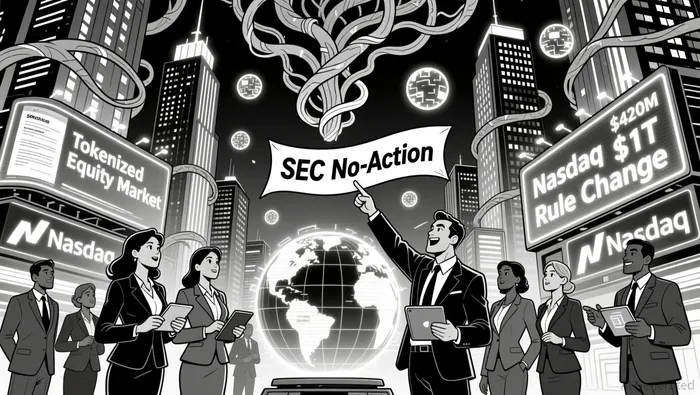
Between 2023 and 2025, tokenized stocks have transitioned from niche innovation to institutional-grade assets. Platforms like RobinhoodHOOD--, Kraken, and CoinbaseCOIN-- now offer 24/7 trading of tokenized equities, enabling fractional ownership and global participation according to a legal guide. By 2025, the tokenized equity market had reached a market cap of approximately $420 million, with projections suggesting it could surpass $1 trillion as adoption accelerates. This growth is underpinned by regulatory developments that signal a shift toward mainstream acceptance.
The U.S. Securities and Exchange Commission (SEC) has taken a measured yet progressive stance, issuing no-action letters to entities like the Depository Trust Company (DTC) and Fuse Crypto, allowing pilot programs for tokenizing custodied assets and utility tokens. Nasdaq's proposed rule changes further illustrate this trend, aiming to integrate tokenized securities into traditional trading infrastructure while maintaining T+1 settlement standards. These moves reflect a broader effort to harmonize blockchain's advantages-speed, transparency, and programmability-with existing regulatory frameworks.
Strategic Entry Points: Diversification, Timing, and Risk Mitigation
For investors seeking to capitalize on tokenized stocks, strategic entry requires a nuanced understanding of market dynamics. Diversification remains a cornerstone strategy, with data from 2025 showing that 28% of American adults owned cryptocurrency, nearly double the 2021 figure. Spreading investments across tokenized equities, real estate, and stablecoins can mitigate risks associated with market volatility. For instance, tokenized real estate platforms now allow fractional ownership of properties starting at $1,000, democratizing access to an asset class traditionally reserved for institutional players.
Timing strategies also play a critical role. The Q3 2025 Crypto Market Review highlights the effectiveness of technical indicators in navigating tokenized assets, particularly as stablecoins and tokenized treasuries gain institutional traction. The Rolling Strategy–Hold Ratio (RSHR), a method for evaluating trading strategies across varying market conditions, has emerged as a tool to optimize entry points. Additionally, regulatory milestones-such as the passage of the GENIUS Act-have historically coincided with market surges, as seen in Ethereum's 65% rise during Q3 2025.
Case Studies: Institutional Adoption and Platform Innovation
BlackRock's BUIDL fund exemplifies how traditional financial giants are embracing tokenization. Built on EthereumETH--, the fund tokenizes U.S. Treasury securities, offering investors $1-per-token liquidity and daily dividend accruals. With $2.8 billion in assets under management as of 2025, BUIDL underscores the potential for tokenized instruments to bridge traditional and decentralized finance. Similarly, Robinhood's tokenized stock offerings for European investors-trading on Arbitrum- highlight the role of blockchain in extending market hours and reducing entry barriers.
These case studies reveal a broader trend: institutional players are leveraging tokenization to enhance operational efficiency. For example, Franklin Templeton's FOBXX and BlackRock's BUIDL have integrated stablecoins like USDC into liquidity pools, enabling instant exchanges and hedging mechanisms. Such innovations are redefining portfolio construction, with tokenized assets offering 24/7 trading and fractional ownership that traditional markets cannot match.
Navigating Risks: Regulatory Clarity and Market Volatility
Despite the promise, tokenized stocks remain subject to regulatory and operational risks. In the U.S., tokenized shares are classified as traditional securities, requiring compliance with registration rules or exemptions like Reg D. The EU's MiFID II framework adds another layer of complexity, mandating prospectus obligations and transparency for tokenized stocks. Investors must also contend with market volatility, as tokenized equities have exhibited unique price discovery dynamics during off-hours trading.
To mitigate these risks, asset managers are advised to focus on tokenized cash instruments-such as treasuries and money market funds-as foundational components of their portfolios. These assets offer stability while aligning with regulatory expectations, reducing exposure to the legal uncertainties surrounding real-world assets (RWAs) like real estate or private credit according to industry analysis.
Conclusion: A Blockchain-Driven Future
Tokenized stocks are poised to disrupt traditional equity markets by enhancing liquidity, reducing costs, and expanding access. For investors, the key lies in adopting a strategic, diversified approach that balances innovation with risk management. As regulatory frameworks mature and institutional adoption accelerates, the next few years will likely see tokenized assets become a staple of modern portfolios. Those who act now-leveraging technical indicators, regulatory clarity, and institutional-grade platforms-stand to gain a first-mover advantage in a rapidly evolving financial ecosystem.





Comentarios
Aún no hay comentarios