
The Emergence of Tokenized Prediction Markets: A New On-Chain Asset Class
The blockchain ecosystem is witnessing a paradigm shift as tokenized prediction markets evolve from niche experiments into a robust on-chain asset class. These markets, which allow participants to speculate on the outcomes of real-world events, are now underpinned by regulated infrastructure, composability, and high-liquidity mechanisms. For investors, this represents a unique opportunity to capitalize on DeFi primitives that are redefining financial infrastructure.
Regulatory Tailwinds: A Catalyst for Growth
The U.S. regulatory landscape has emerged as a critical catalyst for the maturation of tokenized prediction markets. As of late 2025, the consensus probability of stablecoin regulation passing stands at 65-70%, with platforms like Polymarket capturing over $8.5 million in open interest for related contracts according to market data. This regulatory clarity has spurred institutional adoption, as evidenced by Kalshi's legal victory in 2024, where a federal appeals court allowed the CFTC-regulated platform to list election contracts. Such developments signal a broader acceptance of prediction markets as tools for hedging regulatory uncertainty and gauging market sentiment.
Composability and Liquidity: The DeFi Building Blocks
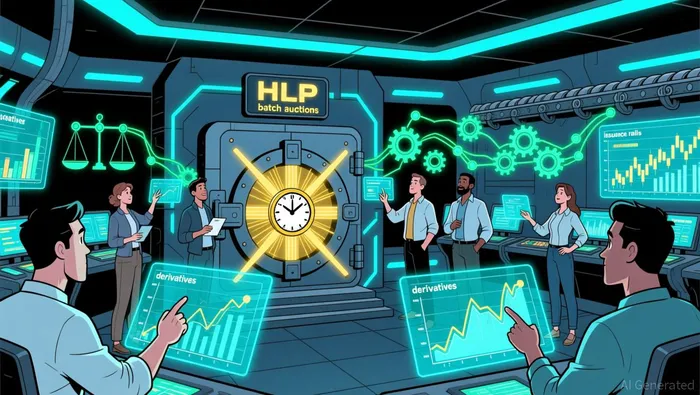
Tokenized prediction markets are no longer siloed ecosystems. Platforms like Kalshi, Polymarket, and Myriad are leveraging Hybrid Liquidity Provider (HLP) vaults and batch auction execution protocols to aggregate liquidity and mitigate adverse selection risks. For instance, Kalshi's Builder Codes program enables external teams to integrate liquidity and develop applications on SolanaSOL--, while Myriad's HLP vaults facilitate efficient price discovery for high-volume events according to platform reports. These innovations are creating a "trading stack" that interconnects spot trading, derivatives, and issuance rails, enabling seamless capital flow as research shows.
Composability further amplifies this value. On-chain parlay prediction markets-where users bet on multiple event outcomes simultaneously-have emerged as a novel use case, offering leveraged payoffs if all constituent outcomes occur. This mirrors traditional sports betting but with the transparency and programmability of blockchain.
Investment Case Studies: From Volume to Yields
The financial infrastructure angle is underscored by explosive growth metrics. Monthly trading volume in prediction markets surged from under $100 million in early 2024 to over $13 billion by late 2025. Platforms like OndoONDO-- Finance and Maple FinanceSYRUP--, which tokenize real-world assets (RWAs), have also entered the fray, offering institutional-grade treasury and credit exposure with yields ranging from 4-12%. These platforms exemplify how prediction markets are becoming part of a broader tokenized ecosystem, where liquidity incentives and cross-venue arbitrage drive efficiency according to industry analysis.
A compelling case study lies in stablecoin regulation. If enacted, the $50-100 billion market cap uplift for compliant issuers could create a flywheel effect, where prediction markets act as both indicators and enablers of regulatory outcomes. This dual role-price discovery and infrastructure-positions tokenized prediction markets as a linchpin in the DeFi-to-tradfi transition.
Future Outlook: Challenges and Opportunities
While the trajectory is bullish, challenges persist. Methodological concerns like "wash trading" may prompt platforms to enhance surveillance protocols in 2026. However, the projected growth in open interest-expected to reach $25 million by year-end 2025-suggests that demand for these markets will outpace risks.
For investors, the strategic imperative lies in targeting platforms that combine regulatory compliance with composability. Kalshi's hybrid model, Polymarket's API-driven liquidity, and Myriad's focus on socially relevant events according to market analysis each offer distinct value propositions. Additionally, the integration of stablecoin-based systems ensures reliable execution, a critical factor for institutional adoption.
Conclusion: A New Asset Class Emerges
Tokenized prediction markets are no longer speculative curiosities. They are becoming foundational components of a decentralized financial ecosystem, driven by regulated infrastructure, composability, and high-liquidity mechanisms. For investors, this represents a rare convergence of technological innovation and regulatory tailwinds. As these markets mature, they will not only reflect but actively shape the future of finance.






Comentarios
Aún no hay comentarios