
The Emergence of Tokenized Equities: A Paradigm Shift in Capital Markets
The tokenization of equities is no longer a theoretical exercise but a rapidly advancing reality, reshaping the architecture of global capital markets. As blockchain technology converges with traditional financial infrastructure, tokenized equities promise to unlock unprecedented liquidity, reduce settlement friction, and democratize access to asset ownership. However, this transition from conceptual models to live trading environments is fraught with regulatory, structural, and liquidity risks that demand rigorous scrutiny.
Regulatory Frameworks: A Global Patchwork of Progress and Uncertainty
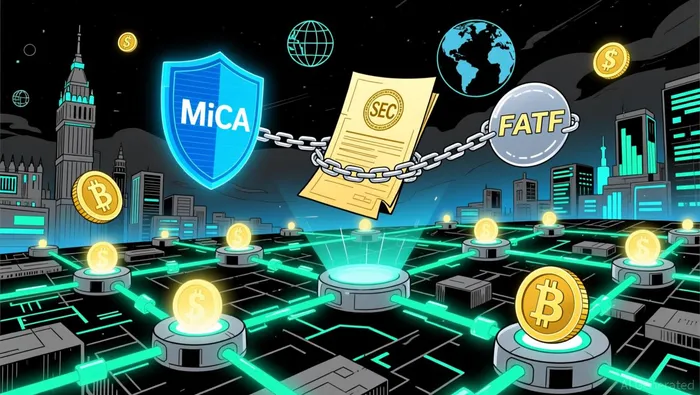
The regulatory landscape for tokenized equities has evolved dramatically since 2023. In Europe, the Markets in Crypto-Assets Regulation (MiCA) fully took effect in December 2024, establishing a harmonized framework for asset-reference tokens (ARTs) and e-money tokens (EMTs). MiCA mandates transparency, consumer protection, and stablecoin reserve requirements, setting a benchmark for global standards according to ESMA. ESMA's role in developing machine-readable iXBRL for white papers and standardized JSON schemas for order books further underscores the EU's commitment to interoperability and market integrity as detailed by ESMA.
In the United States, the SEC has adopted a dual approach of consultation and enforcement. The 2025 public roundtable on tokenization and "Project Crypto" signaled a proactive effort to align securities laws with blockchain innovation according to Chainalysis. A notable milestone was the SEC's tentative resolution with Gemini Trust Company in September 2025, addressing crypto lending practices and hinting at a broader regulatory framework for tokenized asset activities as reported by Gibson Dunn. Meanwhile, SIFMA and SIFMA AMG have emphasized the need to preserve foundational investor protections, arguing that technological evolution should not compromise market integrity according to SIFMA.
Globally, the Bank for International Settlements (BIS) and Financial Action Task Force (FATF) have reinforced the urgency of stablecoin oversight and anti-money laundering (AML) compliance. The BIS's April 2025 stablecoin reserve recommendations and FATF's revised "Travel Rule" highlight the growing consensus on risk mitigation in cross-border tokenized equity markets according to insights.
Structural Risks: Fragmentation and Concentration in Live Trading
Despite regulatory progress, structural risks persist in tokenized equity markets. The 2025 liquidity crisis in crypto and Asian equities exposed critical vulnerabilities. In crypto markets, fragmented infrastructure-where assets trade across multiple exchanges with limited cross-venue arbitrage-exacerbated volatility during periods of stress as observed. Ownership concentration, akin to low free float in emerging equity markets, further amplified price swings, as algorithmic liquidations triggered self-reinforcing downward spirals according to Alaric Securities.
Asian equity markets, while distinct in regulatory structure, face similar challenges. With an average free float of 35% (compared to 80% in developed markets), modest institutional trades can disproportionately impact prices. Operational hurdles, such as divergent settlement cycles and currency convertibility issues, compound these risks, creating a volatile environment for tokenized equities as noted.
Tokenized real-world assets (RWAs), such as real estate and private credit, illustrate both the potential and pitfalls of this transition. While fractional ownership and 24/7 trading theoretically enhance liquidity, empirical evidence reveals demand-side constraints. Tokenized real estate, for instance, often suffers from low trading volumes due to investor unfamiliarity and regulatory fragmentation according to Growth Turbine. Custodial concentration and valuation opacity further hinder secondary market activity, underscoring the need for infrastructure upgrades as research indicates.
Liquidity Dynamics: Innovation vs. Illusion
Tokenized equities introduce novel liquidity dynamics, but their success hinges on solving systemic inefficiencies. Wrapped securities-tokens representing traditional assets-face challenges in price discovery and arbitrage. Weak mechanisms for reconciling token prices with underlying assets create "shadow liquidity," where apparent depth in order books masks real-world constraints according to TD Securities. In contrast, natively issued tokens, integrated with existing infrastructures like DTCC and Nasdaq, maintain fungibility with traditional shares but require regulatory clarity to scale as TD Securities reports.
Case studies from 2025 highlight both progress and limitations. BlackRock's BUIDL and Franklin Templeton's FOBXX tokenized funds demonstrated blockchain's potential to streamline institutional cash management through 24/7 settlement and stablecoin collateral exchange according to the NY Fed. Similarly, the European Central Bank's 2024-2025 blockchain settlement trials showcased alignment with institutional systems, enhancing regulatory compliance as detailed by BlockInvest. However, secondary market liquidity for tokenized assets remains constrained, often restricted to whitelisted investors according to Regulation Tomorrow.
The October 2025 crypto crash epitomized the fragility of liquidity in tokenized markets. Over-leveraged positions and regulatory uncertainty led to cascading liquidations as order books thinned, revealing the illusion of stability as Alaric Securities reports. This crisis underscores the need for robust risk management frameworks, particularly in decentralized finance (DeFi) ecosystems where governance and DEX tokens exhibit asymmetric volatility responses to regulatory signals according to MDPI.
Opportunities and the Path Forward
The transition to tokenized equities is not without promise. Regulatory alignment, such as the SEC's no-action letter for DTC's tokenization pilot signals cautious optimism, signals cautious optimism. Institutional adoption is accelerating, with 80% of jurisdictions reviewed by TRM Labs witnessing financial initiatives in digital assets according to TRM Labs. Meanwhile, stablecoin frameworks are maturing, providing a foundation for cross-border transactions as TRM Labs reports.
However, scaling tokenized equity markets requires addressing structural inefficiencies. Interoperability between blockchains, high-quality settlement assets, and decentralized trading venues must be prioritized according to Regulation Tomorrow. Investor education and demand-side incentives will also be critical to overcoming liquidity constraints in RWAs as research indicates.
Conclusion
Tokenized equities represent a paradigm shift in capital markets, but their success depends on navigating a complex interplay of regulatory, structural, and liquidity risks. While frameworks like MiCA and Project Crypto provide a roadmap for innovation, the 2025 liquidity crises and structural bottlenecks highlight the urgency of addressing systemic vulnerabilities. For investors, the key lies in balancing optimism with caution-leveraging the efficiencies of tokenization while mitigating the risks of a nascent, fragmented ecosystem.






Comentarios
Aún no hay comentarios