
The Emergence of Scalable Robotaxi Commercialization
The autonomous mobility sector is undergoing a transformative shift, driven by the rapid commercialization of robotaxi services. Strategic partnerships are emerging as critical catalysts, enabling companies to scale operations, reduce costs, and align with global sustainability goals. From Abu Dhabi's ambitious deployments to collaborations between tech giants like Waymo and UberUBER--, the industry is witnessing a convergence of innovation and environmental stewardship. This article examines how these partnerships are not only accelerating market growth but also embedding sustainability at the core of autonomous mobility.
Strategic Partnerships as the Engine of Growth
Abu Dhabi has positioned itself as a global hub for autonomous mobility through 29 strategic commercial deployment agreements with companies such as K2, LODD Autonomous, and Autologix. These partnerships are advancing integrated, multi-modal autonomous systems for e-commerce, healthcare delivery, and logistics, supported by the Smart and Autonomous Systems Council. Similarly, Waymo's collaboration with Uber has expanded the U.S. robotaxi fleet to over 600 vehicles, leveraging AI and data to scale operations and reduce costs.
The market's explosive growth is further fueled by partnerships between automakers, tech firms, and mobility platforms. For instance, Didi Chuxing's alliance with GAC AION in May 2023 aims to mass-produce fully self-driving electric robotaxis, targeting large-scale integration by 2025. Meanwhile, Uber's strategic pivot to becoming a platform for autonomous mobility has led to collaborations with Momenta, PonyPONY--.ai, and WeRideWRD--, enabling rapid deployment across international markets. These alliances highlight a shift from in-house development to ecosystem-driven innovation, reducing barriers to entry and accelerating commercialization.
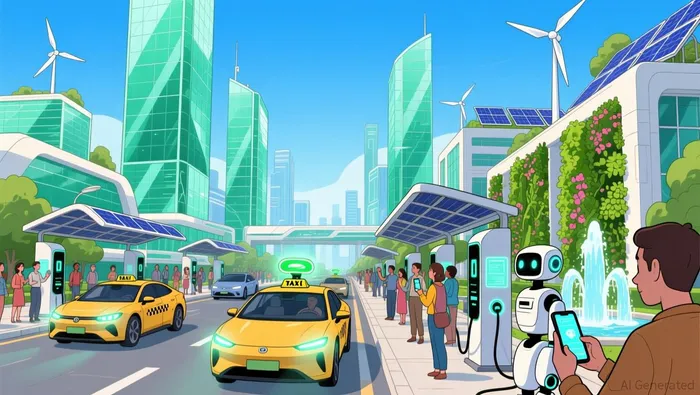
Sustainability as a Core Imperative
The environmental benefits of robotaxi partnerships are becoming increasingly measurable. A 2023 Berkeley Lab study found that electric robotaxis could reduce per-mile greenhouse gas emissions by 63–82% compared to hybrid private vehicles. Tesla's Robotaxi initiative, for instance, has already cut over 20 million metric tons of CO2 emissions by promoting shared rides and electric vehicles. By 2026, Tesla projects its Robotaxi program will expand to 20 countries, operating at a cost of $0.25 per mile-a 75% reduction compared to traditional ridesharing.
Waymo's fully electric fleet, now comprising over 2,500 vehicles, has prevented an estimated 315 tons of CO₂ emissions weekly by November 2025. The company's 2024 performance-476,000 miles per accident-also underscores the safety and efficiency gains of autonomous systems. In China, robotaxi services are expected to account for 20–25% of shared mobility passenger kilometers by 2030, further reducing emissions and traffic congestion.
However, challenges remain. While electric propulsion dominates the robotaxi market (72.2% of 2024 propulsion share), experts caution that increased vehicle miles traveled (VMT) from robotaxis could offset some environmental gains. Studies suggest robotaxis might raise total VMT by up to 83%, potentially worsening congestion and emissions. This tension underscores the need for policy frameworks that prioritize shared, right-sized vehicles and renewable energy integration.
Investment Implications and Future Outlook
The global robotaxi market, valued at $1.95 billion in 2024, is projected to grow at a 73.5% CAGR to reach $43.76 billion by 2030. Strategic partnerships are central to this growth, with infrastructure providers like Nvidia investing $3 billion in robotaxi platforms to support 100,000 Level 4-ready vehicles by 2027. For investors, the sector offers dual opportunities: capitalizing on technological disruption while aligning with decarbonization goals.
Key players like Waymo, Uber, and Tesla are redefining urban mobility through scalable, energy-efficient models. Meanwhile, emerging markets in Asia-Pacific-led by WeRide and Pony.ai-are leveraging 5G and smart city initiatives to accelerate adoption. As regulatory hurdles ease and public trust grows, the robotaxi ecosystem is poised to become a cornerstone of sustainable urban infrastructure.
Conclusion
Strategic partnerships are not merely accelerating robotaxi commercialization-they are redefining the trajectory of sustainable mobility. By combining cutting-edge technology with environmental stewardship, these collaborations are addressing the dual challenges of urban congestion and climate change. For investors, the sector represents a compelling intersection of innovation, scalability, and ESG alignment. As the market matures, those who prioritize partnerships with clear sustainability metrics will likely lead the next wave of autonomous mobility.







Comentarios
Aún no hay comentarios