
The Emergence of Regulated Stablecoin Settlement in Traditional Finance
A New Era of Payment Infrastructure
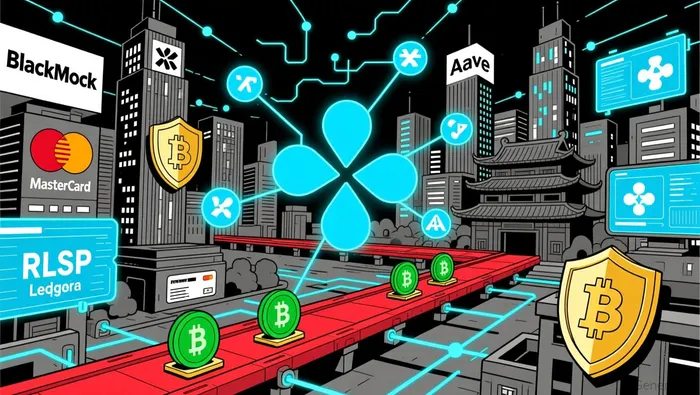
Ripple's RLUSD, fully backed by cash and cash equivalents under the New York Department of Financial Services (NYDFS) Trust Company Charter, has surpassed $1 billion in circulation on both the XRP Ledger and EthereumETH--, according to a Blockchain Magazine report. This growth is not merely speculative; it reflects a strategic alignment with traditional financial systems. The pilot project with Mastercard and WebBank-where RLUSD will settle credit card transactions on the XRPL-is detailed in a Yahoo Finance article. By utilizing the XRP Ledger's high-speed, low-cost infrastructure, the collaboration aims to reduce settlement times from days to seconds while maintaining compliance with anti-money laundering (AML) and know-your-customer (KYC) protocols, as noted in a WalletInvestor article.
Monica Long, Ripple's President, emphasized that the XRP Ledger's decade-long track record of reliability and scalability provides a robust foundation for this use case in a Bitcoin.com report. For investors, this signals a maturation of blockchain infrastructure, where performance and regulatory compliance are no longer mutually exclusive.
Institutional Adoption and Liquidity Expansion
The RLUSD ecosystem is rapidly gaining traction in institutional finance. Bybit's recent listing of RLUSD with trading pairs in BitcoinBTC--, Ethereum, XRP, and USDTUSDT-- has significantly boosted liquidity, attracting both retail and institutional traders, as CoinEdition reported. Additionally, RLUSD's integration into tokenized funds by BlackRock and VanEck allows investors to redeem fund shares directly in the stablecoin, enhancing its utility as a settlement asset, according to a CoinEdition article. Aave's Horizon platform further underscores this trend by enabling tokenized asset lending using RLUSD as collateral, as covered by CryptoNewsLand.
These developments are not isolated. Ripple's acquisition of Hidden Road Investments has deepened institutional access to RLUSD, with clients using it for balance holdings and collateral management, as TradingView reported. As of November 2025, RLUSD's market capitalization stands at $741 million, ranking it as the 94th largest cryptocurrency (reported in Research Signals). This growth trajectory is supported by XRP's surging open interest-exceeding $1 billion-indicating strong speculative and investment demand tied to the broader ecosystem.
Investment Implications and Risk Assessments
The convergence of RLUSD and XRP Ledger in traditional finance presents both opportunities and risks. On the upside, the pilot project with Mastercard could serve as a blueprint for broader blockchain adoption in settlement systems, potentially reducing operational costs for banks and payment processors by up to 70%. For XRP Ledger, this validates its position as a compliant, high-throughput infrastructure for institutional use cases, a critical factor in attracting further investment.
However, risks remain. Regulatory scrutiny of stablecoins persists, with the U.S. Treasury and Federal Reserve closely monitoring their role in systemic risk. While RLUSD's NYDFS-backed structure mitigates some concerns, any policy shift could impact its adoption. Additionally, the success of the Mastercard pilot hinges on regulatory approvals, which may delay timelines.
Analysts project that XRP Ledger is advancing toward institutional maturity, driven by RLUSD's expansion and innovations like compliance-driven lending protocols. For investors, this suggests a long-term bullish outlook, provided the ecosystem maintains its regulatory alignment.
Conclusion
The integration of RLUSD and XRP Ledger into traditional finance is not just a technological advancement-it is a strategic redefinition of payment infrastructure. By combining blockchain's efficiency with regulatory compliance, Ripple and its partners are creating a model that could redefine how value is transferred globally. For investors, the key takeaway is clear: the future of finance lies in hybrid systems where innovation and regulation coexist. As RLUSD's market cap continues to grow and institutional adoption accelerates, the XRP Ledger's role in this evolution positions it as a critical asset for forward-thinking portfolios.





Comentarios
Aún no hay comentarios