
The Emergence of a Liquid Clean Energy Marketplace and Its Investment Implications
A Market in Motion: Liquidity and Transparency Take Center Stage
For years, clean energy trading was mired in inefficiencies. Deals were brokered via email and phone calls, with opaque pricing and fragmented counterparty risk. CleanTrade, authorized by the CFTC in September 2025, has shattered that paradigm. Within two months of its launch, the platform facilitated $16 billion in notional trading, drawing heavyweights like BlackRockBLK--, Goldman Sachs, and Cargill. This isn't just growth-it's a stamp of institutional approval.
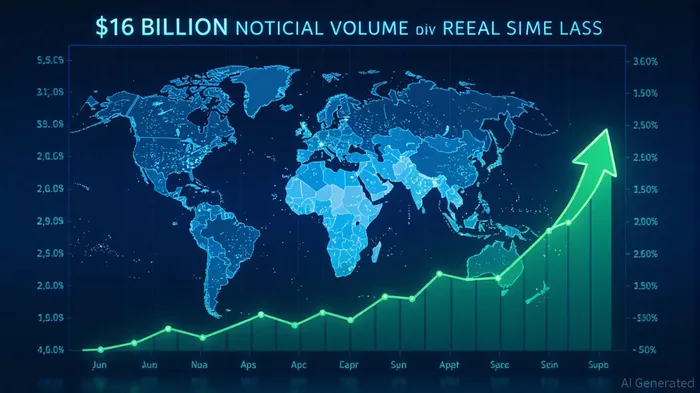
The platform's success lies in its ability to standardize complex instruments like Virtual Power Purchase Agreements (vPPAs), physical PPAs, and Renewable Energy Certificates (RECs). By bringing real-time pricing and structured workflows to these transactions, CleanTrade mirrors the liquidity of traditional energy markets. As a result, corporations can lock in clean energy costs with the same precision they apply to oil or natural gas, while investors gain a clear line of sight into risk-adjusted returns.
Risk Management: The Institutional Investor's New Best Friend
Institutional-grade infrastructure isn't just about volume-it's about control. CleanTrade's risk management tools are a game-changer. The platform reduces counterparty risk through CFTC-compliant frameworks and offers real-time analytics to optimize portfolios. For ESG-focused investors, this means aligning financial goals with decarbonization targets without sacrificing transparency.
Consider the numbers: 77% of sustainable investors prioritized ESG integration between 2023 and 2025. CleanTrade's infrastructure directly addresses this demand, enabling investors to track carbon offsets and renewable credits with granular precision. The platform's role in catalyzing $1.1 trillion in global sustainable debt issuance in the first nine months of 2025 underscores its strategic value. This isn't just about compliance-it's about building a financial architecture that rewards long-term sustainability.
Strategic Advantages: Positioning for the Energy Transition
The implications for investors are clear. CleanTrade's rise isn't an isolated event-it's part of a broader regulatory and market shift. The CFTC's approval of platforms like Electron Exchange DCM, Railbird Exchange, and Quanta Exchange signals a commitment to diversifying clean energy trading infrastructure. For investors, this means a maturing ecosystem with multiple avenues to deploy capital.
Moreover, the ESG asset class is poised for exponential growth, expanding from $39 trillion to $125 trillion by 2032. CleanTrade's tools-ranging from portfolio optimization to compliance-ready transactions-position investors to capitalize on this growth while mitigating the volatility often associated with emerging markets. The platform's scalability ensures that as demand for clean energy derivatives rises, so too does the capacity to meet it.
The Bottom Line: Can't Ignore the Momentum
The clean energy transition isn't a distant horizon-it's here, and it's being powered by platforms like CleanTrade. For institutional investors, the message is simple: liquidity, transparency, and risk management are no longer optional. They're table stakes. With the CFTC's backing and a $1.2 trillion market at its feet, CleanTrade isn't just facilitating transactions-it's building the rails for the next decade of energy innovation.
Now is the time to lean in. The energy economy is evolving, and those who adapt to this new paradigm will find themselves at the forefront of one of the most consequential investment opportunities of our era.





Comentarios
Aún no hay comentarios