
The Emergence of a Liquid Clean Energy Marketplace and Its Implications for Institutional Investors
A New Era of Liquidity and Transparency
Historically, renewable energy markets have been plagued by illiquidity and opacity, with transactions often relying on fragmented, relationship-based negotiations. CleanTrade disrupts this paradigm by providing a centralized, regulated marketplace for trading Virtual Power Purchase Agreements (vPPAs), physical Power Purchase Agreements (PPAs), and Renewable Energy Certificates (RECs). Launched in September 2025, the platform has already facilitated $16 billion in notional value within two months of its debut, signaling robust institutional demand. This liquidity is critical for scaling renewable energy projects, as it enables developers to secure financing more efficiently and reduces the risk premium associated with green assets.
CleanTrade's infrastructure mirrors that of traditional energy markets, such as those operated by the Intercontinental ExchangeICE-- (ICE), but with a focus on sustainability. By standardizing contracts and integrating real-time analytics for carbon risk and grid congestion, the platform enhances asset valuation precision. For instance, developers can now quantify the financial impact of regulatory changes or grid bottlenecks, enabling faster decision-making and reducing project delays. 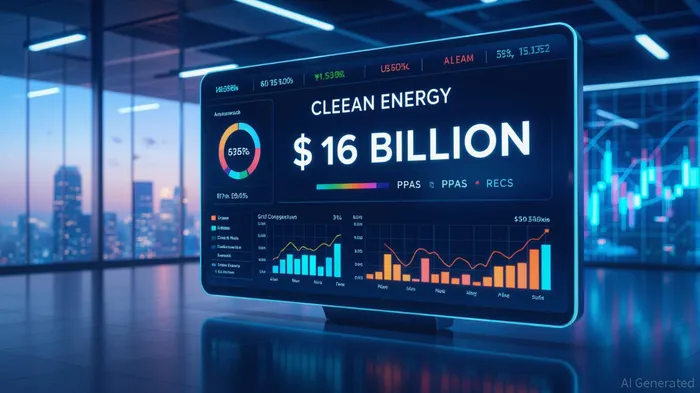 This transparency not only attracts institutional investors but also aligns with global decarbonization goals, as evidenced by the platform's role in supporting $2.2 trillion in clean energy investment in 2025.
Institutional Investor Adoption and Risk Mitigation
Institutional investors are increasingly allocating capital to sustainable assets, with 84% of those surveyed in 2025 planning to expand their holdings in this space over the next two years. CleanTrade's structured trading environment addresses key barriers to adoption, such as counterparty risk and price volatility. By offering tools to hedge against fossil fuel price swings and lock in long-term energy costs, the platform provides institutional investors with budget certainty and risk-adjusted returns.
The platform's integration of ESG metrics with financial analysis further strengthens its appeal. CleanTrade's CleanSight tool, for example, allows investors to track both environmental outcomes (e.g., carbon emissions reductions) and financial performance, ensuring compliance with ESG reporting standards. This dual focus is particularly relevant as ESG-linked assets are projected to surpass $50 trillion by 2025, reflecting a broader shift in capital markets.
A landmark transaction between Cargill and Mercuria on CleanTrade in January 2025 exemplifies the platform's institutional-grade infrastructure. The deal, which involved the trading of vPPAs, demonstrates how CleanTrade can facilitate large-scale, low-risk investments in renewable energy. Such transactions validate clean energy as a serious asset class, attracting players like BlackRockBLK-- and Fidelity, which are now deploying capital to capitalize on the sector's growth.
Scalability and Market Dynamics
The scalability of CleanTrade is underpinned by its alignment with macroeconomic trends. The renewable energy asset management market, valued at $11.18 billion in 2025, is projected to grow at a compound annual rate of 13.54% through 2034, reaching $35.07 billion. The platform's role in this expansion is twofold: it reduces transaction costs by streamlining workflows and enhances market depth by enabling diverse participants-from utilities to hedge funds-to engage in structured trading.
Moreover, the platform's use of AI and blockchain tools to automate contract execution and verify carbon credits has reduced transaction times from months to days. This efficiency is critical for scaling renewable energy infrastructure, as it allows developers to secure funding quickly and deploy projects at scale. For institutional investors, this means access to a broader pool of assets with predictable cash flows, mitigating the risks associated with project-specific volatility.
Conclusion: A Catalyst for Systemic Change
REsurety's CleanTrade platform represents more than a technological innovation-it is a catalyst for systemic change in how the world finances and values clean energy. By addressing liquidity constraints, enhancing transparency, and integrating ESG metrics, CleanTrade has transformed renewable energy assets into institutional-grade commodities. For investors, this means a new frontier of opportunities where financial returns and environmental impact are no longer mutually exclusive.
As the global clean energy market approaches $1.8 trillion by 2033, platforms like CleanTrade will be instrumental in channeling capital toward a sustainable future. The rapid adoption of the platform by major players and its role in facilitating $1.1 trillion in sustainable debt issuance in 2025 underscore its transformative potential. For institutional investors, the message is clear: the era of liquid, scalable clean energy markets is here, and those who engage early will reap significant rewards.





Comentarios
Aún no hay comentarios