
The Emergence of Institutional-Backed Altcoin Infrastructure: Strategic Implications for Retail Investors in the Post-Ethereum Era
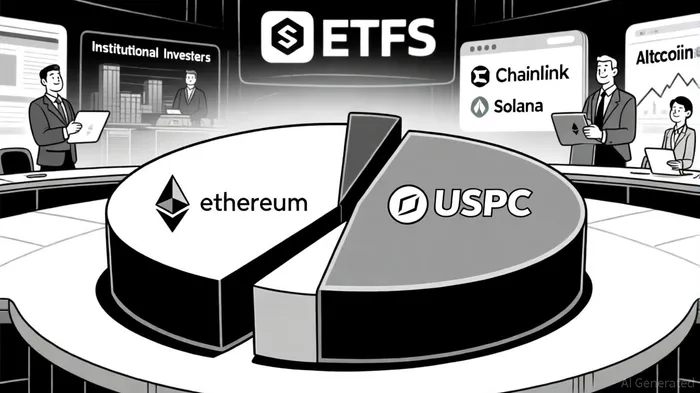
The post-Ethereum era has ushered in a seismic shift in the cryptocurrency landscape, with institutional capital reshaping altcoin infrastructure into a cornerstone of global finance. Ethereum’s 2024–2025 upgrades—Dencun, Pectra, and the broader EthereumETH-- 2.0 transition—have not only enhanced scalability but also positioned the network as a foundational layer for decentralized finance (DeFi), real-world asset (RWA) tokenization, and cross-chain interoperability. According to a report by Bitget, Ethereum now dominates 50% of the stablecoin market, with $102 billion in USDT and USDCUSDC--, driven by institutional adoption and regulatory clarity [2]. This transformation has created a new paradigm where altcoin infrastructure is no longer speculative but a critical component of institutional-grade financial systems.
Institutional Trends: From Speculation to Infrastructure
Institutional investors have allocated $3 billion to Ethereum staking by Q2 2025, while tokenized assets surged to $412 billion, including $24 billion in RWA tokenization [2]. The U.S. GENIUS Act (July 2025) further solidified Ethereum’s role by mandating 1:1 high-quality liquid asset (HQLA) reserves for stablecoins, ensuring regulatory alignment with traditional finance. Meanwhile, Ethereum ETFs attracted $10 billion in assets, outpacing BitcoinBTC-- counterparts, as institutional players capitalize on the network’s deflationary supply model and 3.8% annual staking yield [2].
These developments have cascading effects on altcoin infrastructure. Projects like ChainlinkLINK-- (LINK), which provides decentralized oracleORCL-- networks for Ethereum-based smart contracts, and SolanaSOL-- (SOL), with its high-throughput DeFi ecosystem, have seen surges in institutional interest. Data from TokenMetrics reveals that companies like Sharp Technologies and Galaxy Jump raised funds for SOL-focused operations, signaling a shift toward altcoins with scalable, real-world applications [1].
Retail Investor Strategies: Navigating an Institutionalized Market
For retail investors, the post-Ethereum era demands a recalibration of strategies. While Ethereum’s institutional adoption has created a robust foundation, it has also intensified competition. Retail investors must now focus on projects that align with Ethereum’s infrastructure goals while mitigating risks from market volatility and institutional dominance.
- Diversification with Utility-Driven Altcoins: Retail investors should prioritize altcoins with tangible use cases, such as cross-chain interoperability (Polkadot, Cosmos) or DeFi infrastructure (Chainlink, Hyperliquid). For example, Chainlink’s Cross-Chain Interoperability Protocol (CCIP) enables institutions to integrate blockchain systems with traditional finance, making LINK a critical asset for Ethereum’s ecosystem [3].
- Leveraging Liquid Staking Tokens (LSTs): Ethereum’s liquid staking derivatives, such as stETH, offer retail investors exposure to staking yields without locking up capital. With Ethereum ETFs drawing $29.22 billion in net inflows since July 2024 [2], LSTs provide a bridge between retail participation and institutional-grade returns.
- Exploring Niche Ecosystems: Projects like Tapzi (TAPZI), a skill-based Web3 gaming platform, and Vanna AI, a privacy-focused AI project, represent emerging opportunities. Tapzi’s cross-chain compatibility with Ethereum and BNBBNB-- Smart Chain, combined with AI-powered anti-cheat mechanisms, positions it as a scalable solution for institutional gaming and DeFi applications [1].
Risk Mitigation: Balancing Innovation and Caution
The altcoin space remains volatile, with over 70% of projects historically failing to achieve product-market fit [2]. Retail investors must adopt risk management practices such as:
- Portfolio Allocation: Limiting altcoin exposure to 10–20% of a diversified portfolio to balance high-risk, high-reward opportunities with stable assets.
- Due Diligence: Prioritizing projects with audited smart contracts, transparent tokenomics, and institutional partnerships. For instance, Polkadot’s (DOT) collaboration with JPMorganJPM-- underscores its credibility as an infrastructure play [4].
- Regulatory Compliance: Favoring ETFs and regulated platforms to avoid scams. The SEC’s reclassification of Ethereum as a utility token and updated guidance on LSTs have provided a framework for safer retail participation [2].
The Future of Altcoin Infrastructure: A Retail Investor’s Roadmap
As Ethereum solidifies its role as a global settlement layer, altcoin infrastructure will continue to evolve. Retail investors should focus on three key areas:
1. Cross-Chain Protocols: Projects enabling seamless value transfer between Ethereum and other blockchains (e.g., CosmosATOM--, Sei).
2. RWA Tokenization: Platforms tokenizing real-world assets like real estate or commodities, leveraging Ethereum’s security and scalability.
3. Consumer-Facing Applications: Projects abstracting blockchain complexity for mass adoption, such as Tapzi’s gaming ecosystem or Cardano’s (ADA) sustainable smart contract platform [1].
In conclusion, the post-Ethereum era presents both challenges and opportunities for retail investors. By aligning with institutional-grade infrastructure projects and adopting disciplined risk management, retail participants can navigate this evolving landscape and capitalize on the next wave of crypto innovation.
**Source:[1] How Institutional Money is Reshaping Crypto in 2025, [https://www.tokenmetrics.com/blog/treasury-companies-and-etfs-how-institutional-money-is-reshaping-crypto-in-2025?0fad35da_page=6&74e29fd5_page=15][2] Ethereum's Strategic Dominance in the Stablecoin Era, [https://www.bitget.com/news/detail/12560604937172][3] Best Crypto to Buy in 2025: Top Coins and Strategies, [https://coincub.com/best-crypto-to-buy-2025/][4] Ethereum Price Prediction: Analysts Target $6K as NEAR and Dot Join Bullish Watchlists, [https://coincentral.com/ethereum-price-prediction-analysts-target-6k-as-near-and-dot-join-bullish-watchlists/]






Comentarios
Aún no hay comentarios