
The Emergence of DOGE ETFs and Institutional Investor Sentiment in the Digital Asset Space
Grayscale's GDOG: A Cautious Debut
Grayscale's GDOG ETF, which debuted on November 24, 2025, was met with muted enthusiasm. Despite being listed on the NYSE Arca, the fund recorded no net inflows on its first day, with secondary trading volume totaling just $1.41 million-far below Bloomberg senior ETF analyst Eric Balchunas' forecast of $12 million. This tepid response underscores the challenges of monetizing meme coins in a market already grappling with outflows. For context, XRP and Solana ETFs launched on the same day attracted $164 million and $56 million in inflows, respectively.
GDOG's 0.35% management fee, while competitive with broader crypto ETFs, failed to incentivize institutional participation. The fund's lack of primary capital inflows suggests that investors remain skeptical of DOGE's utility as a standalone asset, particularly given its volatility and speculative nature.
Bitwise's BWOW: Aggressive Pricing and Community-Driven Momentum
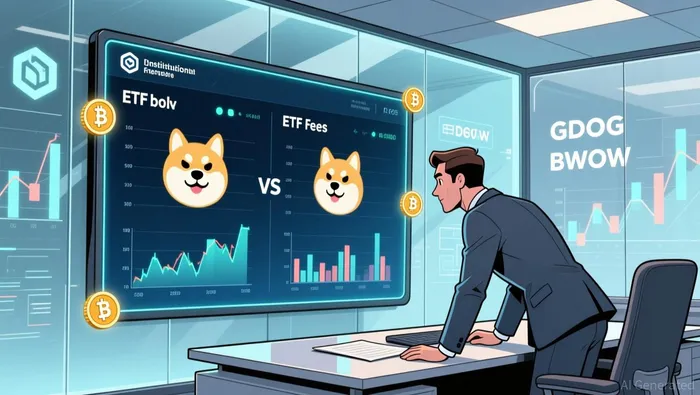
Bitwise's BWOW ETF, launched on November 26, 2025, adopted a more aggressive strategy to capture market share. With a 0.34% management fee-waived entirely for the first month on the first $500 million in assets-BWOW positioned itself as a cost-effective alternative to GDOG. This promotional structure, coupled with Bitwise's broader $15 billion AUM in crypto products, signaled confidence in DOGE's institutional potential.
The fund's launch was driven by "strong community demand," as noted by Bitwise CEO Hunter Horsley, who emphasized DOGE's decade-long cultural relevance and $22 billion market capitalization. While BWOW's AUM figures remain unreported as of December 2025, its fee waiver strategy appears to have resonated with investors, particularly in a landscape where other altcoin ETFs (e.g., Solana's BSOL) have already surpassed $500 million in assets. According to FastBull, SolanaSOL-- ETF inflows hit record $58 million in consecutive quarters.
Institutional Adoption: A Mixed Picture
The divergent performances of GDOG and BWOW highlight the fragmented institutional interest in DOGE. While GDOG's launch revealed "concerning market realities" for single-token crypto ETFs, BWOW's community-driven approach reflects a growing recognition of meme coins' cultural and speculative appeal. However, institutional adoption remains uneven. For instance, the Rex-Osprey Dogecoin ETF, which launched in September 2025, achieved $17 million in first-day volume-a stark contrast to GDOG's $1.4 million.
This disparity suggests that institutional investors are selectively allocating capital to altcoin ETFs with stronger fundamentals or clearer use cases. Solana and XRPXRP-- ETFs, for example, have attracted over $1 billion in cumulative inflows by late November 2025. According to FastBull, Solana ETF inflows hit record $58 million in consecutive quarters, underscoring the importance of blockchain utility and transactional volume in driving institutional interest.
Implications for the Digital Asset Space
The early performance of DOGE ETFs raises critical questions about the role of meme coins in institutional portfolios. While GDOG and BWOW provide regulated exposure to DOGE, their underwhelming reception compared to other altcoin ETFs indicates that investors remain cautious about assets lacking tangible utility. As one analyst noted, these products should be treated as "high-risk, single-asset exposures" rather than diversified crypto investments.
Moreover, the competitive fee structures of GDOG and BWOW highlight the importance of cost efficiency in attracting institutional capital. Bitwise's decision to waive fees for the first $500 million in assets demonstrates a strategic understanding of the need to incentivize early adoption-a tactic that may become more common in the crowded crypto ETF market.
Conclusion
The emergence of DOGE ETFs represents a significant step toward mainstreaming meme coins, but their early performance reveals a cautious institutional landscape. Grayscale's GDOG and Bitwise's BWOW offer contrasting approaches to capturing this niche, with the latter's community-driven model and aggressive pricing showing more promise. However, the broader success of altcoin ETFs like Solana and XRP suggests that institutional adoption will hinge on blockchain utility, technical resilience, and regulatory clarity. As the market evolves, investors must weigh the speculative allure of DOGE against the structural risks inherent in single-asset crypto exposure.







Comentarios
Aún no hay comentarios