
The Emergence of CFTC-Approved Clean Energy Trading Platforms and Their Impact on Renewable Asset Liquidity
Regulatory Clarity and Market Transformation
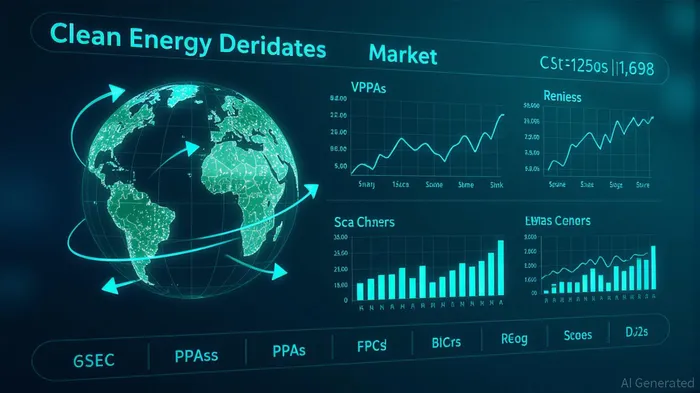
The CFTC's approval of CleanTrade in September 2025 provided much-needed regulatory clarity, rescinding a 2021 advisory that had created uncertainty for market participants. This decision enabled CleanTrade to operate as a centralized, institutional-grade platform for trading Virtual Power Purchase Agreements (VPPAs), Power Purchase Agreements (PPAs), and Renewable Energy Certificates (RECs). Within two months of its launch, the platform facilitated $16 billion in notional trading value, demonstrating robust institutional confidence in ESG-aligned energy markets.
 The CFTC's regulatory flexibility extended beyond CleanTrade. In 2025, the agency withdrew its proposed Operational Resilience Framework for SEFs, citing concerns about duplication with existing standards and the need to align with international practices. This shift reflects a broader trend of streamlining compliance burdens while maintaining market integrity. For instance, the CFTC granted no-action relief to SEFs like LSEG FX SEF, allowing them to bypass mandatory central limit order books-a move that acknowledges the practical realities of swaps trading. These adjustments have created a more adaptive regulatory environment, encouraging innovation in clean energy derivatives.
Institutional Investment and Liquidity Dynamics
The institutional investment landscape in clean energy derivatives has seen exponential growth. According to a report by Bloomberg, ESG investments are projected to surge from $39.08 trillion in 2025 to $125.17 trillion by 2032 according to data. Clean energy investment outpaced fossil fuels in 2025 by $1.1 trillion, with major financial institutions like BlackRockBLK-- and Goldman Sachs prioritizing renewable assets in their portfolios. CleanTrade's integration of real-time analytics, carbon impact tracking, and risk management tools has directly aligned with these ESG mandates, enabling investors to optimize decarbonization strategies while mitigating counterparty risk as research shows.
Quantitative data further underscores this trend. In Q3 2025, U.S. clean energy and transportation investment reached a record $75 billion, with $25 billion allocated to clean energy production and industrial decarbonization. This represents a 15% year-over-year increase, driven by demand for electric vehicles and renewable infrastructure. However, the second quarter of 2025 revealed a mixed picture: while utility-scale clean electricity and industrial decarbonization technologies grew by 13% quarter-on-quarter, manufacturing investment for GHG-reducing technologies declined by 15% as the Q2 report noted. These fluctuations highlight the importance of liquid markets like CleanTrade in stabilizing institutional portfolios by providing transparent pricing and scalable risk management tools.
Expanding the Ecosystem: New Platforms and Global Reach
CleanTrade is not the only player in this evolving space. In 2025-2026, the CFTC designated additional platforms, including Electron Exchange DCM, Railbird Exchange, and Quanta Exchange, signaling a diversification of the clean energy derivatives ecosystem. Nodal Exchange, a leader in power and environmental markets, has also expanded its offerings, introducing new REC contracts and a web-based trading platform to enhance accessibility. These platforms collectively address regional and sector-specific needs, from small-scale solar projects to utility-scale storage, thereby broadening the appeal of clean energy assets to global institutional investors.
Challenges and Future Outlook
Despite the progress, challenges persist. The Q2 2025 Clean Investment Monitor noted a 36% decline in U.S. renewable energy investment compared to the previous half of 2024, while EU-27 investment surged by 63% as the report found. Such regional disparities underscore the need for harmonized regulatory frameworks and cross-border liquidity solutions. Additionally, the cancellation of $7 billion in energy projects in Q2 2025 highlights the volatility inherent in capital-intensive sectors.
Looking ahead, the CFTC's focus on modernizing regulatory approaches-such as its listed spot crypto trading program-suggests a continued emphasis on innovation. Platforms like CleanTrade and Nodal Exchange are likely to play a central role in bridging legacy energy markets with the demands of the green transition. As institutional investors increasingly prioritize decarbonization, the liquidity and transparency provided by CFTC-approved SEFs will be indispensable in scaling renewable energy infrastructure.
Conclusion
The emergence of CFTC-approved clean energy trading platforms represents a paradigm shift in institutional investment. By addressing market fragmentation, enhancing liquidity, and aligning with ESG objectives, these platforms are not only transforming renewable asset markets but also redefining the role of institutional capital in the energy transition. As regulatory frameworks evolve and new entrants expand the ecosystem, clean energy derivatives are poised to become a cornerstone of global investment strategies in the 2030s.





Comentarios
Aún no hay comentarios