
The Emergence of Central Bank Digital Currencies (CBDCs) and Their Impact on Financial Markets
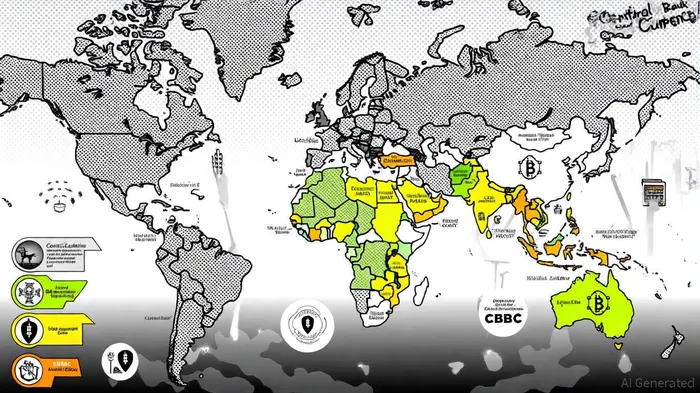
The global financial landscape is undergoing a seismic shift as Central Bank Digital Currencies (CBDCs) transition from theoretical exploration to tangible implementation. By Q3 2025, 134 countries—representing 98% of global GDP—are actively exploring or developing CBDCs, with 11 nations, including the Bahamas, Nigeria, and China, having fully launched retail versions[1]. This rapid adoption is notNOT-- merely a technological evolution but a regulatory and economic recalibration that is reshaping investment flows into digital asset infrastructure.
Regulatory Evolution: A Global Divergence
The regulatory frameworks governing CBDCs are diverging sharply, reflecting both geopolitical priorities and domestic financial needs. The European Central Bank (ECB) has advanced its digital euro project, completing a two-year investigation phase in 2023 and initiating real-world pilots in 2025[1]. Meanwhile, the U.S. Federal Reserve (Fed) remains cautious, emphasizing the need for legislative clarity and public consultation[3]. In contrast, the People's Bank of China (PBOC) has aggressively expanded its digital yuan (e-CNY) to over 30 cities, integrating it into public transportation and government services[1].
Regulatory progress is accelerating globally: 64 countries have implemented formal CBDC regulations as of 2025, a 33% increase from 2023[2]. These frameworks increasingly prioritize privacy, security, and compliance, with 75% of jurisdictions introducing data protection protocols and 62% integrating Anti-Money Laundering (AML) and Know Your Customer (KYC) requirements[2]. The Bank for International Settlements (BIS) is pivotal in harmonizing standards, exemplified by Project mBridge—a multi-jurisdictional initiative involving China, Thailand, Hong Kong, and the UAE to streamline cross-border settlements[1].
Investment Opportunities in Digital Asset Infrastructure
The CBDC boom is unlocking unprecedented investment opportunities in digital asset infrastructure, particularly in blockchain, cross-border payment systems, and cybersecurity.
Blockchain and Wallet Development
The demand for secure, scalable blockchain solutions is surging. Wallet and software development kits (SDKs) for CBDCs are projected to reach $2–5 billion by 2026, driven by the need for user-friendly interfaces and interoperability with existing financial systems[5]. Companies like Adhara and Ripple are pioneering wholesale CBDC rails, while platforms such as StellarXLM-- and Ripple are reducing cross-border remittance costs by up to 6%.Cross-Border Payment Systems
CBDCs are redefining cross-border transactions. The European Central Bank's TIPS service and SWIFT's digital asset settlement trials are creating new corridors for real-time, low-cost international payments[5]. The mBridge project, which processed $42 billion in cross-border trade settlements in 2025[1], exemplifies how CBDCs can bypass traditional intermediaries, cutting costs and settlement times.Cybersecurity and Compliance
As CBDCs handle high-volume transactions, cybersecurity has become a critical investment area. Firms like Thales and FireEye are developing tailored solutions to protect CBDC infrastructure from fraud and hacking[5]. Meanwhile, compliance tools for AML/KYC are projected to grow to $1.5–3 billion by 2026[5], reflecting the sector's emphasis on regulatory alignment.
Market Dynamics and Financial Implications
CBDCs are altering financial market dynamics in three key ways:
- Monetary Policy Transmission: Central banks are experimenting with programmable CBDCs to directly influence money supply and interest rates[4].
- Financial Inclusion: Emerging markets like Brazil and Nigeria are leveraging CBDCs to expand access to banking services, with 62% of central banks citing inclusion as a primary goal[2].
- Market Volatility: CBDC uncertainty has shown negative correlations with stock markets but positive links to cryptocurrencies and commodities[4], underscoring the need for adaptive investment strategies.
Conclusion
The CBDC revolution is no longer a distant possibility but an unfolding reality. As regulatory frameworks mature and infrastructure investments scale, the financial sector is poised for a paradigm shift. Investors who align with CBDC-driven innovation—whether in blockchain, cross-border systems, or cybersecurity—stand to capitalize on a $5.6 billion market[5] while navigating the complexities of a fragmented global regulatory landscape. The next decade will test not only the resilience of digital currencies but the adaptability of financial systems themselves.







Comentarios
Aún no hay comentarios