
The Emergence of CeDeFi and Its Impact on Crypto Market Accessibility and Liquidity
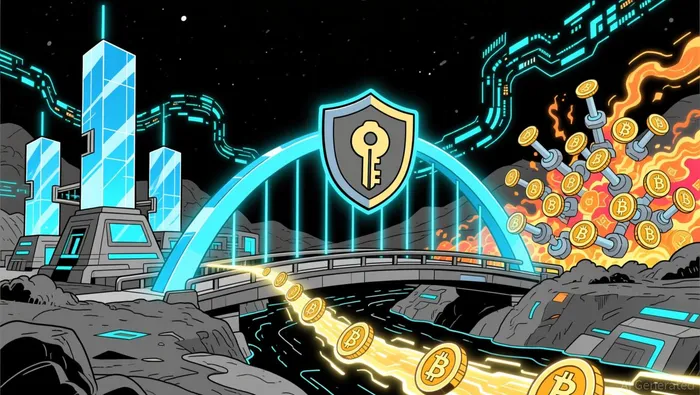
The crypto landscape in 2025 is defined by a seismic shift toward hybrid financial infrastructure. Centralized-Decentralized Finance (CeDeFi) has emerged as a bridge between the efficiency of centralized systems and the transparency of decentralized networks, redefining how users access liquidity and manage risk. This evolution is not just a technical innovation-it's a paradigm shift that democratizes participation in global markets while addressing long-standing pain points like cross-chain complexity, slippage, and fragmented user experiences.
The CeDeFi Revolution: Bridging Two Worlds
CeDeFi platforms like OKX are leading the charge by integrating centralized and decentralized ecosystems into a single interface. For instance, OKX's 2025 CeDeFi feature allows users to trade tokens across SolanaSOL--, Base, and X Layer without switching wallets or managing gas fees, while automatically generating self-custody wallets for asset control. This eliminates the friction of juggling multiple networks and reduces exposure to volatility risks through best-price routing across 100+ liquidity pools.
The market is responding. Total Value Locked (TVL) in DeFi protocols surged 40.2% in Q3 2025 to $161 billion, driven by ETH's rally and stablecoin adoption. Meanwhile, centralized exchanges (CEXes) saw spot trading volumes grow 31.6% quarter-over-quarter, with Binance capturing 40% market share according to the report. The synergy between these two worlds is evident: DeFi's composability meets CeFi's scalability, creating a flywheel effect for liquidity and accessibility.
Investment Opportunities in Hybrid Infrastructure
The rise of CeDeFi has unlocked novel investment avenues. Platforms like Bitget are leveraging this trend by listing innovative protocols such as Puffer Finance (PUFFER), a Native Liquid Restaking Protocol (nLRP) on EigenLayerEIGEN--. Bitget's Launchpool initiative offers free token farming with 2.7 million PUFFER tokens in rewards, democratizing access to staking for EthereumETH-- users. This model lowers entry barriers, enabling retail investors to participate in yield generation without technical expertise.
Meanwhile, interoperability protocols like Stripchain are addressing cross-chain fragmentation. After raising $10.1 million in funding led by Sora Ventures, Stripchain's intent-based architecture and StripVM technology aim to streamline asset transfers across ecosystems. For investors, this represents a play on infrastructure-as-a-service, where demand for seamless cross-chain solutions is expected to grow as DeFi adoption accelerates.
Risk Mitigation in a Hybrid World
While CeDeFi's potential is vast, it introduces unique risks. Decentralized markets often suffer from lower liquidity and higher slippage compared to centralized exchanges. For example, OKX explicitly warns users that DEX trades may incur greater volatility, emphasizing the need for robust risk management.
Innovative insurance products are emerging to address these gaps. OMEGAFINTECH and NOVAFINTECH, for instance, offer coverage for AI-driven risks and third-party API failures in hybrid platforms. These solutions are critical as fintech firms scale into AI-driven systems, where regulatory violations or biased algorithms could trigger financial liabilities. For investors, integrating risk insurance into CeDeFi strategies is no longer optional-it's a strategic imperative.
The Road Ahead: Strategic Considerations for Investors
The CeDeFi movement is still in its early innings. As platforms like OKX and Bitget refine their hybrid models, three trends will shape the next phase:
1. Self-Custody as a Standard: Automated wallet generation and online recovery features will become table stakes for user retention.
2. AI-Driven Liquidity Aggregation: Algorithms optimizing cross-chain trades will reduce slippage and enhance returns.
3. Regulatory Convergence: Hybrid platforms will need to navigate evolving compliance frameworks, particularly in stablecoin and staking derivatives.
For investors, the key is to prioritize platforms that balance innovation with risk resilience. Early adopters of protocols like Puffer Finance or interoperability solutions like Stripchain stand to benefit from first-mover advantages in a rapidly consolidating market.






Comentarios
Aún no hay comentarios