
Emerald Holding's M&A Strategy and Earnings Dilemma: Is the Pause a Prelude to Profitability?
Emerald Holding Inc. (NYSE: EEX) has long been a polarizing figure in the B2B events industry, its fortunes tied to a relentless acquisition strategy and a pivot toward AI-driven innovation. The company's Q3 2025 earnings report, however, has reignited debates about whether its aggressive M&A approach and technological bets can finally translate into sustainable profitability-or if the recent EPS miss and operational headwinds signal deeper structural challenges.
A Mixed Earnings Picture: Growth vs. Organic Decline
Emerald's Q3 2025 results reflected a classic tug-of-war between acquisition-driven growth and organic stagnation. Total revenue rose 6.7% year-over-year to $77.5 million, bolstered by the August 2025 acquisition of Generis Group. Yet organic revenue-a critical metric for assessing the health of existing operations-declined by 6.8%, attributed to construction delays at the Las Vegas Convention Center and tariff-related disruptions. The company also reported a net loss of $14.4 million, widening from $11.1 million in the same period in 2024, and negative free cash flow of -$0.4 million.
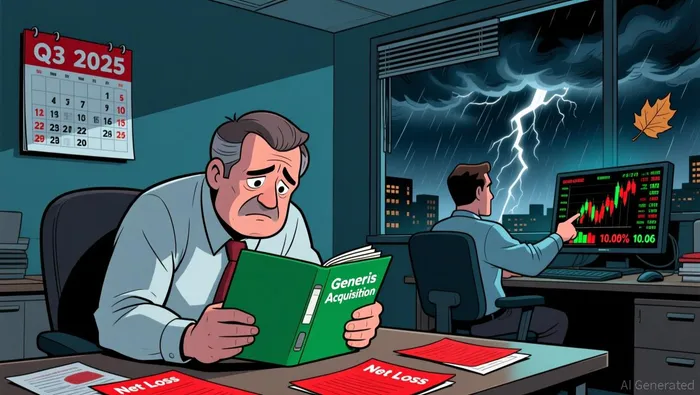 This duality underscores a recurring theme in Emerald's strategy: while acquisitions provide a short-term revenue boost, they often come at the expense of organic momentum. As noted by Bloomberg, "Emerald's reliance on M&A to drive growth has masked underlying weaknesses in its core event portfolio." The question for investors is whether the Generis acquisition-a $60 million deal with contingent payments tied to performance-can reverse this trend.
Generis: Strategic Fit or Financial Burden?
The Generis acquisition, which added 17 executive summits to Emerald's portfolio, was framed as a strategic win. Generis's expertise in one-to-one executive meetings and proprietary matchmaking platforms align with Emerald's goal of fostering "high-impact B2B experiences." The deal also expanded Emerald's footprint in key sectors like manufacturing and life sciences, areas with strong growth potential.
However, the financial terms and integration costs have complicated the narrative. Acquisition-related expenses, including legal and advisory fees, contributed to a $7.8 million operating loss in Q3 2025. While EmeraldEEX-- raised its full-year 2025 Adjusted EBITDA guidance to $122.5–$127.5 million, this optimism is tempered by the fact that the company's net loss widened despite the revenue boost. Analysts at Maxim Group caution that "the long-term profitability of Generis will depend on Emerald's ability to integrate its operations without further diluting margins."
AI Innovation: A Double-Edged Sword
Emerald's foray into AI has been another focal point. The company launched the C-Suite Summit in Q3 2025, a curated event exploring AI's role in leadership and marketing. Additionally, it introduced an AI-powered event agent to automate attendee interactions, aiming to enhance efficiency and scalability. These initiatives align with Emerald's broader vision of leveraging technology to "transform the event industry."
Yet, the impact on profitability remains mixed. While Adjusted EBITDA grew 32.4% year-to-date through September 2025, Q3 saw a mere 2.4% increase compared to the prior year, signaling a slowdown. The company's SG&A expenses also rose to $51.3 million in Q3, partly due to post-acquisition costs and stock-based compensation. As one industry observer noted, "Emerald's AI tools are promising, but their ability to offset integration costs and organic declines is unproven."
Expert Skepticism and the Path Forward
Emerald's M&A strategy has drawn both praise and criticism. Proponents highlight its success in diversifying its portfolio, with acquisitions like This is Beyond and Insurtech Insights opening new revenue streams. Critics, however, point to past missteps, such as the controversial purchase of MJBiz, as evidence of a "spray-and-pray" approach.
The company's updated 2025 guidance-$460–$465 million in revenue and $122.5–$127.5 million in Adjusted EBITDA-reflects confidence in its strategy. Yet, with a 10.06% drop in its stock price following the Q3 report, investors remain wary. The key question is whether Emerald can balance its acquisition-driven growth with cost discipline and organic innovation.
Conclusion: A Turning Point or a False Dawn?
Emerald's Q3 2025 results present a paradox: a revenue increase driven by strategic acquisitions, coupled with a net loss and declining organic performance. The Generis acquisition and AI initiatives are undeniably ambitious, but their ability to resolve Emerald's profitability issues hinges on execution. If the company can integrate Generis efficiently, scale its AI tools to reduce costs, and stabilize its core events, the updated EBITDA guidance could signal a turning point. However, the recent EPS miss and operational headwinds suggest that investors should approach with caution.
As Emerald CEO Hervé Sedky emphasized in a recent earnings call, "Our focus remains on leveraging technology and strategic acquisitions to build a resilient, high-growth platform." Whether this vision translates into profitability will depend on the company's ability to prove that its M&A and AI strategies are more than just a temporary fix.





Comentarios
Aún no hay comentarios