
Elon Musk's xAI and the Memphis AI Infrastructure Play: A Catalyst for Tech and Clean Energy Investment
The convergence of artificial intelligence (AI) and clean energy is reshaping global economic landscapes, and few projects exemplify this shift as dramatically as Elon Musk's xAIXAI-- Colossus expansion in Memphis, Tennessee. By deploying cutting-edge GPU infrastructure, forging strategic local partnerships, and navigating environmental challenges, xAI is positioning Memphis as a pivotal hub for innovation. For investors, the interplay between AI-driven infrastructure and clean energy initiatives presents a compelling case for long-term growth-and urgency to act.
Strategic Infrastructure and Local Partnerships: Building the "Digital Delta"
xAI's Colossus expansion, housed in a repurposed Electrolux facility, is a cornerstone of Memphis' transformation into the "Digital Delta." The project, which includes a 1 million-square-foot site in Whitehaven, is projected to create over 500 high-paying jobs and attract ancillary tech firms like Nvidia and Dell. This economic uplift is bolstered by xAI's collaboration with local energy providers, including Memphis Light, Gas and Water (MLGW) and the Tennessee Valley Authority (TVA), to meet its staggering power demands. The facility's initial 0.5-megawatt agreement with MLGW is expected to scale to over 1,000 megawatts-a third of Memphis' current peak demand-as operations expand according to clean energy analysts.
xAI's infrastructure strategy extends beyond power. The company has launched a Request for Proposal (RFP) portal to engage local businesses, aiming to inject capital into the Memphis economy while securing supply chain efficiency according to local economic development sources. Additionally, a $80 million water recycling facility will conserve 4.7 billion gallons of aquifer water annually, addressing regional water scarcity while supporting industrial users. These partnerships underscore xAI's dual focus on economic development and resource sustainability, aligning with Memphis' broader vision to diversify its economic base.
Environmental Initiatives and the Clean Energy Dilemma
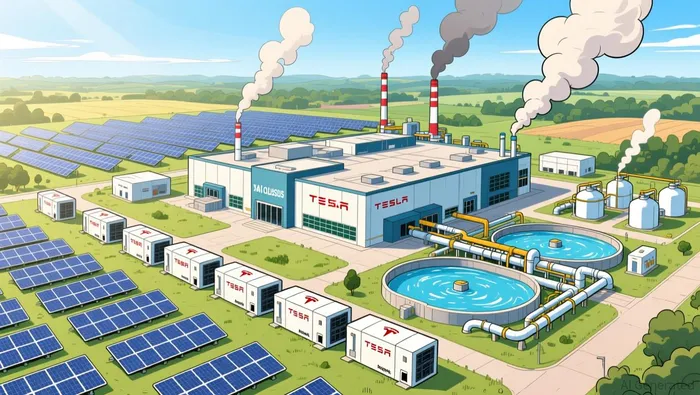 While xAI's environmental initiatives, such as a 30-megawatt solar farm and Tesla Megapack battery storage, signal a commitment to renewables, the project's reliance on gas turbines remains contentious. The deployment of 35 turbines-projected to emit 11.51 tons of hazardous pollutants annually-has drawn criticism from environmental justice advocates, particularly in South Memphis, a predominantly Black community already burdened by industrial pollution according to local environmental justice groups. Critics argue that these emissions exacerbate existing health disparities, while xAI maintains compliance with New Source Performance Standards (NSPS) and emphasizes its solar and water conservation efforts as per xAI's public statements.
This tension highlights a broader challenge: balancing the energy demands of frontier AI with decarbonization goals. According to the International Energy Agency, global clean energy investment reached $2.2 trillion in 2025, with solar PV leading the charge. xAI's solar initiative, though covering only 10% of Colossus' power needs, aligns with this trend and could serve as a model for integrating renewables into high-energy AI infrastructure. However, the scale of xAI's operations-projected to consume electricity equivalent to 150,000 homes annually-underscores the need for accelerated clean energy adoption according to industry analysts.
Financial Projections and Memphis' Economic Trajectory
The economic impact of xAI's presence in Memphis is already measurable. In 2023, the Memphis Metropolitan Statistical Area (MSA) achieved a historic Gross Regional Product (GRP) of $102.9 billion, with 5.8% year-over-year growth according to local economic data. xAI's status as the city's second-largest taxpayer within a year of operation further cements its role in this growth, with Mayor Paul Young's administration pledging to reinvest $3.2 million in xAI tax revenue into affected communities as reported by local news outlets.
Yet, challenges persist. The Milken Institute ranked Memphis 196th among U.S. cities in 2025 economic performance, citing the need for sustained investment in advanced manufacturing and green energy according to economic research. xAI's expansion, however, offers a catalyst. By attracting AI and tech firms, Memphis could replicate the success of Silicon Valley or Austin, leveraging its strategic location and lower operational costs. Analysts project that capital expenditure on AI training rigs could reach $200 billion by 2030, with Memphis poised to capture a significant share according to AI industry forecasts.
The Strategic Case for Immediate Investment
For investors, the convergence of AI and clean energy in Memphis represents a dual opportunity. First, xAI's infrastructure investments-spanning GPUs, power, and water-are foundational to the AI industry's growth. Second, the city's push for renewable integration aligns with global decarbonization trends, offering exposure to both tech and green energy sectors.
The urgency to act stems from two factors. First, xAI's rapid deployment-building Colossus 2 in six months-demonstrates its ability to outpace competitors, creating a first-mover advantage for early investors according to industry analysis. Second, regulatory and environmental pressures are intensifying. As the IEA notes, clean energy investment is outpacing fossil fuels, and companies that fail to adapt risk obsolescence according to the International Energy Agency. xAI's solar and water recycling projects, while modest, position it to navigate these pressures while maintaining operational scale.
Conclusion: A High-Stakes Inflection Point
xAI's Colossus expansion is more than a tech project-it is a microcosm of the AI-green energy transition. Memphis' strategic partnerships, economic momentum, and xAI's infrastructure bets create a compelling case for investors. However, the environmental and regulatory challenges cannot be ignored. For those willing to navigate these complexities, the rewards are substantial: a stake in a city redefining its economic identity and a company at the forefront of AI innovation. The question is not whether to invest, but how quickly.





Comentarios
Aún no hay comentarios