
Elon Musk's Potential 2026 Bitcoin Move: Strategic Implications for Institutional Adoption and Price Catalysts
The interplay between macroeconomic dynamics and high-profile signaling effects has long defined Bitcoin's trajectory, but 2026 could mark a pivotal inflection point. Elon Musk's historical influence on cryptocurrency markets-through both corporate actions and social media-has demonstrated a unique ability to amplify institutional adoption and price volatility. As macroeconomic conditions evolve, including Federal Reserve policy shifts and regulatory clarity, Musk's potential 2026 BitcoinBTC-- move could serve as a catalyst for broader institutional integration and price surges.
Historical Signaling Effects and Institutional Adoption
Elon Musk's public statements and corporate decisions have consistently shaped Bitcoin's market behavior. Tesla's $1.5 billion Bitcoin purchase in early 2021, followed by its decision to halt Bitcoin payments over environmental concerns, created significant market uncertainty and volatility. Similarly, Musk's tweets have historically driven sharp price movements, with non-negative tweets correlating to abnormal Bitcoin returns of up to 16.9% in some instances. These actions function as signaling mechanisms, influencing retail and institutional investors to adjust their strategies based on perceived endorsements or warnings.
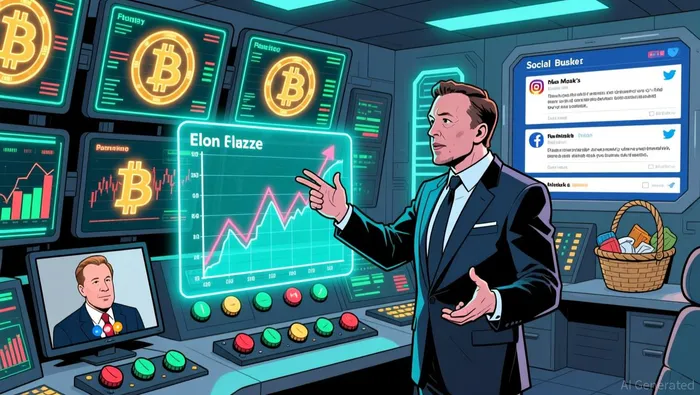
Beyond price impacts, Musk's advocacy has indirectly accelerated institutional adoption. Tesla's Bitcoin holdings and X's (formerly Twitter) DogecoinDOGE-- promotions normalized cryptocurrencies as legitimate assets, encouraging other firms to explore digital allocations. This trend aligns with broader macroeconomic drivers, such as inflationary pressures and the search for alternative stores of value, which have made Bitcoin increasingly attractive to institutional investors.
Macroeconomic Drivers in 2026: Fed Policy and Inflation
The Federal Reserve's policy trajectory will be a critical determinant of Bitcoin's performance in 2026. Projections indicate that the Fed may reduce the federal funds rate from its current range of 3.50% to 3.75% toward 3% by year-end 2026, depending on inflation and labor market data. Lower interest rates typically enhance the appeal of risk-on assets like Bitcoin, as investors seek higher returns amid diminished yields on traditional fixed-income instruments.
Inflationary trends further bolster Bitcoin's case as a hedge against currency devaluation. Research underscores that cryptocurrencies often thrive in high-inflation environments, where their scarcity and decentralized nature position them as alternatives to fiat currencies. If the Fed's rate cuts coincide with disinflation or a "Goldilocks" scenario-where growth remains robust without triggering inflationary spikes-Bitcoin could see sustained buying pressure. Analysts like Gabe Selby of CF Benchmarks argue that such conditions could push Bitcoin toward $102,000 by mid-2026.
Institutional adoption and regulatory clarity The U.S. GENIUS Act, passed in July 2025, is reshaping the regulatory landscape for digital assets, requiring stablecoin issuers to maintain 1:1 reserves and clarifying compliance standards. This regulatory clarity is expected to accelerate institutional adoption, as firms like JPMorgan and BlackRock expand their crypto offerings, including tokenized money-market funds. Grayscale's 2026 Digital Asset Outlook predicts that bipartisan crypto legislation will further integrate Bitcoin into traditional finance, with spot ETFs and regulated trading facilitating capital inflows.
Institutional confidence is also bolstered by macroeconomic optimism. Over $100 billion has already been invested in U.S. Bitcoin ETFs, with 94% of institutional investors viewing blockchain technology as a long-term strategic asset. This shift reflects a broader reclassification of Bitcoin from speculative asset to a diversified portfolio component, particularly in a low-yield environment.
Potential 2026 Catalysts: Musk's Strategic Move
Speculation about Musk's 2026 Bitcoin strategy has intensified, with industry analyst Samson Mow suggesting he could make an "aggressive" move to re-engage with the asset. Historical precedents, such as Tesla's Bitcoin purchase and Dogecoin promotions, indicate that Musk's actions could trigger immediate market reactions. If he were to reintroduce Bitcoin payments at TeslaTSLA-- or announce a major institutional investment, the signaling effect could catalyze a surge in adoption and price.
Musk's recent economic forecasts- predicting "double-digit" U.S. growth by late 2026 driven by AI advancements-further align with a bullish macroeconomic backdrop. Such optimism could encourage institutional investors to allocate capital to Bitcoin as a hedge against inflation and a beneficiary of risk-on sentiment. However, risks remain, including potential bearish phases if macroeconomic data diverges from expectations or if Musk's actions are perceived as inconsistent with environmental or regulatory priorities.
Strategic Implications for Investors
For macro-driven investors, 2026 presents a confluence of factors that could redefine Bitcoin's role in global finance. Key positioning strategies include: 1. Hedging Against Inflation: Allocating to Bitcoin as a store of value amid rising public debt and currency depreciation. 2. Capitalizing on Fed Easing: Leveraging rate-cut expectations to overweight risk assets like Bitcoin. 3. Monitoring Institutional Flows: Tracking ETF inflows and regulatory developments to gauge adoption trends. 4. Assessing Musk's Signaling: Closely watching Tesla's corporate actions and Musk's public statements for directional cues.
While volatility persists, the interplay of macroeconomic tailwinds, regulatory clarity, and Musk's potential 2026 move creates a compelling case for institutional and strategic investors to position for a new era of digital asset integration.







Comentarios
Aún no hay comentarios