
Elon Musk and Bitcoin: A Macro Catalyst in the Age of AI and Energy
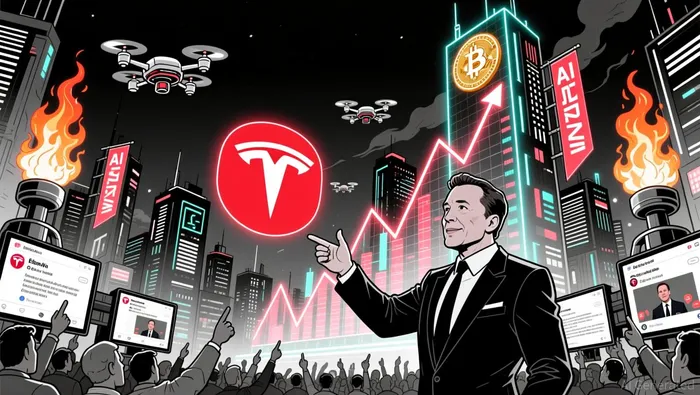
In 2025, the interplay between Elon Musk's influence and Bitcoin's macroeconomic trajectory has become a focal point for investors navigating a rapidly evolving economic landscape. Musk's public statements, corporate decisions, and social media activity continue to shape investor sentiment, while his broader vision of energy-driven value creation aligns with Bitcoin's positioning as a hedge against inflation and a strategic asset in an AI-dominated future.
Musk's Historical Impact on Bitcoin's Price and Sentiment
Elon Musk's influence on BitcoinBTC-- is well-documented. Tesla's 2021 purchase of $1.5 billion in Bitcoin catalyzed a price surge, demonstrating the tangible impact of corporate actions on cryptocurrency markets. Conversely, Tesla's decision to halt Bitcoin transactions and later sell a significant portion of its holdings triggered sharp price declines. These events underscore Musk's ability to act as a short-term catalyst for Bitcoin's volatility.
Musk's social media activity further amplifies this effect. His tweets, particularly on X (formerly Twitter), have historically driven spikes in DogecoinDOGE-- and Bitcoin prices. For instance, his 2021 endorsement of Dogecoin as "the people's crypto" led to immediate price surges. However, such effects are often ephemeral, with prices retreating after initial enthusiasm wanes. This highlights the dual-edged nature of Musk's influence: while he can ignite retail investor FOMO (fear of missing out), long-term trends remain anchored to fundamentals like institutional adoption and regulatory clarity.
Bitcoin as an Energy-Backed Asset in the AI Era
Musk has consistently framed Bitcoin as an energy-based asset, contrasting it with fiat currencies that governments can "print at will" according to Musk. He argues that Bitcoin's proof-of-work mechanism ties its value to real-world energy expenditure, making it inherently more trustworthy than inflationary fiat systems as reported by financial analysts. This perspective gains traction in 2025 as AI and automation drive unprecedented energy demand.
According to Musk, energy-not money-will become the core unit of value in a post-scarcity world shaped by AI-driven productivity. As AI infrastructure expands, private sector spending on data centers is projected to exceed $500 billion by 2026-2027, intensifying energy consumption and inflationary pressures. In this context, Bitcoin's energy-backed model positions it as a hedge against devaluation, particularly as nations like the U.S. and China compete in an AI arms race according to technology analysts.
 .
.
Macro-Level Catalysts: Inflation, Energy, and AI-Driven Capital
Musk's macroeconomic narrative for Bitcoin is underpinned by three key factors:
1. Inflationary Pressures: Rising public capital expenditure on AI and robotics is fueling inflation, prompting investors to seek hard assets like Bitcoin as a store of value.
2. Energy Dynamics: The surge in AI development requires an additional 75–100 GW of electricity by 2030, reinforcing Bitcoin's energy-based valuation.
3. AI-Driven Capital Allocation: Institutional adoption of Bitcoin has surged, with over 3.09 million BTC held by corporate and government entities, reflecting its growing role in strategic portfolios.
Musk's AI-driven predictions, such as Grok's forecast of Bitcoin reaching $125,000–$150,000 within 150 days, further align with these trends. These projections hinge on looser U.S. monetary policy and regulatory developments that could legitimize Bitcoin as a macroeconomic asset.
Investor Sentiment and Systemic Risks
While Musk's influence drives retail investor behavior, it also introduces risks. Social media sentiment-whether positive or negative-correlates with Bitcoin's volatility, as seen in 2025's market fluctuations. Negative sentiment, for example, has been linked to heightened price swings, while neutral sentiment affects liquidity. This volatility, however, is tempered by institutional demand, with ETFs and corporate treasuries controlling 15% of Bitcoin's total supply.
Conclusion: Bitcoin's Role in the Next Economic Paradigm
Elon Musk's vision of an energy-driven economy, coupled with AI's transformative impact, positions Bitcoin as a critical asset in 2025. While his social media-driven volatility remains a short-term risk, the long-term narrative is anchored in Bitcoin's alignment with macroeconomic forces. As energy becomes the new currency and AI reshapes global capital flows, Bitcoin's role as a hedge against inflation and a store of value is likely to solidify. Investors must balance Musk's influence with broader economic fundamentals, recognizing that the future of Bitcoin lies at the intersection of technology, energy, and institutional adoption.





Comentarios
Aún no hay comentarios