
Elon Musk's 2025: Political Turbulence, Astronomical Pay, and the Dawn of Robotaxi Dominance
In 2025, TeslaTSLA-- shareholders find themselves navigating a volatile landscape shaped by Elon Musk's political entanglements, a staggering $1 trillion compensation package, and the nascent rise of AI-driven robotaxi technology. These factors collectively redefine the strategic risk/reward calculus for investors, as Tesla's valuation increasingly hinges on speculative bets about autonomy, robotics, and regulatory outcomes.
Political Turbulence: A Double-Edged Sword
Musk's role in the Trump administration-specifically as head of the Department of Government Efficiency (DOGE)-has sparked intense scrutiny over conflicts of interest. Critics argue that Musk's lack of formal ethics oversight and access to sensitive data could prioritize private enterprise over public accountability according to reports. For Tesla, this raises existential questions: while research indicates reduced regulatory pressure under Trump-era policies has softened investigations into Tesla's civil rights compliance and autonomous vehicle safety, the erosion of institutional checks could backfire if political alliances sour.
The recent feud between Musk and Trump, which triggered a 14% plunge in Tesla's stock value on June 6, 2025, underscores this volatility. A potential termination of government contracts or subsidies for Tesla and SpaceX could destabilize the company's financials, particularly as it seeks to scale robotaxi operations. Meanwhile, Musk's polarizing political endorsements have fueled protests and boycotts, further complicating brand equity in key markets like Europe, where Tesla's automotive margin has fallen to 13.6%-trailing BYD's 22.3%.
Astronomical Pay: Incentives and Execution Risks
Musk's 2025 compensation package-a $1 trillion pay plan tied to performance milestones-reflects both ambition and peril. The plan requires Tesla to achieve a $8.5 trillion market cap, deliver 20 million vehicles, and deploy 1 million robotaxis, among other targets according to reports. While the company has made incremental progress (e.g., a market cap rise to $1.35 trillion since September 2025), the operational and regulatory hurdles remain daunting.
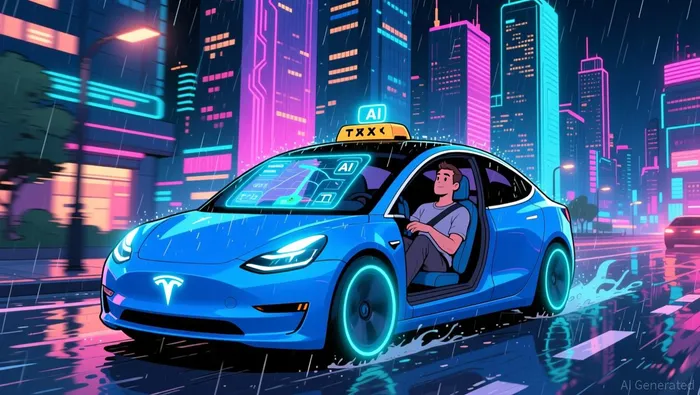
For instance, Tesla's robotaxi program, which recently demonstrated a vehicle operating without a safety monitor (albeit with remote oversight), faces stiff competition from Waymo and Baidu's Apollo Go, which have already launched paid services in multiple cities. Analysts note that Tesla's vertically integrated AI chips and data collection capabilities offer a competitive edge, but regulatory delays-such as the U.S. National Highway Traffic Safety Administration's investigation into Full Self-Driving (FSD) safety-could derail timelines.
The compensation structure itself is a high-stakes gamble. If Musk meets all milestones, he would own 12% of Tesla's stock, equivalent to 423.7 million shares. However, failure to deliver on these targets could erode investor confidence, particularly as Morgan Stanley downgrades Tesla's stock, citing "execution risks" and uncertain regulatory pathways for FSD according to reports.
Robotaxi Dominance: AI as a Valuation Catalyst
Tesla's valuation in 2025 is increasingly decoupled from traditional automotive metrics and reoriented around AI-driven revenue streams. The company's P/E ratio of 279.5 according to analysis reflects investor optimism about robotaxis and FSD licensing, which are projected to account for 40% of operating income by 2030 according to analysts. Recent milestones, such as the testing of robotaxis without safety monitors, have reinforced this narrative, even as competitors like Waymo boast a 7x higher safety record according to data.
However, the sector's valuation multiples remain uneven. While Tesla trades at a premium, the median EBITDA multiple for self-driving companies in Q4 2025 was 9.7x, suggesting skepticism about the scalability of AI-driven business models. Moreover, regulatory fragmentation-particularly in the U.S.-creates uncertainty around liability frameworks and deployment timelines.
Strategic Risk/Reward Assessment
For Tesla shareholders, the interplay of political, financial, and technological factors creates a high-risk, high-reward scenario:
- Upside: If Musk navigates political tensions, secures regulatory approvals, and executes on robotaxi and Optimus robotics, Tesla could dominate a $2.874 trillion autonomous vehicle market by 2031. A $8.5 trillion valuation, while ambitious, is not inconceivable in a scenario where AI-driven revenue outpaces EV sales.
- Downside: Political fallout, regulatory setbacks, or execution failures could trigger a valuation collapse. The recent 14% stock drop illustrates how swiftly sentiment can shift, particularly in a market where expectations are priced into a P/E of 279.5.
Conclusion
As 2026 approaches, Tesla's trajectory will hinge on Musk's ability to balance political influence with corporate governance, deliver on AI-driven milestones, and navigate a crowded robotaxi landscape. For shareholders, the key question is whether Tesla's speculative bets will crystallize into sustainable value-or dissolve into volatility. The answer lies not just in the technology, but in the execution of a vision that remains as audacious as it is uncertain.





Comentarios
Aún no hay comentarios