
Elon Musk's $1 Trillion Pay Package and Tesla's AI/Robotics Future: A Make-or-Break Moment for Shareholders
Strategic Alignment: From EVs to AI-Driven Ecosystems
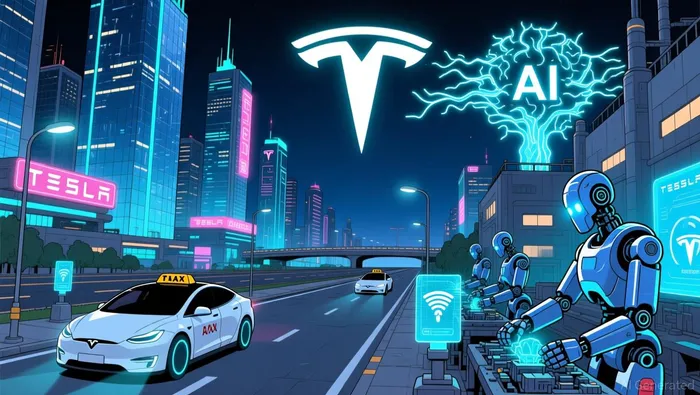
The compensation package ties Musk's rewards to 12 performance tranches, including targets such as a $8.5 trillion market capitalization, 12 million annual vehicle deliveries, and the deployment of one million robotaxis and Optimus humanoid robots, according to a TechStory report. These milestones reflect Tesla's strategic pivot toward autonomous mobility and AI-driven infrastructure. For instance, the robotaxi initiative, now in trials in Austin and the Bay Area, aims to launch a fully autonomous ride-hailing service by 2026, according to TeslaRati. Similarly, the Optimus project, with its potential to disrupt industrial and domestic labor markets, is central to Tesla's vision of becoming a "Silicon Valley-style tech empire," as noted by Wall Street Pit.
The vesting structure-requiring Musk to hold shares for a minimum of 7.5 years-ensures his long-term commitment to these goals. By linking compensation to metrics like EBITDA growth (targeting $400 billion by 2035) and market cap expansion, Tesla's board signals confidence in Musk's ability to execute a multi-decade transformation, as noted in a Yahoo Finance article. However, the package's success hinges on execution: achieving a 5.7x increase in market cap from $1.5 trillion to $8.5 trillion would require not just technological breakthroughs but also regulatory approvals and global adoption of Tesla's AI-driven services, according to a Not a Tesla App report.
Financial Implications and Expert Validation
Tesla's Q3 2025 results highlight the company's dual-track strategy: record revenue of $26.27 billion from vehicle sales, as reported in a TechStory article and aggressive R&D investments in AI and robotics. While near-term margins face pressure from price cuts and tariffs, analysts like Wedbush have raised Tesla's price target to $600, citing the potential of robotaxi and Optimus to unlock new revenue streams, according to a TechStory article.
Third-party validations underscore the financial logic behind Musk's incentives. A Wall Street Pit report notes that Tesla's valuation is increasingly tied to its AI roadmap, with robotaxi and Optimus projected to generate high-margin software and hardware revenue, according to a MK report. Meanwhile, Intel's potential partnership to produce Tesla's AI5 and AI6 chips-expected to double performance while reducing costs-could secure a stable supply chain for autonomous systems, as reported in a Financial Content report.
Risks and Governance Concerns
Despite the strategic logic, critics argue the package over-rewards Musk at the expense of governance. Institutional Shareholder Services (ISS) opposed the deal, warning that the lack of clear metrics for AI/robotics milestones could lead to "shareholder dilution and misaligned incentives," according to a Nasdaq article. Additionally, Tesla's declining vehicle sales and competition from Chinese EV startups raise questions about its ability to meet production targets, as noted in a Newswheel article.
The board, however, defends the package as a "pay-for-performance" structure, emphasizing that Musk receives no compensation unless all targets are met, as stated in a Reuters article. This high-stakes approach reflects Tesla's bet on Musk's leadership to navigate a rapidly evolving tech landscape.
Conclusion: A Make-or-Break Moment
Elon Musk's $1 trillion pay package is more than a compensation deal-it is a declaration of Tesla's intent to dominate the AI and robotics era. By aligning Musk's incentives with ambitious, technology-driven milestones, Tesla's board has staked its future on a vision that could redefine mobility, energy, and automation. For shareholders, the package represents both an unprecedented opportunity and a significant risk. The coming years will determine whether this bold bet pays off-or becomes a cautionary tale of overambition.





Comentarios
Aún no hay comentarios