
Elon Musk's $1 Billion Bet on Tesla: A Catalyst for Investor Confidence?
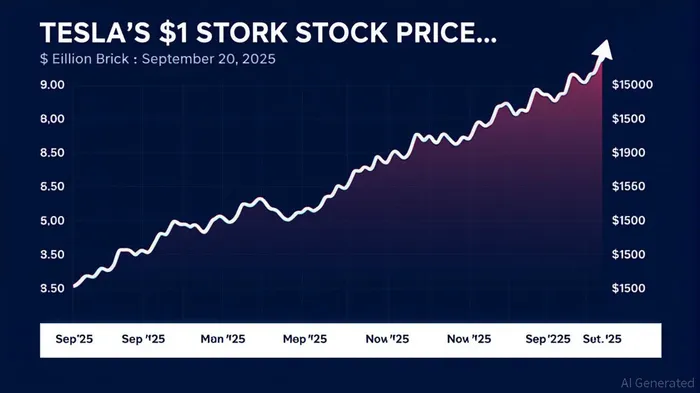
Elon Musk's recent $1 billion investment in TeslaRACE-- Inc. (TSLA) has ignited a wave of speculation about the interplay between executive confidence and market dynamics. According to a report by The New York Times, Musk's purchase occurred alongside the unveiling of a revised compensation package that could reward him with stock options worth $1 trillion if Tesla achieves ambitious milestones in vehicle production, safety, and profitability[1]. This dual move—personal investment and conditional incentives—has been interpreted as a strategic signal to investors, reinforcing the notion that executive confidence can act as a catalyst for broader market optimism[2].
The Psychology of Executive Confidence
When a CEO commits substantial personal capital to their company, it often serves as a psychological trigger for investors. In Musk's case, the $1 billion purchase—a rare move for a billionaire—demonstrates alignment with shareholder interests and underscores his belief in Tesla's long-term trajectory. As stated by CNN, the transaction occurred amid a premarket surge of 7% in Tesla's stock, suggesting that the market viewed Musk's action as a vote of confidence. While direct expert analysis on this specific event is limited, historical precedents show that CEO stock purchases can amplify investor sentiment, particularly in high-growth sectors like electric vehicles.
The revised compensation package further amplifies this effect. By tying Musk's potential $1 trillion in stock options to measurable goals, Tesla's board has created a framework where executive and investor interests are inextricably linked. This structure not only incentivizes Musk to prioritize long-term value creation but also reassures shareholders that the CEO's vision is backed by tangible, performance-based rewards.
Market Reactions and Investor Behavior
The immediate 7% premarket jump in Tesla's stock highlights the power of perceived leadership stability. In volatile markets, investor decisions often hinge on signals of resilience and direction. Musk's purchase, coupled with the board's endorsement of his pay package, appears to have quelled short-term concerns about executive turnover or strategic drift. Analysts note that such actions can reduce uncertainty, prompting retail and institutional investors to reassess risk profiles and allocate capital accordingly.
However, the long-term success of this strategy depends on Tesla's ability to meet the outlined milestones. If the company falls short, the market's initial euphoria could give way to skepticism. Conversely, exceeding targets could create a self-reinforcing cycle of confidence, where Musk's growing stake and Tesla's performance validate each other.
Conclusion
Elon Musk's $1 billion investment in Tesla is more than a financial transaction—it is a symbolic gesture that underscores the role of executive confidence in shaping investor behavior. By aligning his personal wealth with Tesla's future and structuring incentives around measurable outcomes, Musk has reinforced a narrative of commitment and accountability. While the stock's immediate reaction reflects this dynamic, the true test lies in Tesla's ability to deliver on its ambitious roadmap. For investors, the lesson is clear: in an era of uncertainty, leadership actions often serve as the most reliable barometer of a company's potential.





Comentarios
Aún no hay comentarios