
Ellipal's Titan 2.0 and X Card: A Game Changer in Cold Storage Security for Crypto Investors?
In the maturing cryptocurrency market of 2025, the demand for robust, user-friendly cold storage solutions has never been higher. As institutional adoption accelerates and regulatory scrutiny intensifies, hardware wallet innovators like Ellipal are redefining the standards for security and accessibility. The company's flagship products—the Titan 2.0 and the X Card—have emerged as contenders in a crowded field, offering unique value propositions that could reshape the landscape of self-custody solutions. This analysis evaluates Ellipal's long-term investment potential by dissecting its technological innovations, market positioning, and alignment with industry trends.
Product Innovation: Air-Gapped Security Meets User-Centric Design
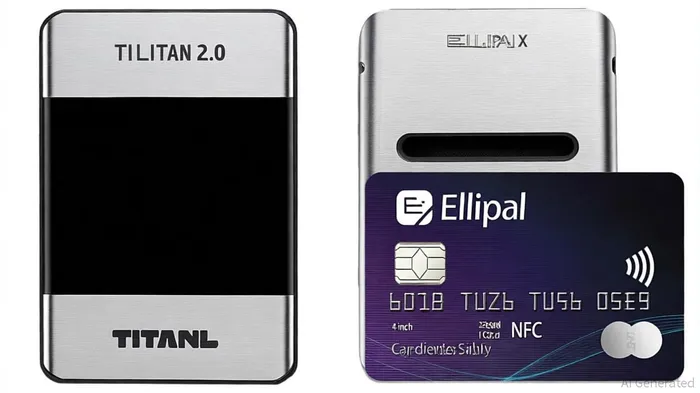
Ellipal's Titan 2.0 and X Card exemplify the company's commitment to balancing cutting-edge security with usability. The Titan 2.0, a 4-inch touchscreen hardware wallet, boasts a 100% air-gapped design, tamper-proof metal construction, and a self-destruct mechanism triggered by unauthorized access attempts [1]. Its upgraded 2000 mAh battery and support for over 10,000 cryptocurrencies make it a versatile option for users with diverse portfolios [2]. Firmware updates are conducted via microSD card, ensuring no exposure to online threats during the process [3].
The X Card, a credit card-sized cold wallet, takes portability to the next level. Leveraging NFC technology and a CC EAL6+ secure chip, it enables offline transaction signing without requiring USB or Bluetooth connectivity [4]. Its tamper-proof design includes a self-destruct feature after 10 incorrect PIN attempts, while its backup system allows users to duplicate their wallet onto up to 10 additional cards [5]. Despite lacking a built-in screen, the X Card relies on a mobile app for transaction verification, prioritizing security over convenience [6].
These innovations position Ellipal as a leader in air-gapped cold storage, a critical differentiator in an era where cyberattacks on custodial platforms are increasingly common. By eliminating remote attack vectors and integrating multi-factor authentication, Ellipal's products address two of the most pressing concerns for crypto investors: security and usability.
Market Dynamics: A Growing Pie and Niche Differentiation
The global hardware wallet market is projected to grow at a 29.95% CAGR from 2025 to 2030, expanding from USD 0.56 billion to USD 2.06 billion by 2030 [7]. This growth is driven by institutional adoption of self-custody solutions, regulatory mandates for secure storage, and rising awareness of cyber threats. North America dominates the market with a 39.4% share, while the Asia-Pacific region—where Ellipal is headquartered—emerges as the fastest-growing segment [8].
Ellipal's competitive positioning is bolstered by its focus on multi-chain support and portability. The Titan 2.0's compatibility with 50+ blockchains and the X Card's NFC-enabled design cater to distinct user segments: the former appeals to power users and institutional investors, while the latter targets mobile-first traders and frequent travelers [9]. This dual-product strategy allows Ellipal to capture market share across both high-end and mass-market segments.
However, challenges persist. The Titan 2.0's non-replaceable battery and slower firmware update process highlight trade-offs in design prioritization [10]. Meanwhile, the X Card's reliance on a mobile app for transaction verification may deter users seeking full offline transparency. Competitors like Ledger and Trezor, with their open-source models and established ecosystems, remain formidable rivals [11].
Regulatory Tailwinds and Long-Term Viability
Regulatory developments in 2025 further amplify the importance of secure storage solutions. The EU's Markets in Crypto-Assets (MiCA) framework and evolving U.S. compliance requirements emphasize audit-ready systems and non-custodial infrastructure, aligning with Ellipal's core strengths [12]. As regulators push for stricter data protection and anti-money laundering (AML) protocols, hardware wallets with advanced encryption and tamper-proof features—such as Ellipal's offerings—are likely to gain traction.
Moreover, the rise of decentralized finance (DeFi) and non-fungible tokens (NFTs) has increased demand for wallets supporting multi-chain interoperability. Ellipal's Titan 2.0, with its broad blockchain compatibility and staking capabilities, is well-positioned to capitalize on this trend [13].
Investment Thesis: Balancing Innovation and Market Realities
While Ellipal's financials remain opaque, its inclusion in top hardware wallet rankings and its competitive feature set suggest strong market penetration [14]. The company's ability to innovate—such as the X Card's backup redundancy and the Titan 2.0's anti-tamper mechanisms—demonstrates a forward-thinking approach that could drive long-term growth.
However, investors must weigh these strengths against risks:
1. Competition: Ledger and Trezor dominate market share, leveraging brand loyalty and open-source transparency [15].
2. Regulatory Uncertainty: Shifting enforcement priorities under potential U.S. administration changes could impact compliance costs [16].
3. User Adoption: The X Card's lack of a screen may limit appeal for users prioritizing transaction visibility.
Despite these challenges, Ellipal's focus on air-gapped security and portability aligns with the crypto market's maturation. As institutional investors and retail users increasingly prioritize self-custody, the company's products are poised to capture a growing share of the $2.06 billion market by 2030 [7].
Conclusion
Ellipal's Titan 2.0 and X Card represent a compelling evolution in cold storage security, addressing the dual imperatives of robust protection and user accessibility. While the company faces stiff competition and regulatory headwinds, its innovative design and alignment with market trends position it as a long-term player in the crypto infrastructure space. For investors seeking exposure to the self-custody revolution, Ellipal's hardware wallet ecosystem offers a high-conviction bet—provided the company can sustain its innovation pace and navigate the evolving regulatory landscape.







Comentarios
Aún no hay comentarios