
Elekta AB's Strategic Position in a Transforming Radiation Oncology Market
Market Dynamics and Elekta's Competitive Edge
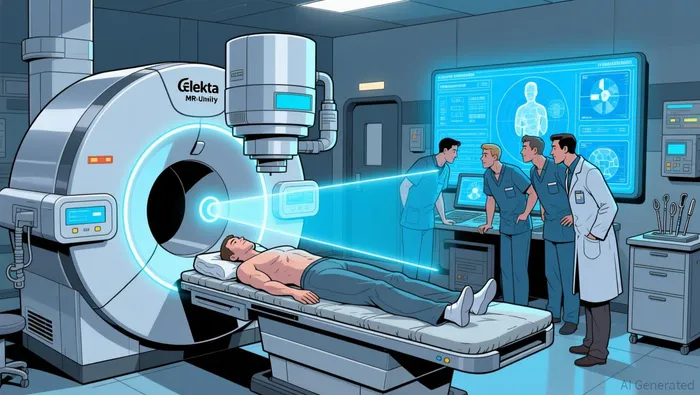
The global radiation oncology market is dominated by External Beam Radiation Therapy (EBRT), which accounts for 57.9% of the 2025 market share. Elekta's dominance in this segment is underpinned by its leadership in advanced technologies such as 3D Conformal Radiotherapy (3D-CRT) and MRI-guided adaptive radiotherapy. The company's Unity MR-Linac, which combines real-time MRI imaging with radiation delivery, has demonstrated clinical benefits in prostate cancer treatment, including improved patient-reported urinary symptoms.
Elekta's competitive advantage extends beyond hardware. Its Elekta ONE software suite, which streamlines treatment planning and workflow efficiency, has driven a strong book-to-bill ratio of 1.12 in Q4 2024/25 according to financial reports. This digital ecosystem aligns with broader industry trends toward AI-driven treatment planning and adaptive radiotherapy (ART), which enable real-time adjustments to treatment plans based on anatomical changes.
Financial Performance and Operational Challenges
Despite robust demand, Elekta's Q4 2024/25 financials reveal mixed signals. Net sales rose 3% year-over-year to SEK 5,156 million, with adjusted gross and EBIT margins reaching five-year highs of 40.3% and 16.3%, respectively according to the company's year-end report. However, a non-cash impairment charge of SEK 1,064 million-attributed to discontinued R&D projects-resulted in a net loss of SEK 381 million. This underscores the risks of high R&D expenditures in a sector where innovation cycles are long and capital-intensive.
The company's path to margin recovery hinges on its ACCESS 2025 strategy, which emphasizes cost savings through operational simplification and supply chain optimization. By Q1 2026/27, Elekta aims to achieve annualized savings of at least SEK 500 million as announced in the Q2 2025 press release. These measures are critical as the U.S. Radiation Oncology Case Rate (ROCR) Act of 2025 threatens reimbursement cuts for smaller providers, potentially limiting market access for Elekta's advanced systems.
Strategic Partnerships and Global Expansion
Elekta's ability to navigate macroeconomic headwinds is bolstered by strategic collaborations. A notable partnership with RaySearch Laboratories and Radiology Oncology Systems (ROS) has expanded access to refurbished linear accelerators integrated with AI-powered software like RayStation. This initiative targets low- and middle-income countries, where rising cancer incidence and government initiatives (e.g., India's Ayushman Bharat) are driving demand.
In the Asia-Pacific region, Elekta is leveraging its ACCESS 2025 strategy to address infrastructure gaps. The region, projected to capture 24.4% of the global market by 2032, offers growth opportunities as healthcare expenditure rises. Elekta's focus on cost-effective solutions, such as AI-assisted treatment planning, aligns with the need to reduce operational costs while maintaining clinical efficacy as reported by market analysts.
Macroeconomic and Reimbursement Risks
Elekta's global operations face dual pressures from inflation and currency fluctuations, which impact capital expenditures and pricing power. In the U.S., where the market accounts for 38.5% of global revenue according to market research, reimbursement challenges loom large. The ROCR Act's potential to reduce payments for advanced therapies could disproportionately affect Elekta, given its reliance on high-margin systems like the Unity MR-Linac.
However, Elekta's advocacy for reimbursement reforms-highlighted in its 2025 Impact Report-seeks to demonstrate the cost-effectiveness of radiotherapy as a standalone and combined treatment modality according to the company's press release. This strategy aims to counteract regulatory headwinds by emphasizing clinical value, a critical differentiator in a market increasingly scrutinized for cost-benefit ratios.
Long-Term Growth Prospects
Elekta's long-term outlook is anchored in its R&D pipeline, which includes innovations like the Evo CT-Linac and Comprehensive Motion Management (CMM) for the Unity MR-Linac as detailed in industry reports. These technologies address key pain points in radiation oncology, such as organ movement during treatment, and position Elekta to capture growth in the adaptive radiotherapy software market, expected to expand rapidly.
The company's strategic focus on decentralized operations and customer-centric solutions further strengthens its resilience. By prioritizing speed, precision, and scalability in adaptive workflows, Elekta is well-positioned to meet the demands of a market increasingly driven by personalized medicine and real-time data analytics as demonstrated in recent industry events.
Conclusion
Elekta AB's strategic position in the radiation oncology market is a blend of technological leadership, operational agility, and global expansion. While macroeconomic and reimbursement challenges pose near-term risks, the company's R&D investments, cost-saving initiatives, and partnerships with regional players create a robust foundation for long-term growth. For investors, Elekta represents a compelling case study in navigating a high-stakes, high-reward sector where innovation and adaptability are paramount.







Comentarios
Aún no hay comentarios