
Electronic Arts' $55 Billion Buyout: Is the Current Share Price Reflecting Fair Value for Long-Term Investors?
Electronic Arts Inc. (NASDAQ: EA) has become the focal point of investor speculation following its landmark $55 billion all-cash buyout by a consortium led by Saudi Arabia's Public Investment Fund (PIF), Silver Lake, and Affinity Partners, according to a MarketMinute article. The deal, offering shareholders $210 per share—a 25% premium over EA's unaffected price of $168.32—has sent the stock to record highs, closing at $193.35 post-announcement, according to a TechXplore report. But does this pricing reflect fair value for long-term shareholders, or is the market overreacting to a one-time event?
Valuation Metrics: Premium Pricing vs. Lagging Growth
EA's current market capitalization of $50.56 billion and enterprise value of $51.20 billion, according to StockAnalysis data, suggest a premium valuation. However, its fundamentals tell a different story. In the latest quarter, EA's revenue growth stagnated at 0.7% year-over-year, far below the S&P 500's 6.1% growth (per StockAnalysis). Its price-to-sales ratio of 6.68x and forward P/E of 22.89x place it well above market averages, raising questions about whether investors are overpaying for a company with decelerating growth.
The buyout price of $210 per share implies a valuation of approximately $57.75 billion (based on 275 million shares outstanding), a 15% premium to EA's current market cap. While this signals confidence from the consortium, it also highlights a disconnect between EA's operational performance and its implied private equity value. Analysts remain divided: Alicia Reese of Wedbush maintains an “Outperform” rating with a $210 target, as noted in a Nasdaq analysis, aligning with the buyout price, while B of A's Omar Dessouky raised his target to $166 in a Benzinga article. The average 12-month price target of $172.30—14.73% below the current price—suggests skepticism about sustaining this premium (StockAnalysis).
Market Sentiment and Strategic Rationale
The buyout's structure—a 100% cash offer with $36 billion in equity and $20 billion in debt—reduces shareholder uncertainty, as there's no dilution or reliance on future earnings. This has driven EA's stock to a 36-year high, reflecting market optimism about the deal's certainty. However, the $20 billion in debt financing, led by JPMorgan Chase, introduces risks. If EA's cash flow post-buyout is insufficient to service this debt, the company could face financial strain, potentially undermining long-term value.
The consortium's rationale likely hinges on EA's durable cash flow from franchises like FIFA and Apex Legends, as well as its dominance in digital distribution. PIF's 9.9% stake rollover and the inclusion of Affinity Partners—linked to Jared Kushner—also suggest strategic bets on EA's global expansion potential. Yet, the decision to take EAEA-- private raises concerns about reduced transparency and innovation risks. Public markets often incentivize growth, whereas private ownership may prioritize debt repayment over R&D investment.
Dividend and Buyback History: A Missed Opportunity?
EA's dividend yield of 0.64%, according to MarketBeat, is modest, and the absence of buybacks in the past four years indicates underutilized capital-return strategies. The buyout could be seen as a forced solution to unlock shareholder value, particularly for investors frustrated with stagnant growth. However, the 25% premium offered by the consortium is a one-time event, not a recurring benefit. For long-term holders, the key question is whether EA's post-buyout strategy will reignite growth or merely stabilize its position in a saturated gaming market.
Conclusion: A Premium for Certainty, Not Necessarily Value
The current share price of $193.35 reflects a market that has largely priced in the buyout's success, trading at a 9.3% discount to the $210 offer. While this appears favorable for shareholders, the valuation disconnect between EA's fundamentals and its implied private equity value suggests caution. The deal's $55 billion price tag is justified by EA's brand strength and recurring revenue streams, but its lackluster growth metrics and heavy debt load pose long-term risks.
For investors, the buyout represents a high-probability windfall if regulatory and shareholder approvals proceed smoothly (expected in early 2027, per the MarketMinute article). However, the average analyst target of $172.30 implies a potential 7% correction from current levels, underscoring the premium's fragility. Long-term value creation will depend on EA's ability to innovate post-buyout and the consortium's willingness to reinvest in growth, rather than simply consolidating its position in a maturing industry.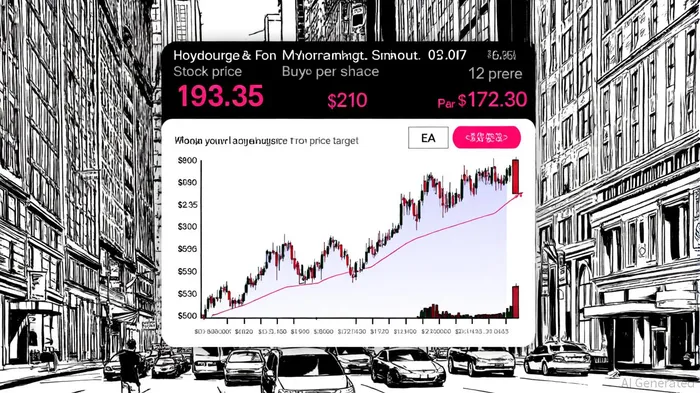







Comentarios
Aún no hay comentarios