
The Electric Marine Vehicle Revolution: Market Disruption and Early-Mover Opportunities
The electric marine vehicle (MEV) market is on the cusp of a transformative era, driven by environmental imperatives, technological breakthroughs, and regulatory momentum. With a projected compound annual growth rate (CAGR) of 17.1%, the global MEV market is expected to surge from $10.2 billion in 2025 to $41.5 billion by 2034, according to The Business Research Company report. This exponential growth underscores a critical inflection point for investors, as early adopters and innovators position themselves to dominate a sector poised to redefine global maritime transportation.
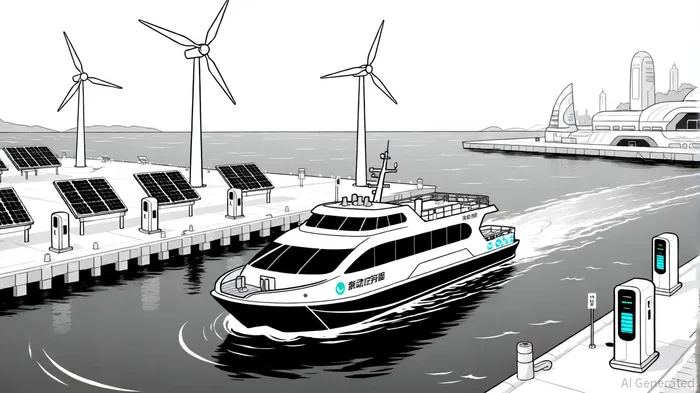
Market Disruption: From Niche to Mainstream
The MEV industry's rapid expansion is fueled by three interconnected forces: environmental regulation, battery innovation, and government incentives. According to The Business Research Company, the International Maritime Organization's (IMO) 2050 emission reduction targets have catalyzed a shift from diesel-powered vessels to hybrid and fully electric alternatives. For instance, the European Union's mandate for zero-emission ships by 2026 has already spurred investments in lithium-ion and solid-state battery systems, which now enable electric ferries to operate on routes with ranges exceeding 100 nautical miles, according to a Roots Analysis report.
Meanwhile, advancements in energy storage are addressing historical limitations. Companies like Corvus Energy, a leader in marine energy storage systems (ESS), have deployed over 1,300 hybrid and all-electric systems globally, avoiding an estimated 11 million tonnes of CO₂ emissions, as reported by The Energyst. Their recent $60 million Series E funding round, led by Morgan Stanley, highlights the sector's scalability and investor confidence, per a Morgan Stanley press release.
Early-Mover Advantage: Strategic Innovations and Market Capture
The race to dominate the MEV market is being led by firms leveraging technological differentiation and strategic partnerships. For example, Candela Technology AB's hydrofoiling electric ferries, such as the C-8 model, combine 69 kWh batteries with hydrodynamic lift to achieve 30-knot speeds and 57-nautical-mile ranges-outperforming traditional vessels in efficiency, according to The Green Boater. Similarly, X Shore's modular electric boats, equipped with 126 kWh lithium-ion systems, are redefining versatility for both leisure and commercial applications, per Tracxn.
Military and industrial sectors are also accelerating adoption. Hybrid-electric systems, which balance emission reductions with operational range, now account for 34% of the market, IMARC finds. In this space, Wärtsilä and ABB are pioneering integrated propulsion solutions, while startups like Fleetzero are disrupting cargo shipping with modular electric ships that reduce construction costs by up to 40%, according to a Spherical Insights piece.
Overcoming Barriers: Infrastructure and Cost Challenges
Despite its promise, the MEV market faces hurdles. High upfront costs-electric propulsion systems can be 2–3 times pricier than diesel equivalents-and limited charging infrastructure in remote areas remain significant barriers, per a MarkWide Research analysis. However, governments are mitigating these risks. The Connecticut Department of Energy and Environmental Protection (DEEP), for instance, has allocated $1 billion in federal funds to replace diesel engines with electric alternatives, according to Consegic Business Intelligence. Meanwhile, port authorities in Europe and Asia-Pacific are expanding shore power networks, with Norway's $1.2 billion investment in ferry charging infrastructure serving as a blueprint, as reported by GlobeNewswire.
Investment Outlook: Where to Position Capital
For investors, the MEV sector offers opportunities across three tiers:
1. Battery and ESS Providers: Firms like Corvus Energy and ElectrovayaELVA--, which supply critical energy storage solutions, are well-positioned to benefit from the IMO's decarbonization mandates (a Spherical Insights report highlights many leading suppliers).
2. Propulsion System Innovators: ABB and Torqeedo GmbH, with their advanced electric motors and hybrid systems, are capturing market share in commercial and leisure segments (industry analyses from Consegic and others document this trend).
3. Niche Disruptors: Startups such as Candela and X Shore, which prioritize design and efficiency, are attracting venture capital for their scalable, high-margin models (startup listings such as Tracxn identify these fast-growing companies).
Conclusion: A Blue Ocean for Visionary Investors
The electric marine vehicle revolution is not a distant future-it is unfolding now. With market leaders securing billions in funding and governments aligning policies to accelerate adoption, the window for early-mover advantage is narrowing. For investors, the key lies in identifying firms that combine technological leadership with strategic agility. As the sector matures, those who act decisively today will reap outsized rewards in a $41.5 billion market by 2034, according to the same report.





Comentarios
Aún no hay comentarios