
Elastic’s AI-Driven Growth Momentum and Strategic Positioning in Enterprise Search and Observability
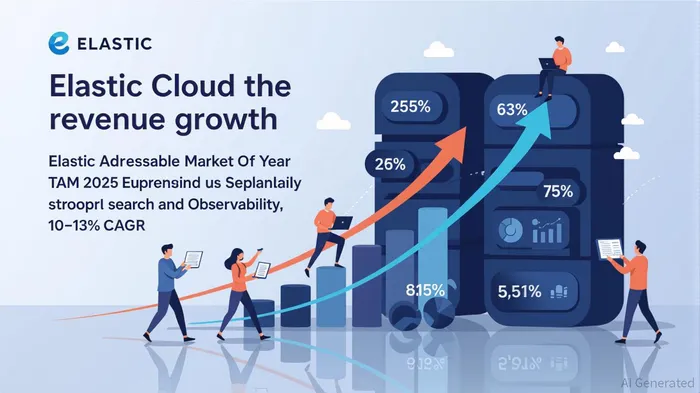
The rise of AI-native platforms is reshaping enterprise software, and ElasticESTC-- has emerged as a standout player in the AI-driven transformation of search and observability. With a 17% year-over-year revenue increase in Q3 FY2025—driven by 26% growth in Elastic Cloud—the company is capitalizing on surging demand for generative AI applications and platform consolidation in enterprise environments [1]. This momentum, coupled with strategic innovations and third-party validation, positions Elastic as a compelling long-term investment in the AI-native software stack.
Financial Performance and Cloud Transition
Elastic’s financials underscore its accelerating growth. Total revenue reached $382 million in Q3 2025, with Elastic Cloud contributing $180 million, reflecting a strategic shift toward cloud-first solutions [1]. This aligns with broader market trends: enterprises are prioritizing scalable, AI-enhanced observability tools to manage complex, cloud-native infrastructures. Elastic’s ability to deliver 26% YoY cloud revenue growth outpaces many peers, signaling strong customer retention and expansion within its core markets [2].
The company’s financial strength is further reinforced by its revised full-year 2026 guidance, projecting $1.679–$1.689 billion in revenue—a 14% growth rate at the midpoint [4]. This optimism stems from Elastic’s AI-driven innovations, which are addressing pain points in log retention, search accuracy, and real-time analytics. For instance, the Elastic Rerank Model improves search relevance by leveraging generative AI, while the logsdb index mode optimizes storage costs for log data [4]. These capabilities are critical as enterprises grapple with exponential data growth and the need for cost-efficient observability.
AI-Driven Innovation and Market Leadership
Elastic’s leadership in AI-native platforms is evident in its product roadmap and third-party recognition. The company was named a Leader in the 2025 Gartner® Magic Quadrant for Observability Platforms, praised for its AI Assistant’s ability to triage incidents using natural language and correlate logs, metrics, and traces [5]. This AI-driven approach reduces mean time to resolution (MTTR) for IT teams, a key differentiator in a market where downtime costs enterprises billions annually.
Similarly, Elastic’s Forrester Wave recognition in Security Analytics highlights its AI transparency and integration of SIEM, XDR, and cloud security into a unified platform [1]. Notably, the company achieved perfect scores in malware protection and real-world threat detection, attributes that resonate with enterprises seeking to streamline security operations amid rising cyber threats. These accolades validate Elastic’s ability to deliver AI-driven value across observability and security, two high-growth segments within its $88 billion total addressable market (TAM) [3].
Strategic Partnerships and TAM Expansion
Elastic’s strategic alliances are amplifying its AI-driven value proposition. A five-year partnership with AWS and integrations with GoogleGOOGL-- Cloud’s Vertex AI and MicrosoftMSFT-- Azure’s serverless infrastructure underscore its commitment to hybrid and multi-cloud flexibility [3]. These collaborations enable enterprises to deploy AI models for grounded prompts and low-latency querying, addressing the technical debt of legacy systems.
The TAM for enterprise search and observability is projected to grow at a 10–13% CAGR through 2030, with vector search and observability subsegments expanding even faster [3]. Elastic’s open-source Search AI Platform, which supports agentic workflows and Retrieval Augmented Generation (RAG), is well-positioned to capture this growth. By reducing lock-in and offering cost-optimized storage, Elastic is appealing to enterprises wary of vendor-specific AI solutions [5].
Investment Thesis: A Long-Term Play on AI-Native Platforms
Elastic’s trajectory reflects the broader shift toward AI-native software. Its financial performance, product innovation, and ecosystem partnerships align with long-term tailwinds in enterprise AI adoption. While challenges such as pricing complexity and technical expertise requirements persist [5], Elastic’s leadership in GartnerIT-- and Forrester reports—alongside its 20% YoY revenue growth in Q1 2026—demonstrate resilience and adaptability [4].
For investors, Elastic represents a unique opportunity to bet on the convergence of AI, observability, and security. As enterprises increasingly prioritize platforms that unify data, automate workflows, and reduce operational costs, Elastic’s AI-driven capabilities are likely to drive sustained revenue growth and market share expansion.
**Source:[1] Elastic Reports Third Quarter Fiscal 2025 Financial Results [https://ir.elastic.co/news/news-details/2025/Elastic-Reports-Third-Quarter-Fiscal-2025-Financial-Results/default.aspx][2] Elastic Reports Q3 Results with 26% Cloud Revenue Growth [https://www.efficientlyconnected.com/elastic-delivers-strong-q3-fiscal-2025-results-growth-driven-by-cloud-and-ai-initiatives/][3] Elastic's $88B TAM in Search, Observability and Security [https://www.genaitech.net/p/elastics-88b-tam-in-search-observability][4] Earnings call transcript: Elastic Q1 2026 results beat expectations [https://www.investing.com/news/transcripts/earnings-call-transcript-elastic-q1-2026-results-beat-expectations-stock-rises-93CH-4215725][5] Elastic Recognized as a Leader in 2025 Gartner® Magic Quadrant for Observability Platforms [https://www.businesswire.com/news/home/20250710345636/en/Elastic-Recognized-as-a-Leader-in-2025-Gartner-Magic-Quadrant-for-Observability-Platforms]





Comentarios
Aún no hay comentarios