
El Salvador's Strategic Bitcoin Reserve: A Model for Sovereign Crypto Asset Management?
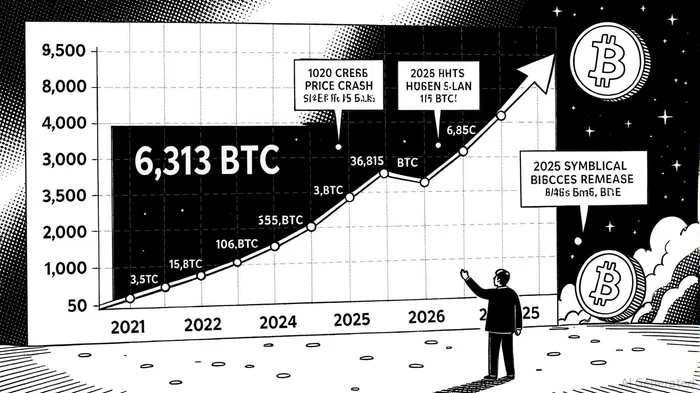
El Salvador’s adoption of BitcoinBTC-- as legal tender in September 2021 marked a bold experiment in sovereign crypto asset management. Four years later, the country holds 6,313 BTC, valued at over $701 million as of September 2025, despite volatility, international skepticism, and IMF-imposed fiscal constraints [1]. This case study raises a critical question: Can El Salvador’s approach serve as a blueprint for other nations seeking to integrate Bitcoin into their economic frameworks?
Value Retention: Navigating Volatility with Strategic Accumulation
El Salvador’s Bitcoin holdings have appreciated dramatically since 2021, with an average purchase price of $43,357 per BTC [2]. By August 2025, Bitcoin’s price surged past $122,780, pushing the value of El Salvador’s reserve to an estimated $746 million [3]. This growth reflects a disciplined strategy of “buying the dip,” as the government continued acquiring Bitcoin during the 2022 crash, when prices fell below $20,000 [4].
However, volatility remains a double-edged sword. While the 2025 price rally generated substantial unrealized gains, earlier losses during the 2022 downturn underscore the risks of holding a highly speculative asset as a reserve. To mitigate these risks, El Salvador diversified its holdings across 14 wallets, each containing no more than 500 BTC, reducing exposure to quantum computing threats and operational vulnerabilities [5]. This approach aligns with institutional best practices, such as cold storage and multi-signature security, but does not eliminate the inherent volatility of Bitcoin itself.
Policy Adaptability: Balancing IMF Pressure and Crypto Ambition
El Salvador’s Bitcoin policy has evolved under intense scrutiny from the IMF, which has long criticized the move as economically destabilizing. In January 2025, the country secured a $1.4 billion loan by agreeing to scale back Bitcoin’s role as legal tender, including removing the mandate for businesses to accept it and discontinuing the Chivo wallet program [6]. These concessions addressed IMF concerns about fiscal sustainability but did not signal a retreat from crypto.
Instead, El Salvador has pursued a parallel strategy of innovation. It launched a public dashboard to track Bitcoin transactions, enhancing transparency while avoiding address reuse [5]. The government also announced plans for a Bitcoin Bank, potentially positioning the country as a global hub for institutional crypto services [7]. These initiatives suggest a pragmatic approach: adapting to international pressure while maintaining a long-term commitment to Bitcoin as a strategic reserve asset.
Geopolitical Relevance: A Pioneer in Decentralized Finance
El Salvador’s adoption of Bitcoin has had broader geopolitical implications. By positioning itself as the first nation to integrate Bitcoin into its legal tender framework, the country has sparked a global conversation about the potential of decentralized finance to challenge traditional monetary systems. This move has resonated particularly in developing economies, where Bitcoin is seen as a tool for financial inclusion and remittance cost reduction [8].
The geopolitical stakes are further elevated by El Salvador’s collaboration with nations like Bolivia to explore shared regulatory frameworks for crypto [9]. While these efforts remain nascent, they hint at a future where regional cooperation could counterbalance the influence of traditional financial institutionsFISI--. Meanwhile, El Salvador’s tax-free policies for crypto transactions—eliminating capital gains, VAT, and property taxes—have attracted foreign investors, reinforcing its reputation as a crypto-friendly jurisdiction [10].
Conclusion: A Model in Progress
El Salvador’s Bitcoin reserve demonstrates both the potential and pitfalls of sovereign crypto asset management. The country’s ability to retain value despite volatility, adapt policies under IMF pressure, and influence global discourse positions it as a unique case study. However, challenges remain: Bitcoin’s limited adoption in daily transactions, ongoing liquidity constraints, and the risk of regulatory backlash from international bodies.
For El Salvador to serve as a true model, it must prove that Bitcoin can function as a stable, long-term reserve asset while balancing innovation with fiscal responsibility. As the world watches, the success of this experiment may hinge on whether other nations view El Salvador’s approach as a cautionary tale—or a glimpse into the future of decentralized finance.
Source:
[1] El Salvador celebrates Bitcoin milestone with symbolic 21 BTC purchase [https://cryptoslate.com/el-salvador-celebrates-bitcoin-milestone-with-symbolic-21-btc-purchase/]
[2] El Salvador's Bitcoin Holdings in 2025: How Much BTC Does... [https://www.btcc.com/en-US/square/ZenithLedgerUS/688710]
[3] Bitcoin Price History Chart + Historical Events 2009–2025 [https://99bitcoins.com/cryptocurrency/bitcoin/historical-price/]
[4] El Salvador's Bitcoin Bank: Could This $103,839 Coin Skyrocket Further? [https://www.interactivecrypto.com/el-salvadors-bitcoin-bank-could-this-103839-coin-skyrocket-further]
[5] Bitcoin El Salvador Holdings: How the Country is... [https://www.okx.com/en-us/learn/bitcoin-elsalvador-holdings-strategy]
[6] Bitcoin Banks Coming to El Salvador: But What's the Full Plan? [https://coincentral.com/bitcoin-banks-coming-to-el-salvador-but-whats-the-full-plan/]
[7] El Salvador's Bitcoin Bank: Could This $103,839 Coin Skyrocket Further? [https://www.interactivecrypto.com/el-salvadors-bitcoin-bank-could-this-103839-coin-skyrocket-further]
[8] Bitcoin is Digital Cash [https://erickimphotography.com/bitcoin-is-digital-cash/]
[9] The politics of capital mobility in dollarized economies [https://www.tandfonline.com/doi/full/10.1080/09692290.2024.2405162]
[10] TOP 10 Crypto Tax-Free Countries in 2025 - Global Overview [https://gofaizen-sherle.com/blog/crypto-tax-free-countries]






Comentarios
Aún no hay comentarios