
Ekovest Berhad's Ownership Structure: A Catalyst for Investor Confidence or a Hidden Risk?
Ownership Concentration and Corporate Governance
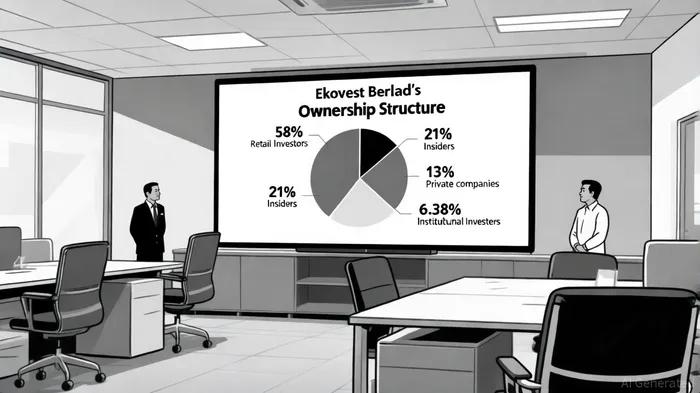
Ekovest's ownership structure is defined by a mix of retail investors, insiders, and private entities. Retail investors hold 58% of the shares, according to Yahoo Finance, granting them significant influence over corporate decisions such as dividend policies and board appointments. This broad base of smaller shareholders could theoretically democratize governance, but it also risks fragmented decision-making and susceptibility to short-term market sentiment.
Insiders, including top executive Kang Lim, collectively own 21% of the company, with Lim personally controlling 18% of shares outstanding. Such high insider ownership typically aligns management with shareholder interests, as executives stand to gain from long-term value creation. However, it also raises concerns about potential conflicts of interest, particularly in a company of Ekovest's relatively small size. For instance, the absence of a majority institutional investor-private companies hold 13% and institutions 6.38%-means that insiders and retail investors dominate corporate governance. This dynamic could lead to decisions prioritizing short-term gains over sustainable growth, especially if retail shareholders demand immediate returns.
The role of private entities like Ekovest Holdings Sdn Bhd (10% stake) and Lim Seong Hai Holdings Sdn Bhd (2.9% stake) further complicates the picture. While these entities may provide strategic continuity, their limited presence compared to retail investors suggests a lack of institutional oversight. This could weaken checks and balances, particularly in a sector like capital goods, where long-term project execution is critical.
Share Price Performance and Institutional Investor Behavior
Ekovest's share price has exhibited mixed performance from 2023 to 2025. As of October 2025, the stock trades at MYR 0.41, with a 52-week range of RM0.24 to RM0.47. Despite a 9.46% monthly gain and an 8% annual increase, the stock recently tumbled 26%, reflecting volatility tied to its ownership structure. The beta of 0.52 indicates lower volatility than the broader market, but this may mask underlying risks tied to governance and financial performance.
Institutional investors, while present, do not dominate the ownership landscape. No single institutional investor holds a majority stake, according to Simply Wall St, and the company lacks hedge fund backing or extensive analyst coverage. This suggests limited institutional confidence, which could deter large-scale capital inflows. Conversely, the absence of heavy institutional pressure might allow management to pursue long-term strategies without short-term performance pressures.
The company's financials further complicate the narrative. While Q3 2025 saw a 30.76% year-over-year profit increase and a year-to-date loss of RM30.427 million, according to Chenpak, high financing costs-particularly for toll operations-have eroded profitability. Retail investors, who hold 58% of shares, may react strongly to such earnings fluctuations, exacerbating share price volatility.
Risk Factors and Industry Benchmarks
Ekovest's ownership structure diverges from typical benchmarks in the capital goods industry. Most Malaysian firms in this sector maintain a balance between institutional and retail ownership, with institutional investors often providing governance stability. Ekovest's reliance on retail shareholders, however, introduces risks such as liquidity constraints and herd behavior during market downturns.
The company's insider ownership (21%) also sits at the higher end of industry norms. While this can incentivize management to act in shareholders' best interests, it may also lead to overconfidence in strategic decisions. For example, Ekovest's property development projects, such as EkoTitiwangsa, require significant capital outlays and long timelines. If these initiatives underperform, the concentrated ownership structure could amplify losses for retail investors and strain trust in management.
Conclusion: Catalyst or Risk?
Ekovest Berhad's ownership structure presents a dual-edged sword. On one hand, the alignment of insider and retail investor interests could drive accountability and long-term value creation. On the other, the lack of institutional oversight and the dominance of retail shareholders may lead to governance inefficiencies and heightened share price volatility.
For investors, the key lies in balancing these factors. The company's recent financial turnaround in Q3 2025 (per Chenpak) and strategic focus on property development offer growth potential, but its high financing costs and ownership concentration remain red flags. As Ekovest navigates its next phase, stakeholders must monitor how governance dynamics evolve-particularly whether insider influence translates into sustainable performance or becomes a drag on investor confidence.







Comentarios
Aún no hay comentarios