
Edwards Lifesciences: Cementing Leadership in the Structural Heart Disease Revolution
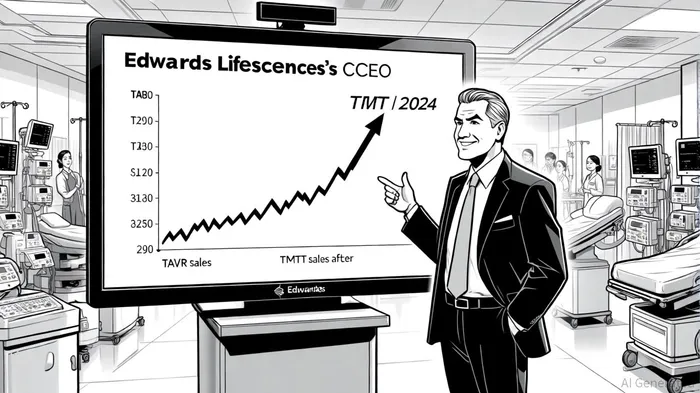
The structural heart disease market is undergoing a seismic shift, driven by an aging global population, rising prevalence of valvular heart diseases, and the rapid adoption of minimally invasive therapies. At the center of this transformation is Edwards Lifesciences CorporationEW-- (EW), a company that has not only adapted to the evolving landscape but has actively reshaped it. With a commanding position in Transcatheter Aortic Valve Replacement (TAVR) and a breakout performance in Transcatheter Mitral and Tricuspid Therapies (TMTT), Edwards is accelerating its dominance in a market projected to grow at a compound annual rate of 9.24% through 2030[1].
Market Dynamics and Edwards' Strategic Position
According to a report by Mordor Intelligence, the structural heart devices market reached $13.81 billion in 2025, with Edwards LifesciencesEW-- securing a dominant share, particularly in TAVR[1]. While some sources estimate its TAVR market share at 54%[4], others, including industry analysts, suggest it has crept closer to 60%[1]. This discrepancy reflects the company's relentless innovation and its ability to capture demand across risk categories. For instance, the SAPIEN 3 Ultra RESILIA platform, approved for asymptomatic patients in both the U.S. and Europe, has broadened the addressable market for TAVR, enabling Edwards to outpace competitors like MedtronicMDT-- (28% TAVR share) and Abbott[1].
The company's Q1 2025 results underscore this momentum. Total sales hit $1.41 billion, a 6.2% year-over-year increase, with TAVR sales alone contributing $1.05 billion—a 3.8% rise driven by RESILIA adoption[4]. Meanwhile, the TMTT segment, once a nascent market, has become a growth engine. Sales surged 58% year-over-year to $115 million in Q1 2025, fueled by the PASCAL and EVOQUE systems[4]. Management has since raised full-year TMTT guidance to $530 million to $550 million, signaling confidence in sustained demand[4].
Innovation as a Growth Catalyst
Edwards' leadership is not merely a function of market share but of strategic innovation. The recent CE Mark approval for the SAPIEN M3 transcatheter mitral valve replacement system exemplifies this. By entering the high-growth mitral valve disease segment—a market expected to expand rapidly as transcatheter techniques replace surgical interventions—Edwards is positioning itself to capture a critical share of a $3.2 billion opportunity by 2030[1].
This innovation pipeline is critical in an increasingly competitive landscape. Medtronic and AbbottABT-- have made inroads with their own TAVR and TMTT platforms, while Boston ScientificBSX-- has carved out a niche in left atrial appendage closure devices[2]. Yet, Edwards' first-mover advantage and regulatory approvals give it a step up. As stated by a Monexa.ai blog post, the company's “expanding portfolio and regulatory milestones” are key differentiators in a market where speed to market often determines success[2].
Challenges and Strategic Resilience
Despite its strengths, Edwards faces headwinds. Margin pressures loom as pricing negotiations with payers intensify, particularly in the U.S. and Europe. Additionally, the TMTT segment, while high-growth, is capital-intensive and requires ongoing investment in clinical trials and physician training. Data from Monexa.ai indicates that Edwards is addressing these challenges through cost optimization and strategic partnerships, ensuring that its growth does not come at the expense of profitability[3].
Moreover, the company's Q2 2025 results—showing 11% year-over-year revenue growth—demonstrate its ability to balance innovation with operational discipline[1]. By raising full-year revenue guidance to 9–10%, management has signaled confidence in navigating these pressures while maintaining its growth trajectory[1].
Conclusion: A Compelling Investment Thesis
For investors, Edwards Lifesciences represents a rare confluence of market leadership, innovation, and scalable growth. Its dominance in TAVR is secure, but its TMTT expansion and foray into mitral valve replacement are what make it a standout. While competition is intensifying, the company's regulatory agility, product pipeline, and financial discipline position it to outperform peers.
As the structural heart disease market evolves, Edwards is not just keeping pace—it is setting the pace. For those seeking exposure to a sector poised for decades of growth, EW offers a compelling case: a company that turns medical innovation into shareholder value.





Comentarios
Aún no hay comentarios