
Is EDP (ENXTLS:EDP) a Value Opportunity Amid Regulatory and Currency Risks?
Valuation Dislocation: A Mixed Signal
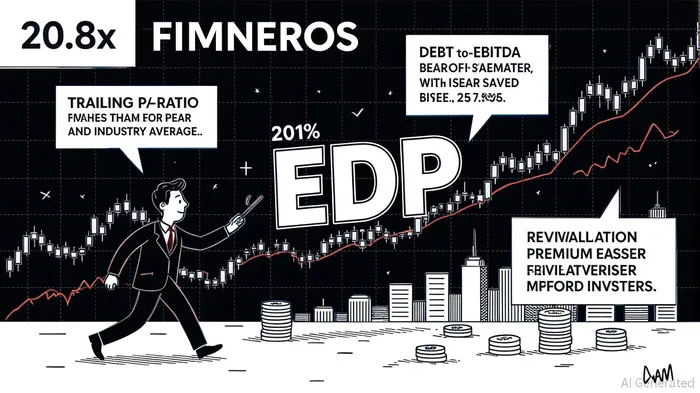
EDP (ENXTLS:EDP) presents a complex valuation profile. While its trailing P/E ratio of 20.8x suggests a premium to both its peer average (16.6x) and the industry average (12.4x) , a discounted cash flow (DCF) analysis indicates the stock is trading above its intrinsic value of €3.25, at €3.76 as of September 2025 . This 15.6% premium raises questions about whether the market is overestimating EDP's growth potential. However, analysts' 12-month price target of €4.27 implies a potential 11.8% undervaluation relative to intrinsic value , creating a paradox that warrants closer scrutiny.
The company's balance sheet further complicates the valuation narrative. EDP carries €22.4 billion in total debt, with net debt of €19.2 billion after accounting for €3.18 billion in cash reserves . A debt-to-EBITDA ratio of 4.7x and an EBIT interest coverage ratio of 3.0x suggest manageable leverage but highlight vulnerabilities. For instance, declining profit margins—from 8.5% in 2024 to 4.8% in Q2 2025 —signal operational inefficiencies that could strain earnings and amplify debt risks.
Strategic Resilience: Navigating Regulatory and Currency Risks
EDP's exposure to regulatory and currency risks is significant, particularly through its UK subsidiary, EDF Energy, which operates under a Contract for Difference (CfD) mechanism for the Hinkley Point C nuclear project . This long-term agreement guarantees revenue stability by compensating the operator when market prices fall below a strike price, but it also locks EDP into performance thresholds (e.g., a 91% load factor) . While this mitigates short-term price volatility, it exposes the company to currency fluctuations and regulatory shifts in the UK energy market.
To counter these risks, EDP has adopted proactive strategies. Between FY24 and FY25, the company implemented measures to address political and regulatory uncertainties, including hedging currency exposures and diversifying its renewable energy portfolio . These initiatives align with broader industry trends toward decarbonization and grid resilience, which could insulate EDP from macroeconomic shocks. For example, its renewable energy armARM--, EDP Renováveis (EDPR), trades at a P/S ratio of 4.9x and an enterprise value to EBITDA of 22.3x , reflecting investor confidence in its long-term growth trajectory despite short-term volatility.
The Investment Dilemma: Overvaluation or Strategic Premium?
The key question for investors is whether EDP's valuation premium is justified by its strategic resilience. On one hand, the company's high P/E ratio and debt load suggest overvaluation. On the other, its proactive risk management and exposure to high-growth renewable energy markets could offset regulatory and currency headwinds. For instance, EDPR's enterprise value to revenue of 10.2x indicates that the market is willing to pay a premium for its renewable assets, which may become increasingly valuable as global energy transition policies accelerate.
However, EDP's recent operational performance—such as Q2 2025 earnings of €0.10 per share, below analyst expectations —underscores the need for caution. While the company's debt is currently manageable, its cash burn over the past three years raises concerns about liquidity risks . Investors must weigh these factors against the potential for regulatory tailwinds, such as the CfD mechanism, which could stabilize cash flows in the long term.
Conclusion
EDP (ENXTLS:EDP) occupies a precarious position at the intersection of valuation dislocation and strategic resilience. While its P/E ratio and debt metrics suggest overvaluation, its proactive risk mitigation strategies and exposure to renewable energy growth could justify the premium for long-term investors. However, the company's declining profit margins and regulatory dependencies necessitate close monitoring. For those willing to navigate these complexities, EDP may represent a high-conviction opportunity—but only if its strategic initiatives translate into sustainable earnings growth.







Comentarios
Aún no hay comentarios