
U.S. Economic Resilience and Crypto Market Correlation Amid Political and Fiscal Uncertainty
Labor Market Trends: A Mixed Picture of Resilience
The U.S. labor market in September 2025 exhibited signs of both resilience and fragility. The unemployment rate rose to 4.3%, the highest in nearly four years, driven by sluggish labor demand and the lingering effects of protectionist trade policies. Meanwhile, job openings in the JOLTS report for August 2025 fell to 7.1 million, a marginal decline from 7.181 million the prior month. These figures suggest a labor market that, while not in freefall, is struggling to meet the Fed's breakeven rate for job gains.
Average hourly earnings data, a critical component of the nonfarm payrolls report, remained unreported as of November 18, 2025, due to delays linked to the government shutdown. This absence of data has created a vacuum in market expectations, with traders speculating on whether wage growth could signal inflationary pressures or a soft landing. Historically, positive surprises in nonfarm payrolls have driven BitcoinBTC-- higher by up to 5% within 24 hours, but the current environment-marked by fiscal gridlock-complicates such correlations.
Fiscal Gridlock and Crypto's Role as a "Front-End Sensor"
The 2025 U.S. government shutdown, which froze non-essential federal spending and disrupted key economic data releases, had an immediate and severe impact on crypto markets. Bitcoin plummeted over 20% from its October high, while altcoins experienced even sharper declines. This reaction underscores crypto's role as a "front-end sensor" of U.S. dollar liquidity and fiscal policy uncertainty. The Treasury General Account (TGA), a measure of federal reserves, became a critical indicator for crypto participants: as the TGA expanded during fiscal tightness, risk appetite in crypto waned.
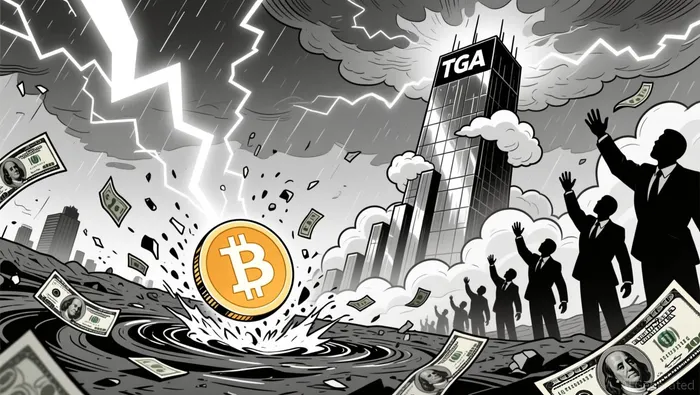 The shutdown also highlighted crypto's sensitivity to liquidity constraints. With the Bureau of Labor Statistics halting data collection during the funding freeze, market participants were left to navigate a landscape of heightened uncertainty. This dynamic mirrors the October 2025 flash crash, which was linked to excessive leverage in crypto derivatives and institutional-grade infrastructure challenges. While regulatory clarity in 2025 spurred institutional interest-71% of traditional hedge funds planned to increase crypto allocations- the sector's volatility remains a double-edged sword.
Crypto as a Hedge or Speculative Play?
The case for crypto as a hedge against fiscal uncertainty is bolstered by its 24/7 trading model and lack of political buffers. During the 2025 shutdown, crypto repriced risk in real time, adjusting exposure and reducing leverage as liquidity constraints emerged. However, the same attributes that make crypto a speculative asset-its high volatility and sensitivity to macroeconomic shifts-also expose it to sharp corrections.
Institutional adoption, while growing, has not yet insulated crypto from systemic shocks. The October flash crash demonstrated that even with increased participation from traditional funds, the sector remains vulnerable to cascading liquidations. For individual investors, the question is whether the current macroeconomic environment justifies exposure to crypto as a hedge or speculative play.
Conclusion: Navigating the Crossroads
The September 2025 jobs data, delayed by fiscal gridlock, remains a critical unknown. If the eventual release shows a soft landing-modest wage growth and stable unemployment-crypto could benefit from risk-on sentiment. However, the broader context of political dysfunction and liquidity constraints suggests that any rally would be short-lived and highly volatile.
For investors, the key lies in balancing macroeconomic signals with risk management. While crypto's role as a hedge against fiscal uncertainty is evident, its speculative nature demands caution. Immediate exposure should be limited to those with a high risk tolerance and a clear understanding of the interplay between U.S. fiscal policy and crypto's liquidity dynamics. In a world where the Fed's policy lags and government shutdowns disrupt data flows, crypto remains a barometer of uncertainty-a tool for hedging, but not a guaranteed safe haven.







Comentarios
Aún no hay comentarios