
The Economic and Political Risks of Trump's $2,000 Tariff Dividend Proposal
Feasibility: A Revenue Gap and Legal Uncertainty
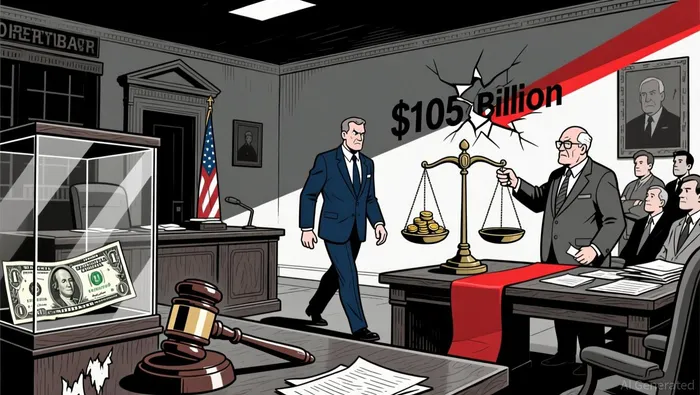
According to a Bloomberg report, Trump's proposal requires $300 billion to distribute $2,000 checks to 150 million individuals earning $100,000 or less. However, tariff revenue in fiscal year 2025 has only generated approximately $195 billion, leaving a $105 billion shortfall, as Investopedia noted. Treasury Secretary Scott Bessent has hinted that the dividend might instead materialize as tax cuts, such as exemptions for tips and overtime, rather than direct payments, as ABC News reported.
Compounding the issue is the legal challenge to the tariffs themselves. The Supreme Court is set to rule on whether Trump's unilateral imposition of tariffs under the 1977 International Emergency Economic Powers Act (IEEPA) is constitutional. Chief Justice John Roberts has already criticized the tariffs as an "imposition of taxes on Americans," emphasizing that Congress holds the authority to levy such taxes, as CBS News reported. If the Court invalidates the tariffs, the administration may be forced to refund businesses, further straining the projected revenue base, as CBS News reported.
Sector-Specific Impacts and Market Volatility
The tariffs, which include 25% levies on goods from Canada and Mexico and 10% on Chinese imports, have already triggered sector-specific disruptions. For instance, California-a state heavily reliant on cross-border trade-faces a potential economic hit as imported goods like gas, alcohol, and meat become more expensive, as The Desert Sun reported. The Center for American Progress notes that sectors such as automotive, healthcare, and consumer goods are particularly vulnerable, with households projected to spend an additional $1,800 annually on tariff-affected goods, as CBS News reported.
Market volatility has followed. In the past quarter, tech stocks like Palantir Technologies (PLTR) saw sell-offs amid investor concerns over supply chain disruptions and geopolitical risks, as GuruFocus reported. Similarly, crypto markets experienced outflows from BitcoinBTC-- and EthereumETH-- ETFs as macroeconomic uncertainty persisted, as CryptoNews reported. These trends underscore the dual pressures of inflationary costs and policy-driven uncertainty.
Investment Strategies: Hedging Against Policy Uncertainty
Experts recommend a diversified approach to mitigate risks. For traditional sectors, ETFs targeting less tariff-exposed areas-such as utilities (XLU) and financials (XLF)-offer a buffer, as Greenbush Financial reported. Inflation-protected bonds and gold are also gaining traction as hedges against rising prices, as Greenbush Financial reported.
Meanwhile, crypto investors are adopting unconventional strategies. Eric Trump-backed American Bitcoin Corp. has increased its Bitcoin holdings to over 4,004 BTC through mining and strategic purchases, capitalizing on market selloffs, as CoinSpeaker reported. The TRUMP meme coin has also surged 15.7% amid speculation about a spot ETF and politically driven headlines, as CoinSpeaker reported.
Conclusion: Navigating a High-Stakes Landscape
Trump's tariff dividend proposal sits at the intersection of economic ambition and political risk. For investors, the key lies in balancing short-term hedging-such as sector rotation and fixed-income allocations-with long-term resilience through diversified portfolios. As the Supreme Court's decision looms and global trade tensions persist, the ability to adapt to shifting policy landscapes will remain critical.






Comentarios
Aún no hay comentarios