
The Economic and Market Implications of Trump’s Recurring Tariff Policy and Refund Risks
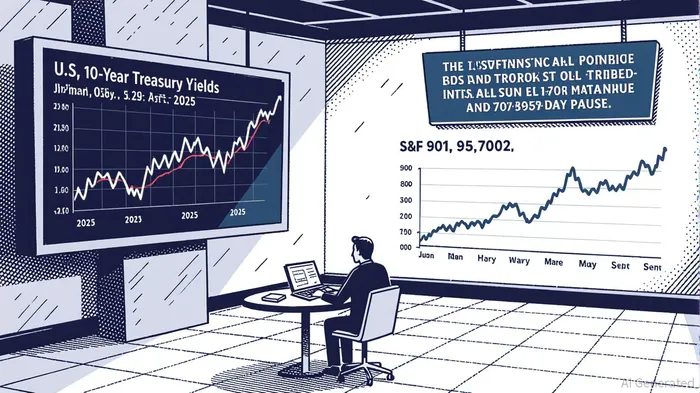
The recurring tariff policies under the Trump administration have emerged as a defining force in global financial markets, creating a volatile landscape marked by uncertainty, legal battles, and shifting investor sentiment. As the U.S. Treasury market grapples with conflicting pressures—rising inflationary expectations and slowing growth forecasts—investors are recalibrating portfolios to navigate the risks of a potential trade war. Meanwhile, global equity and bond markets have shown resilience, albeit with sector-specific vulnerabilities and evolving safe-haven dynamics. This analysis examines the interplay between Trump’s tariff strategies, refund risks, and their implications for Treasury volatility and market stability.
Treasury Market Volatility: A Tug-of-War Between Inflation and Growth
The imposition of sweeping tariffs on April 2, 2025, triggered an immediate spike in U.S. 10-year Treasury yields, as markets priced in inflationary pressures and a more hawkish Federal Reserve stance. According to a report by BlackRockBLK--, the yield surged by over 50 basis points within days, reflecting investor fears of renewed inflation amid supply chain disruptions [3]. However, the subsequent 90-day tariff pause provided temporary relief, allowing yields to stabilize as growth expectations softened [5].
Legal challenges further complicated the landscape. A May 2025 ruling by the U.S. Court of International Trade (CIT) declared most of Trump’s tariffs illegal, yet the administration’s exploration of alternative legal mechanisms—such as Sections 338 and 232 of the U.S. Trade Act—kept market expectations of continued tariffs alive [2]. This legal ambiguity created a “drift and dash” pattern in Treasury markets, where inflationary pressures (pushing up yields) clashed with slowing growth expectations (pulling down yields). As noted by LPL Research, this tug-of-war has made Treasury markets highly sensitive to policy developments, with foreign investors re-evaluating U.S. asset exposure amid tariff-related risks [2].
Global Equity and Bond Market Resilience Amid Trade Tensions
While U.S. equities faced sharp volatility, global markets demonstrated resilience in Q2 2025. The S&P 500 rebounded by 10.9% after the 90-day tariff pause, driven by growth and small-cap stocks [1]. European equities, particularly in Germany, also outperformed, with the MSCIMSCI-- Germany index reporting 16.8% earnings growth [2]. Fixed income markets fared equally well, with European government bonds outperforming U.S. Treasuries and emerging market bonds showing solid gains [1].
However, sector-specific vulnerabilities persist. The technology sector, for instance, faces bottlenecks due to export curbs and tariffs, delaying advanced chip production and increasing costs for firms like IntelINTC-- [2]. Conversely, financial institutionsFISI-- have capitalized on volatility, with Goldman SachsGS-- reporting a 15% year-on-year increase in trading income [2]. Safe-haven assets like gold have surged, hitting record highs in 2025 as ETF inflows totaled $21 billion, reflecting a shift toward monetary sovereignty amid the weaponization of financial systems [2].
Refund Risks and Fiscal Implications
The potential for tariff refunds adds another layer of complexity. If courts uphold the illegality of Trump’s tariffs, importing companies could reclaim hundreds of billions in payments, though consumers—indirectly burdened by higher prices—would not benefit [1]. For businesses, refunds present both opportunities and risks: small and medium-sized enterprises might reinvest savings or reduce prices, but there is no guarantee they will pass on benefits [1].
From a fiscal perspective, refunding such a large amount would strain the federal budget, exacerbating an already substantial deficit [1]. This uncertainty has prompted businesses to retain records of tariff-related payments and consult tax professionals, as advised by legal experts [1]. For investors, the refund risks underscore the fragility of policy-driven revenue streams and the need for contingency planning.
Investment Strategies in a Volatile Environment
The current environment demands a nuanced approach to portfolio construction. Diversification into bonds and liquid alternatives—such as market-neutral funds—has proven effective in mitigating equity volatility. BlackRock highlights that the BlackRock Global Equity Market Neutral Fund delivered positive returns during the S&P 500’s correction, illustrating the value of hedging strategies [3]. Institutional investors have also shifted toward safe-haven assets like gold and sukuk, which consistently act as reliable hedges during geopolitical threats [1].
Active management is increasingly critical. J.P. Morgan Research warns that ongoing trade policy could trigger a broad-based downshift in global growth, necessitating nimble portfolio adjustments [4]. Lower volatility equity strategies and sector rotation—favoring resilient industries like AI-driven tech—may offer better downside protection [5].
Conclusion
Trump’s recurring tariffs and refund risks have created a volatile yet dynamic market environment. While Treasury markets remain sensitive to policy shifts, global equities and bonds have shown resilience through diversification and strategic hedging. Investors must balance the risks of inflationary pressures and legal uncertainties with opportunities in safe-haven assets and adaptive portfolio strategies. As trade tensions persist, the ability to navigate policy-driven volatility will define long-term investment success.
**Source:[1] Trump Tariffs Could Be Overturned: Companies May Get ... [https://www.eliteconsultingpc.com/blogs/chicago-tax-consulting-cpa-firm-blog/1393528-trump-tariffs-could-be-overturned-companies-may-get-billions-in-tax-refunds][2] Will Tariffs and Market Volatility Continue Under Trump? [https://www.lpl.com/research/weekly-market-commentary/tariffs-and-market-volatility-likely-to-stick.html][3] Tariff uncertainty: Impacts on markets and portfolios - BlackRock [https://www.blackrock.com/us/financial-professionals/insights/tariffs-and-investment-portfolios][4] Mid-year market outlook 2025 | J.P. Morgan Research [https://www.jpmorganJPM--.com/insights/global-research/outlook/mid-year-outlook][5] Lessons From Financial Markets Since Liberation Day [https://www.cfr.org/article/lessons-financial-markets-liberation-day]





Comentarios
Aún no hay comentarios