
The Economic and Market Implications of the U.S. Government Funding Deal
Defense: A Strategic Bet on Supply Chain Independence
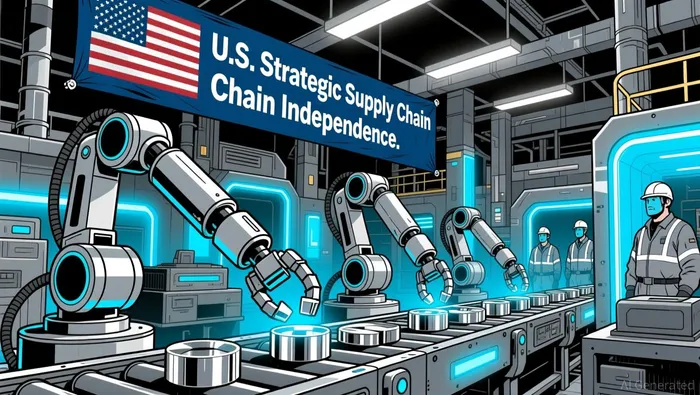
The Department of Defense (DoD) has made a bold move to secure U.S. rare earth magnet production through a multibillion-dollar partnership with MP Materials, a critical materials producer. This includes a $400 million investment in preferred stock and a 10-year off-take agreement for 100% of magnets produced at MP's new facility, as reported in a BusinessWire announcement. The deal is a direct response to geopolitical risks in global supply chains and signals a shift toward domestic self-sufficiency.
For investors, this partnership highlights the DoD's prioritization of strategic industries. Companies like Karman Space & Defense and Velo3D are already benefiting from sustained defense spending, with KarmanKRMN-- reporting a 41.7% year-over-year revenue jump in a BusinessWire report and Velo3DVELO-- reaffirming its 2025 revenue targets in a Seeking Alpha article. The DoD's focus on hypersonic and missile defense programs further underscores a long-term commitment to modernization, creating tailwinds for firms with niche capabilities in advanced manufacturing and cybersecurity.
Agriculture: Preserving Research Amid Staffing Cuts
The USDA's Agricultural Research Service (ARS) and National Institute of Food and Agriculture (NIFA) have retained their $3.5 billion funding for research programs, according to a GovExec analysis, a rare win in an era of proposed cuts. This stability is critical for ag-tech innovation, particularly as climate resilience and food security dominate global agendas. However, the Trump administration's staffing reductions-$415 million less in salaries for USDA and FDA-could slow implementation of new policies, as noted in the same GovExec analysis.
Investors should watch for opportunities in companies supporting international food aid, such as the McGovern-Dole Food for Education program, which remains funded, as reported in the GovExec analysis. These programs not only stabilize global markets but also create demand for U.S. agricultural exports. The sector's resilience is further bolstered by private-sector moves, like Northwest Healthcare Properties REIT streamlining operations to reinvest in healthcare infrastructure, as detailed in a Yahoo Finance report, which indirectly supports rural economies.
Healthcare: A Funding Vacuum and Private Sector Innovation
The 2025 funding deal has left healthcare in a limbo. While the Senate passed a temporary bill to reopen the government, it notably omitted extensions for Affordable Care Act (ACA) subsidies, sparking fierce criticism from Democrats, as reported in a Yahoo News article. This omission could lead to higher insurance premiums for 22 million enrollees, creating uncertainty for healthcare providers and insurers.
Yet, the private sector is stepping in. Fortis Healthcare Limited in India reported a 41.7% revenue surge in Q3 2025, as detailed in a Marketscreener report, while IHH Healthcare Berhad expanded its stake in Fortis, signaling confidence in emerging markets. Meanwhile, Northwest Healthcare Properties REIT is leveraging its strong balance sheet to simplify operations and reinvest in accretive projects, as described in the Yahoo Finance report. These moves suggest that private healthcare infrastructure-rather than federal programs-may drive growth in the near term.
The lack of HHS-specific funding in the deal also opens the door for private equity and venture capital to fill gaps in medical innovation, particularly in areas like telehealth and AI diagnostics.
Strategic Positioning for Investors
The 2025 funding deal is less about immediate fiscal relief and more about long-term strategic realignment. For defense, the focus on supply chain independence creates a "buy-the-whisper" opportunity in rare earths and advanced manufacturing. Agriculture remains a defensive bet, with research funding acting as a buffer against staffing cuts. Healthcare, meanwhile, is a mixed bag-public-sector uncertainty contrasts with private-sector dynamism, making diversified exposure key.
Investors should prioritize companies with direct ties to DoD contracts, ag-tech R&D partnerships, and healthcare REITs with strong operational flexibility. As the funding debate continues, agility will be the most valuable asset.





Comentarios
Aún no hay comentarios