
The Economic Feasibility and Political Risks of Trump's Tariff-Funded Dividend Plan: Implications for U.S. Markets and Investor Strategy in a High-Inflation, High-Debt Environment
The Fiscal Arithmetic of the Tariff Dividend Plan
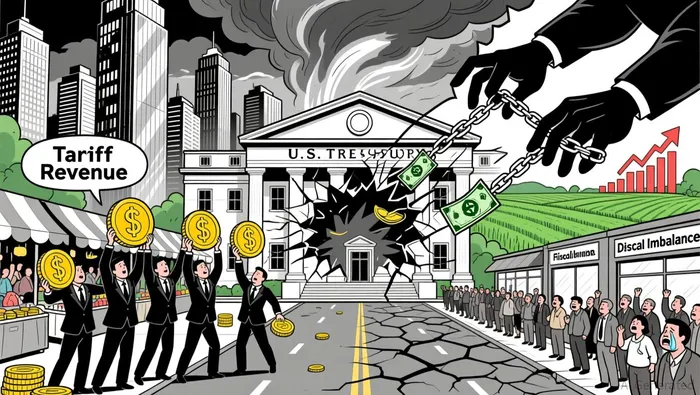
At its core, the plan hinges on a critical mismatch between revenue and cost. According to a report by the Committee for a Responsible Federal Budget (CRFB), the $2,000 dividend would cost approximately $600 billion annually-far exceeding the projected $158.4 billion in 2025 tariff revenue and the Treasury's $195 billion in customs duties for the same period according to the CRFB report. Even under optimistic assumptions, such as phased-out income thresholds and inclusion of dependents, the cost remains unsustainable. The CRFB estimates that this shortfall would push the national debt to 127% of GDP by 2035 under a revenue-neutral model or 134% if rebates are distributed annually according to CRFB analysis.
Economists warn that the plan's fiscal impracticality could exacerbate inflationary pressures. Tariffs inherently raise import prices, and the administration's 17.6% average tariff rate on goods is projected to reduce long-run U.S. GDP by 0.6% before foreign retaliation, with an additional 0.2% drag if retaliation occurs according to the Tax Foundation. The Penn Wharton Budget Model (PWBM) forecasts an even steeper 6% GDP reduction and a 5% wage decline, with middle-income households facing a $22,000 lifetime loss according to PWBM analysis. These macroeconomic headwinds, combined with the deficit-driven debt expansion, create a volatile backdrop for markets.
Political Feasibility: A Divided GOP and Legislative Hurdles
The plan's political viability is equally uncertain. Key Republican lawmakers, including House Budget Committee Chairman Jodey Arrington and Senate Majority Leader John Thune, have criticized the proposal as fiscally reckless. Arrington advocates using tariff revenue to reduce the deficit, while others warn of inflationary risks and fiscal strain according to Bloomberg reporting. Notably, five Republican senators have publicly endorsed debt reduction over direct rebates according to Coloradoan reporting.
Legal experts further complicate the plan's implementation, emphasizing that Trump cannot unilaterally distribute funds without congressional approval according to Coloradoan reporting. This legislative bottleneck underscores the broader GOP divide: while Trump frames the dividend as a populist win, fiscal conservatives prioritize deficit reduction. The lack of consensus not only delays the plan but also amplifies market uncertainty, as investors grapple with the likelihood of policy shifts or compromises.
Market Implications: Volatility, Inflation, and Investor Adaptation
The economic and political turbulence surrounding the tariff dividend plan has already influenced market dynamics. Trump's tariffs, averaging 17.6% on imports, are projected to raise $2.3 trillion in revenue over a decade but could reduce GDP by 0.6% in the long run according to the Tax Foundation. This creates a paradox: while tariffs generate revenue, they also drive inflation and erode consumer purchasing power. BlackRock notes that a 20% effective tariff increase could reduce growth by 2–2.5%, with higher goods prices creating a negative wealth effect on spending according to BlackRock analysis.
For investors, the high-inflation, high-debt environment demands strategic recalibration. Morgan Stanley advises diversifying into short-term fixed income and real assets like commodities to hedge against inflation according to Morgan Stanley research. T. Rowe Price recommends international value and small-cap equities in regions with dovish monetary policy and expanding fiscal spending according to T. Rowe Price insights. Additionally, shorter-duration assets and Treasury inflation-protected securities (TIPS) are favored to manage duration and inflation risks according to T. Rowe Price insights.
The volatility generated by policy uncertainty also opens opportunities for income-focused strategies. Options traders are increasingly exploiting volatility premiums through covered calls and iron condors, capitalizing on range-bound market conditions according to Yale Budget Lab research. However, the dual forces of potential consumer stimulus (via tax cuts or rebates) and inflationary pressures create contradictory market signals, necessitating nimble, adaptive approaches.
Conclusion: Navigating a High-Risk, High-Reward Landscape
Trump's tariff dividend plan epitomizes the tension between populist economic promises and fiscal reality. For investors, the key lies in balancing defensive strategies-such as TIPS, commodities, and short-term bonds-with tactical opportunities in volatile markets. As the administration navigates political and economic headwinds, the interplay of high inflation, rising debt, and trade policy will remain central to portfolio resilience. In this environment, adaptability and diversification are not just prudent-they are imperative.







Comentarios
Aún no hay comentarios