
Ecolab's CIP IQ™ and 4T2 Sensors: A Strategic Leap Toward Dominating Smart Cleaning and Sustainability
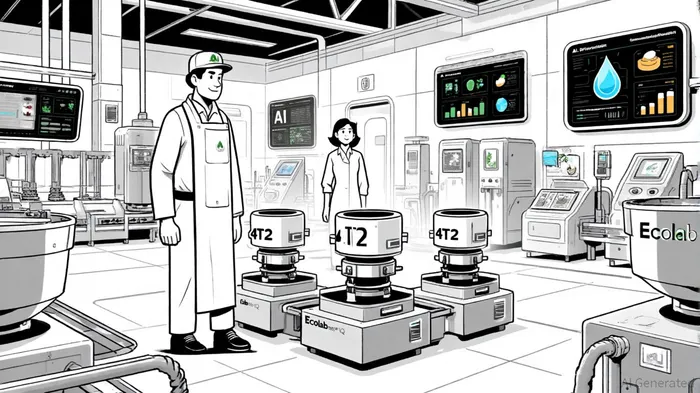
In an era where sustainability and operational efficiency are no longer optional but existential imperatives for industrial players, EcolabECL-- has positioned itself as a trailblazer with the September 2025 launch of its Ecolab® CIP IQ™ system. This AI-enhanced clean-in-place (CIP) digital solution, developed in partnership with 4T2 Sensors, represents a paradigm shift in industrial hygiene and resource management. By integrating 4T2's patented fluid sensing technology into its 3D TRASAR™ sensors, Ecolab has created a system that dynamically optimizes CIP processes using real-time fluid fingerprinting. According to a report by Yahoo Finance, this innovation promises to reduce water usage by 20% and boost operational efficiency by 15%, directly addressing the water-intensive challenges of the food and beverage industry [1].
Strategic Synergy: Ecolab and 4T2's Fluid Intelligence
The collaboration with 4T2 Sensors is not merely a product integration but a strategic alignment of complementary strengths. Ecolab's expertise in industrial hygiene and process optimization now combines with 4T2's impedance sensing technology, which electrically “fingerprints” fluids to tailor cleaning cycles to specific contaminants [2]. This partnership grants Ecolab an exclusive license in the food and beverage sector for 4T2's technology, creating a defensible moat in a market increasingly prioritizing ESG (Environmental, Social, and Governance) metrics. As noted by Industrial News, the system's ability to dynamically adjust CIP durations based on real-time data ensures minimal waste while maintaining stringent hygiene standards [3].
Market Positioning and Competitive Advantage
Ecolab's CIP IQ™ addresses two critical pain points for manufacturers: sustainability compliance and operational cost reduction. The food and beverage industry alone consumes over 200 billion gallons of water annually in the U.S., with CIP processes accounting for a significant portion [4]. By slashing water usage and energy consumption, Ecolab's solution aligns with global decarbonization goals while offering tangible ROI for clients. Customer trials have already demonstrated 10% reductions in water and energy use when full Ecolab recommendations are implemented [5], underscoring the system's scalability.
Moreover, Ecolab's broader CIP strategy—encompassing process development, system realization, and staff training—positions it as a one-stop partner for hygiene management. This holistic approach, combined with AI-driven analytics, creates a sticky ecosystem that competitors struggle to replicate. As Stock Titan highlights, the integration of 4T2's technology into Ecolab's existing 3D TRASAR™ infrastructure ensures seamless adoption for clients, accelerating market penetration [6].
Financial and Strategic Implications for Investors
The financial stakes are substantial. The global CIP systems market is projected to grow at a CAGR of 6.5% through 2030, driven by regulatory pressures and resource scarcity . Ecolab's CIP IQ™, with its 15% efficiency gains and water savings, could capture a significant share of this growth. Additionally, 4T2 Sensors' recent £796K funding round, as reported by Tech Funding News, signals investor confidence in the scalability of its fluid sensing technology, further validating Ecolab's strategic bet .
For Ecolab, the partnership also diversifies its revenue streams. While the company traditionally derives income from chemical sales, CIP IQ™ introduces recurring revenue opportunities through software subscriptions and data analytics services. This shift mirrors broader industry trends toward digitalization, where companies like Siemens and Honeywell are embedding AI into industrial processes. Ecolab's early mover advantage in AI-enhanced CIP systems could cement its leadership in the smart cleaning sector.
Conclusion: A Catalyst for Long-Term Value
Ecolab's CIP IQ™ and its alliance with 4T2 Sensors are more than incremental innovations—they are catalysts for redefining industrial hygiene in the 21st century. By marrying AI with fluid intelligence, Ecolab addresses both the environmental and economic demands of modern manufacturing. For investors, this positions the company as a prime beneficiary of the sustainability transition, with a scalable, defensible, and profitable business model. As global water scarcity and regulatory pressures intensify, Ecolab's smart cleaning solutions are poised to dominate a market where efficiency and sustainability are no longer separate goals but intertwined necessities.





Comentarios
Aún no hay comentarios