
ECB's Rate Decision: A Pivotal Moment for Eurozone Markets
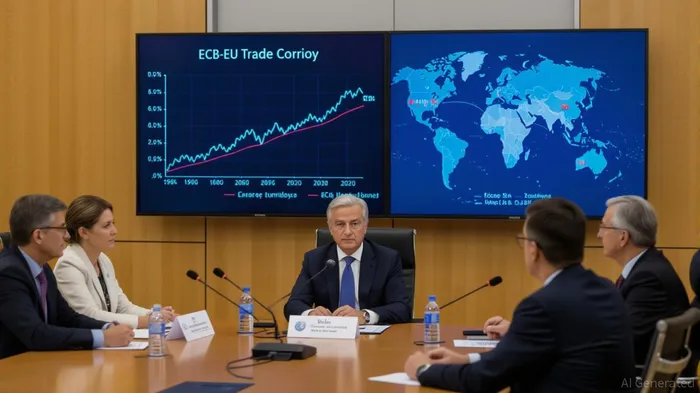
The European Central Bank's (ECB) September 2025 decision to maintain its benchmark interest rate at 2.00%—a “dovish pause”—has sent ripples through global markets. This move, while aligning with expectations, underscores the delicate balancing act the ECB faces: navigating a fragile economic recovery while grappling with persistent inflation driven by U.S.-EU trade uncertainties. For investors, the decision marks a critical juncture, offering insights into how monetary policy and geopolitical risks will shape the eurozone's trajectory in the coming year.
The Dovish Pause: A Calculated Wait
The ECB's decision to hold rates steady reflects its cautious approach to assessing the lagged effects of previous tightening cycles. According to a report by Monex Europe, the Governing Council emphasized that current rates are “sufficiently restrictive” to curb inflation while allowing time for economic data to clarify the path forward [3]. This pause is not a signal of complacency but a strategic pause to monitor inflation's stickiness and the eurozone's resilience amid external shocks.
Market participants had anticipated this outcome, with analysts noting the ECB's growing openness to rate cuts in late 2025 or early 2026, contingent on inflation trends and growth stability [3]. The ECB's forward guidance suggests a preference for patience, avoiding premature easing that could undermine its 2% inflation target. For investors, this implies a prolonged period of elevated rates, with the first cuts likely to be incremental and data-dependent.
Trade-Driven Inflation: A Persistent Headwind
While the ECB's rate decision reflects internal economic conditions, external factors—particularly U.S.-EU tariff uncertainties—remain a significant drag on inflation normalization. A European Commission analysis highlights that broad-based U.S. tariffs have elevated trade policy uncertainty, directly inflating import prices and weakening the competitiveness of eurozone exporters [1]. The eurozone's high trade openness exacerbates these effects, as tariffs on EU exports to the U.S. reduce external demand and disrupt supply chains.
The inflationary pressure is further compounded by the euro's depreciation against the dollar. As stated by the CEPR, the stronger dollar—driven by U.S. tariff policies—has increased import costs for the eurozone, creating a feedback loop that sustains inflation despite accommodative monetary policy [3]. This dynamic has limited the ECB's ability to cut rates aggressively, as doing so could worsen the euro's weakness and deepen inflationary pressures.
Investment Implications: Positioning for Uncertainty
For investors, the ECB's dovish pause and the persistence of trade-driven inflation necessitate a nuanced approach. First, hedging against currency risks becomes critical. A weaker euro may benefit exporters but hurt import-dependent sectors, creating divergent opportunities. Second, sectors resilient to trade shocks—such as domestic consumption or technology—may outperform as the eurozone's growth model shifts toward internal demand.
Additionally, investors should monitor the ECB's inflation forecasts and trade policy developments. The ECB's 2025 growth projection of 0.9% [2] suggests a fragile recovery, with trade tensions likely to delay a return to pre-pandemic growth rates. A diversified portfolio that balances exposure to eurozone equities, inflation-linked bonds, and hedged currency positions could mitigate risks while capitalizing on potential ECB easing in 2026.
Conclusion
The ECB's September 2025 decision is a pivotal moment, reflecting both the central bank's commitment to price stability and the eurozone's vulnerability to global trade dynamics. While a dovish pause buys time for economic data to clarify the path forward, trade-driven inflation risks remain a wildcard. Investors must remain agile, factoring in both monetary policy signals and geopolitical developments to navigate this complex landscape.







Comentarios
Aún no hay comentarios