
ECB Policy Divergence and Its Impact on European Fixed Income Markets: Navigating a Prolonged High-Rate Environment
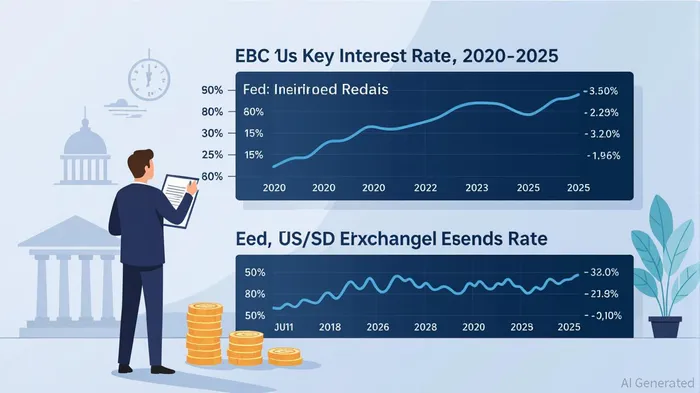
The European Central Bank (ECB) has cemented its divergence from the Federal Reserve (Fed) in 2025, with policy decisions and economic projections creating a stark contrast in global monetary landscapes. At its September 2025 meeting, the ECB held rates steady at 2%, citing inflation alignment with its 2% target and a data-dependent approach to future decisions[2]. Meanwhile, the Fed has maintained its key rate in the 4.25%-4.50% range, citing persistent inflation and robust U.S. growth[4]. This widening gap—nine ECB rate cuts since the pandemic peak versus three from the Fed—has fueled a euro depreciation to 1.04 against the dollar[5], while reshaping European fixed income markets.
ECB's Policy Stance: A Path of Easing Amid Uncertainty
The ECB's staff projections paint a cautiously optimistic picture: inflation is expected to average 2.1% in 2025, 1.7% in 2026, and 1.9% in 2027, with core inflation at 2.4% this year[2]. This trajectory has emboldened the ECB to prioritize rate cuts and balance sheet normalization, despite lingering risks from U.S. trade policies and transatlantic tensions[2]. However, this easing cycle is not without complexity. While short-term rate cuts reduce monetary restriction, the ECB's balance sheet runoff—part of its normalization strategy—exerts upward pressure on long-term bond yields[2]. This duality risks a steepening yield curve, complicating the transmission of monetary policy to the real economy[2].
Fixed Income Markets: Yields, Spreads, and Investor Behavior
The ECB's divergence has triggered a recalibration of European fixed income markets. Short-term bond yields have fallen as rate cuts materialize, but long-term yields face upward pressure from balance sheet normalization[2]. This dynamic has pushed investors toward shorter-duration, investment-grade bonds, which offer both income and capital appreciation potential in a rate-cutting environment[3]. For instance, EUR corporate and GBP government bonds have seen significant inflows, reflecting a preference for high-quality, liquid assets[2].
Credit spreads have also tightened, with investors favoring sectors insulated from geopolitical risks. According to a report by AllianceBernsteinAFB--, investment-grade issuers with strong financials are expected to outperform, as falling rates amplify the appeal of their fixed income offerings[1]. However, the market remains sensitive to U.S. tariff proposals, which could disrupt European industries and trigger volatility[1].
Investor Positioning: Strategies for a Prolonged High-Rate Environment
Despite the ECB's easing cycle, a prolonged high-rate environment—driven by the Fed's caution—demands strategic positioning. Investors are increasingly adopting a “barbell” approach:
1. Short-Duration Bonds: To capitalize on near-term rate cuts and mitigate interest rate risk.
2. Investment-Grade Credits: To secure income while avoiding the fragility of high-yield sectors.
3. Currency Hedges: Given the euro's weakness, hedging against USD exposure is critical for non-eurozone investors[5].
Data from MorningstarMORN-- indicates that European fixed-income funds have attracted consistent inflows, particularly in EUR corporate and GBP government bonds[2]. This trend underscores a shift toward defensive, high-conviction strategies. However, as AberdeenMCD-- Investments notes, sector selection remains pivotal—utilities, healthcare, and technology firms with stable cash flows are likely to outperform in a low-inflation, low-growth scenario[3].
Risks and the Road Ahead
While the ECB's easing cycle offers opportunities, risks persist. The Fed's wait-and-see approach, coupled with U.S. tariff policies, could delay global inflation normalization[5]. Additionally, the ECB's balance sheet normalization may tighten credit conditions, dampening economic recovery[2]. Investors must remain agile, balancing yield-seeking opportunities with macroeconomic uncertainties.
Conclusion
The ECB's policy divergence from the Fed has created a unique landscape for European fixed income markets. While rate cuts and normalization efforts are reshaping yield curves and investor behavior, a prolonged high-rate environment—driven by U.S. monetary caution—demands disciplined positioning. By prioritizing short-duration, high-quality bonds and hedging currency risks, investors can navigate this divergence while capitalizing on emerging opportunities.







Comentarios
Aún no hay comentarios