
ECB's Lagarde Signals No Near-Term Policy Easing, What It Means for Eurozone Markets
The European Central Bank (ECB) has signaled a prolonged pause in its monetary easing cycle, with President Christine Lagarde emphasizing a meeting-by-meeting approach to policy adjustments. This stance, rooted in a stable inflation outlook and a resilient Eurozone economy, has significant implications for bond markets and equity sector positioning. As the ECBXEC-- navigates the delicate balance between inflation control and growth support, investors must reassess risk exposure in a landscape marked by heightened volatility and divergent sectoral performance.
Bond Market Volatility: A Test of Resilience
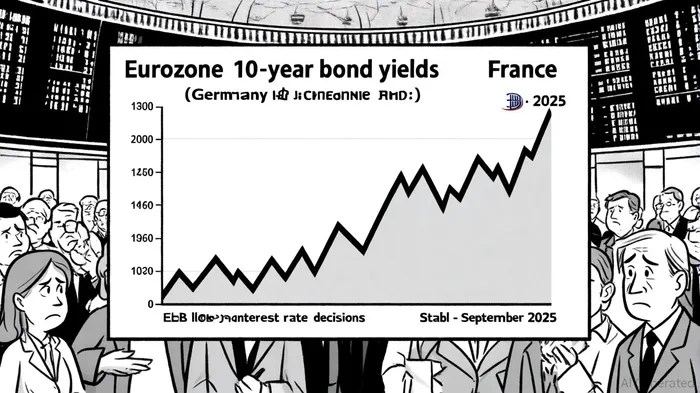
Eurozone bond markets have experienced pronounced volatility in 2025, driven by geopolitical tensions, shifting fiscal policies, and the ECB's cautious approach to rate adjustments. German 10-year bond yields surged to 3.34% by August 2025, reflecting investor concerns over rising government borrowing needs and the normalization of monetary policy, according to a report on surging debt supply. Lagarde has reassured markets that the ECB retains "all the tools needed" to stabilize debt markets, including the Transmission Protection Instrument, though it remains unused for now, as noted in Pictet's Outlook 2025.
The divergence in sovereign bond yields between core and peripheral Eurozone nations has remained historically narrow, with French-German 10-year yield spreads fluctuating around 79 basis points despite political uncertainties in France, according to a bond spreads analysis. This suggests a degree of market integration but also underscores the fragility of investor confidence. Morningstar analysts caution that a "flight to quality" could intensify if trade war risks escalate, favoring government bonds over equities.
Equity Sector Positioning: Winners and Losers in a Hawkish Environment
The ECB's prolonged hawkish stance has reshaped equity sector dynamics, with defensive and rate-sensitive sectors outperforming. Financials, particularly banks, have benefited from higher interest rates, which compress loan loss provisions and bolster net interest margins, according to a J.P. Morgan analysis. Conversely, industrials and consumer discretionary sectors face headwinds from weak global demand and trade policy uncertainty, as highlighted by J.P. Morgan's analysis of U.S. tariff impacts.
European equities, broadly, have shown resilience amid a 1.2% GDP growth projection for 2025. However, institutional investors like Pictet remain underweight in Eurozone equities, citing stretched valuations and limited earnings potential (estimated at 4% EPS growth for 2025). The anticipated convergence in earnings growth between Europe and the U.S. in 2026, driven by fiscal stimulus in Germany and technological investments, may yet attract capital inflows, according to J.P. Morgan.
Strategic Implications for Investors
The ECB's data-driven policy framework introduces uncertainty for market participants. While inflation remains anchored near the 2% target, the risk of a prolonged high-rate environment persists. For bond investors, this necessitates a focus on duration management and credit selection, particularly in sovereign debt markets where yield differentials offer limited protection against volatility.
Equity investors, meanwhile, should prioritize sectors aligned with structural reforms and fiscal stimulus, such as capital goods and healthcare, while avoiding overexposed industrial and export-dependent segments. The ECB's emphasis on completing the Single Market and enhancing banking union resilience may also create long-term opportunities in infrastructure and financial services.
As Lagarde reiterated in her October 2025 speech, the ECB's commitment to price stability and economic resilience will remain paramount. Investors must remain agile, balancing short-term volatility with long-term structural trends in a Eurozone poised for cautious but measured recovery.







Comentarios
Aún no hay comentarios