
easyGroup's easyBitcoin App: A Catalyst for Mainstream Bitcoin Adoption and Long-Term Investment Potential
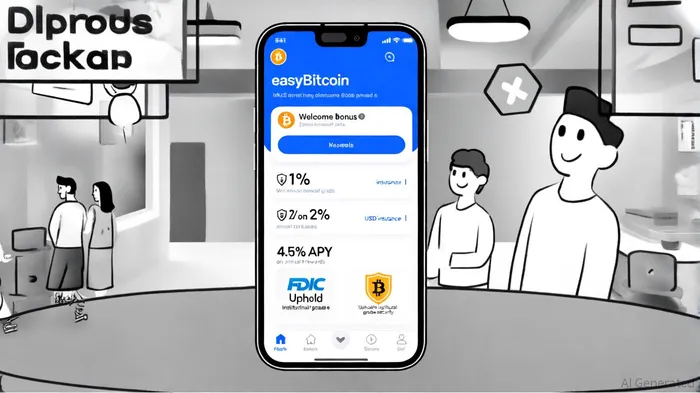
The launch of easyGroup's easyBitcoin app in 2025 marks a pivotal moment in the democratization of BitcoinBTC-- investment, particularly for U.S. retail users. By combining institutional-grade infrastructure with consumer-centric incentives, the app addresses key barriers to adoption—complexity, security concerns, and liquidity risks—while aligning with broader macroeconomic and regulatory trends that position Bitcoin as a long-term store of value.
Institutional-Grade Infrastructure Meets Retail Accessibility
easyGroup's partnership with Uphold ensures the app leverages institutional-grade security and custody solutions, a critical factor for risk-averse retail investors. The platform's FDIC insurance coverage of $2.5 million for USD balances[1] and 4.5% APY on cash holdings paid in Bitcoin[2] further mitigate volatility-related anxieties. These features, coupled with a streamlined onboarding process, reduce the friction that has historically hindered mass adoption. As noted by a report from Morningstar[3], the app's design prioritizes simplicity, enabling users to “buy, hold, and earn” Bitcoin without navigating the complexities of traditional crypto exchanges.
The app's incentives—such as a 1% welcome bonus on recurring purchases and 2% annual rewards for long-term holders[4]—are strategically designed to cultivate habitual investment behavior. This mirrors the success of robo-advisory platforms in traditional finance, where compounding and dollar-cost averaging drive user retention. By abstracting the technicalities of blockchain, easyBitcoin aligns with the growing trend of “crypto-as-utility,” where digital assets are treated as a standard financial tool rather than a speculative gamble.
Institutional Adoption and Regulatory Clarity: A Tailwind for Bitcoin
The broader ecosystem for Bitcoin's adoption has been reshaped by institutional participation and regulatory progress. Treasury companies like MicroStrategy and BitMine have accumulated billions in Bitcoin and EthereumETH-- holdings[5], creating sustained demand and upward price pressure. The approval of spot Bitcoin ETFs in early 2024[6] and the subsequent Ethereum ETF rollout further legitimized cryptocurrencies as investable assets, attracting institutional capital that now accounts for over 60% of total crypto trading volume[7].
Regulatory frameworks such as the EU's MiCA (Markets in Crypto-Assets) and the U.S. SEC's Staff Accounting Bulletin 122 (SAB 122)[8] have also played a critical role. By easing custody rules and improving transparency, these policies have reduced the operational risks for platforms like easyBitcoin, enabling them to offer FDIC-backed services without compromising Bitcoin's decentralized ethos. The Trump administration's endorsement of a Strategic Bitcoin Reserve has further reinforced Bitcoin's status as a macroeconomic hedge, particularly in an era of inflation and currency devaluation.
Retail Adoption and the Path to a $1 Trillion Stablecoin Ecosystem
Retail adoption is accelerating alongside these institutional trends. Platforms like MetaMask's MUSD stablecoin and Base's DeFi ecosystem are abstracting blockchain complexity, while stablecoins—projected to reach $1 trillion in supply by 2025—are bridging traditional and digital finance. easyBitcoin's focus on U.S. retail users positions it to capitalize on this shift, particularly among younger demographics who prioritize convenience and yield.
The app's 4.5% APY on USD balances, paid in Bitcoin, is a novel approach to incentivizing cash holdings. This model not only rewards users for participating in the Bitcoin ecosystem but also introduces them to the asset's volatility in a controlled, risk-mitigated environment. As noted by Coinfomania, such features could drive a “halving effect” in adoption rates, where each new user becomes a node in a growing network of Bitcoin holders.
Assessing Bitcoin's Long-Term Investment Potential
Bitcoin's price surge of 77.62% in 2025 underscores its growing acceptance as a long-term asset. Institutional-grade platforms like easyBitcoin are amplifying this trend by:
1. Lowering entry barriers through FDIC insurance and yield incentives.
2. Normalizing Bitcoin as a financial utility via recurring purchase options and APY rewards.
3. Leveraging regulatory clarity to attract mainstream investors.
However, challenges remain. The app's success hinges on maintaining user trust amid regulatory shifts and market volatility. Additionally, competition from established platforms like CoinbaseCOIN-- and Binance could limit its market share. That said, easyGroup's brand equity as the parent company of EasyJet and its focus on simplicity may give it an edge in the retail segment.
Conclusion
easyGroup's easyBitcoin app is more than a consumer product—it is a symptom of a larger paradigm shift. By integrating institutional-grade infrastructure with retail-friendly features, it addresses the core friction points that have historically limited Bitcoin's adoption. As regulatory clarity and institutional demand continue to converge, the app's role in normalizing Bitcoin as a mainstream asset class could prove transformative. For investors, this signals a critical inflection point: Bitcoin is no longer a niche speculative asset but a foundational component of a diversified portfolio in an increasingly digital financial ecosystem.





Comentarios
Aún no hay comentarios