
Earnings Momentum in the S&P 500: A Catalyst for Short-Term Market Confidence and Tactical Reallocation
The S&P 500's earnings momentum in Q3 2025 has emerged as a linchpin for short-term market confidence, with year-over-year growth projections hitting 8.8% as of October 2025, according to Refinitiv's earnings dashboard. This surge, driven by resilient corporate performance and optimism around Federal Reserve rate cuts, has outpaced the 10-year average of 8.0% in an Investing.com market recap, creating a fertile ground for tactical asset allocation strategies. The interplay between earnings strength and investor sentiment underscores a critical inflection point for portfolios seeking to balance risk and reward in a dynamic macroeconomic landscape.
Earnings Momentum: A Sectoral Breakdown
The earnings surge is not uniform but concentrated in sectors poised to benefit from structural trends. Technology, in particular, has been a standout, with the Magnificent 7 group reporting 12.0% higher earnings year-over-year, according to a TalkMarkets analysis. This outperformance is tied to AI-driven demand for semiconductors and cloud infrastructure, as companies like NvidiaNVDA-- and OracleORCL-- post outsized gains, per an Oxford Harriman commentary. Meanwhile, utilities, materials, and financials have also contributed to the broader recovery, reflecting a broadening of growth beyond the tech-centric rally seen in prior years, as detailed in a MarketMinute article.
However, the energy sector remains a drag, with its exclusion pushing the S&P 500's non-energy earnings growth to 9.6%, according to the Refinitiv dashboard. This divergence highlights the importance of sector rotation in tactical strategies, as investors tilt toward high-growth areas while hedging against cyclical vulnerabilities.
Market Confidence and the Fed's Role
Short-term market confidence has been further bolstered by the Federal Reserve's pivot to rate cuts. With the central bank resuming easing in Q3 2025, investors have interpreted this as a signal of accommodative monetary policy, supporting equity valuations despite soft labor market data, notes a Benchmark Financial recap. The S&P 500's forward P/E ratio of 22.8, above historical averages, reflects this optimism, as does the 81% of companies exceeding EPS estimates, per TalkMarkets.
Yet, this confidence is not without risks. The Conference Board's Leading Economic Index (LEI) declined in August 2025, signaling potential headwinds. Tactical allocators must weigh these macroeconomic signals against the earnings momentum, recognizing that while the Fed's actions have propped up markets, underlying economic fragility could trigger volatility.
Tactical Asset Allocation: Balancing Growth and Defense
The earnings-driven rally has prompted a reevaluation of tactical positioning. Invesco's Q3 2025 strategies emphasize the "structural super-cycle" in technology, advocating for overweights in AI infrastructure and underweights in high-yield credit, according to an Invesco tactical note. Similarly, Aurdan Capital recommends diversifying across asset classes to balance participation in market gains with downside protection, particularly as AI exposure within major indices reaches "concerning levels," in the Aurdan Capital review.
Sector rotation has also gained prominence. Small-cap stocks, historically sensitive to rate cuts, staged a rare rally in Q3 2025, according to the Morningstar review, while defensive sectors like utilities and healthcare have seen inflows amid inflationary volatility, per the iShares flows report. For risk management, active fixed-income ETFs and alternative assets have attracted $377 billion in Q3 flows, nearly double the 2020–2024 average, as documented in the MetLife analysis, as investors seek yield and stability in a low-interest-rate environment.
Quantifying the Implications
The interplay between earnings momentum and tactical strategies can be quantified through two lenses:
1. Sector Rotation: Technology's 14% year-over-year AI investment growth, noted in the Oxford Harriman commentary, justifies an overweight in semiconductors and cloud services, while energy's underperformance warrants a defensive tilt.
2. Risk Mitigation: Diversification into fixed income and alternatives has become non-negotiable, with active bond ETFs capturing 43% more flows in Q3 2025 compared to Q2, as highlighted by MetLife.
Conclusion
The S&P 500's earnings momentum in Q3 2025 has solidified its role as a barometer for short-term market confidence. While the Fed's rate cuts and sector-specific growth have fueled optimism, tactical allocators must remain vigilant against macroeconomic headwinds. By leveraging sector rotation, diversification, and disciplined risk management, investors can harness this momentum without overexposing portfolios to volatility. As the earnings trajectory extends into 2026 with projected 12–13.6% growth (per the Investing.com market recap), the challenge lies in maintaining strategic discipline amid the siren call of short-term gains.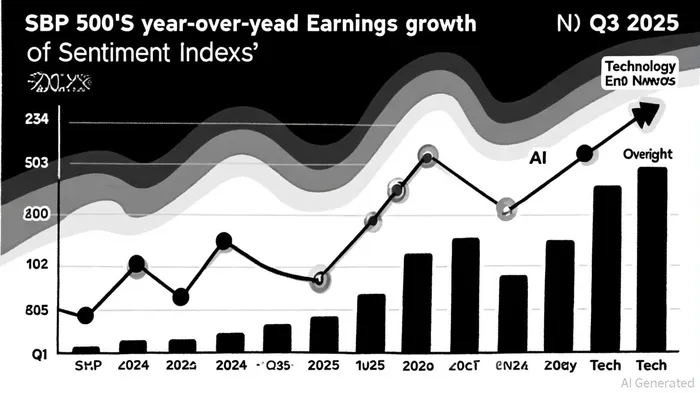





Comentarios
Aún no hay comentarios