
Early Warning Signs of a Maturing Bull Market: Navigating Momentum and Risk in 2025
Early Warning Signs of a Maturing Bull Market: Navigating Momentum and Risk in 2025
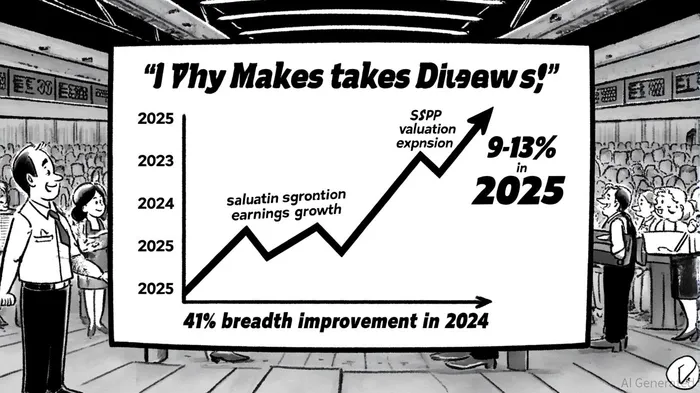
The U.S. stock market has entered a critical phase. For three consecutive years, the S&P 500 has advanced on a combination of speculative fervor and macroeconomic tailwinds. However, as 2025 unfolds, early warning signs of a maturing bull market are becoming increasingly evident. According to an Investing Daily report, the focus has shifted from valuation expansion to earnings growth as the primary driver of performance. This transition, while positive for long-term sustainability, introduces new risks that investors must carefully navigate.
The Earnings-Driven Transition
The maturation of the bull market is most apparent in the shift toward fundamentals. In 2023, market gains were largely fueled by speculative momentum, particularly in the technology sector, as investors priced in future earnings potential, according to Investing Daily. By 2024, however, the narrative had evolved. Improved corporate earnings, coupled with easing inflation and a more dovish Federal Reserve, created a foundation for broader market participation. Data from Investing Daily indicates that 41% of stocks outperformed the S&P 500 in 2024, compared to just 26% in 2023. This improved breadth suggests a healthier, more diversified market environment.
Historical backtesting of S&P 500 stocks with earnings beats from 2022 to 2025 reveals a compelling pattern: when a large share of the index's constituents report earnings above expectations, the market tends to deliver positive returns. Over 30 trading days post-event, the average cumulative return was +4.69%, with a 66.7% win rate (days the index closed higher than the event date). While these results align broadly with the benchmark trend, they underscore the value of earnings momentum in sustaining market performance during a maturing bull cycle.
Yet, this transition is not without vulnerabilities. The "Magnificent 7" mega-cap stocks-Apple, MicrosoftMSFT--, Amazon, Alphabet, Meta, Nvidia, and Tesla-remain central to the market's momentum, per Investing Daily. While their earnings growth has been robust, their dominance creates a fragile equilibrium. A pullback in any of these names could trigger broader market volatility, as smaller-cap stocks and sectors reliant on tech-driven demand face repricing.
Valuation Risks and Structural Imbalances
Despite the earnings-driven optimism, valuations remain a critical concern. As of mid-2025, the S&P 500 trades at the 90th percentile of its historical valuation range, according to Investing Daily, leaving little room for further multiple expansion. This compression of upside potential means future gains will depend almost entirely on earnings growth, not price-to-earnings (P/E) expansion. For investors, this dynamic raises the stakes: if corporate profits fail to meet expectations, the market could face a sharp correction.
Concentration risk further amplifies this vulnerability. The "Magnificent 7" now account for over 30% of the S&P 500's total market capitalization, per Investing Daily. While these companies have delivered exceptional returns, their performance is increasingly decoupled from the broader economy. A slowdown in tech innovation or a shift in consumer spending could disproportionately impact the index, creating a disconnect between market indices and real-world economic activity.
Global Headwinds and Fed Policy Uncertainty
The global economic landscape adds another layer of complexity. China's property sector crisis and Europe's fragile growth trajectory pose significant risks for U.S. multinational corporations, as noted in a Forbes article. Many of these firms derive over 50% of their revenue from international markets, making them particularly sensitive to geopolitical and macroeconomic shocks. Morgan Stanley analysts caution that a global slowdown could erode the earnings momentum that has underpinned the 2025 bull run (Morgan Stanley analysts).
Meanwhile, Federal Reserve policy remains a wildcard. While the central bank has signaled a pause in rate hikes for 2025, renewed inflationary pressures could force a reversal. A return to tighter monetary policy would likely weigh on equity valuations, particularly for growth stocks that rely on discounted future cash flows. The Fed's balance sheet reduction and potential rate hikes could also exacerbate liquidity constraints, creating volatility in a market already stretched on the edges.
Contrarian Indicators and Investor Sentiment
Amid these risks, contrarian indicators suggest the market may be nearing a turning point. The American Association of Individual Investors (AAII) reported its highest bearish sentiment reading since March 2020 in late 2024, as highlighted by Forbes. Historically, extreme pessimism has often preceded market bottoms, as fear-driven selling exhausts itself. Similarly, institutional investors have increased cash positions to the highest levels in nearly three years, another observation reported in the same Forbes piece, a sign of caution that could signal a shift in risk appetite.
However, these indicators must be interpreted with care. While contrarian sentiment can be a useful tool, it does not negate structural risks such as stretched valuations or global economic fragility. Investors should treat these signals as part of a broader risk management framework rather than standalone predictors of market direction.
Conclusion: Balancing Opportunity and Caution
The maturing bull market of 2025 presents both opportunities and challenges. Earnings growth has replaced speculative momentum as the primary driver of performance, a shift that bodes well for long-term stability. However, stretched valuations, concentration risks, and global economic headwinds create a volatile backdrop. Investors must remain vigilant, diversifying portfolios to mitigate sector-specific risks and maintaining a disciplined approach to valuation.
As the Federal Reserve navigates its next policy moves and global economies grapple with structural imbalances, the coming months will test the resilience of this bull market. For now, the data suggests a market in transition-one that rewards patience but demands prudence.





Comentarios
Aún no hay comentarios