
Early Warning Signs of a Global Liquidity Crisis: Are Central Banks Buying Time or Creating Vulnerability?
The repo market, a cornerstone of global financial stability, is showing troubling signs of strain. As central banks grapple with the dual challenges of tightening monetary policy and maintaining liquidity, the question looms: Are their interventions stabilizing the system-or sowing the seeds of a deeper crisis?
Repo Market Stress: A Perfect Storm of Structural and Policy-Driven Risks
The 2024 repo market stress is not a standalone event but a symptom of systemic imbalances. The Federal Reserve's quantitative tightening (QT) has systematically drained $1.3 trillion in bank reserves since 2022, eroding the buffer capacity needed to absorb seasonal liquidity demands. This reserve compression has intensified competition for liquidity, particularly as Treasury issuance trends have extended the average maturity of outstanding debt, placing additional strain on primary dealers.
Compounding these structural issues are policy-driven vulnerabilities. The Fed's 2024 stress test scenarios warn of a potential global recession marked by sharp asset price declines and heightened volatility. Large banks could face significant losses in commercial/residential real estate and corporate debt markets, amplifying systemic risks. Meanwhile, U.S. Treasury market liquidity-measured by metrics like the "spline spread"-has deteriorated, with leveraged short positions in Treasury futures making global bond markets hyper-sensitive to U.S. monetary policy shocks.
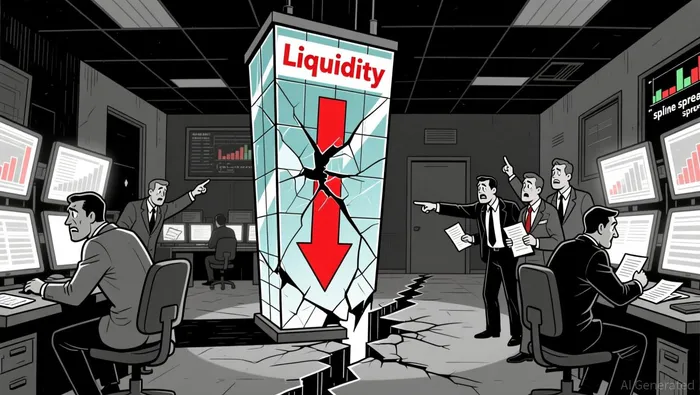
Central Bank Interventions: A Balancing Act
To mitigate these risks, central banks have expanded emergency liquidity tools. The Fed's Standing Repo Facility (SRF) has become a critical lifeline, with a $29.4 billion repo operation in October 2025-the largest in over two decades-highlighting acute funding shortages. By December 2025, the Fed eliminated the previous $500 billion daily limit on SRF operations, signaling a shift toward more flexible interventions. These measures aim to keep repo rates aligned with the federal funds target, but they also reflect a broader trend: central banks increasingly acting as global liquidity backstops.
However, the euro area's exposure to U.S. fiscal imbalances and trade policy uncertainty has weakened the dollar's safe-haven status, creating ripple effects in global bond markets. While large-scale interventions have stabilized markets in the short term, they raise concerns about the sustainability of central bank balance sheets and the challenges of normalizing policy.
Mitigating Crises or Creating Vulnerabilities?
The effectiveness of repo interventions remains contentious. A 2025 IMF working paper notes that political events-such as U.S. debt ceiling standoffs-can trigger repo spread volatility of 20–30 basis points. While higher bank reserves and overnight reverse repo balances at the Fed have dampened some of these shocks, the BIS warns that lax repo haircuts (sometimes zero or negative) have enabled hedge funds to take on excessive leverage in relative value trades. This dynamic, evident during the March 2020 and April 2025 market meltdowns, risks forced selling and volatility spikes.
The IMF's 2025 Global Financial Stability Report underscores the growing interconnectedness between banks and nonbank financial institutions (NBFIs), which could amplify shocks through maturity mismatches and stretched asset valuations. Meanwhile, the BIS emphasizes that structural shifts-like the rise of NBFIs-introduce new layers of complexity, requiring coordinated policy frameworks and enhanced regulatory oversight.
The Long Game: A Delicate Trade-Off
Central banks are caught in a paradox. Short-term interventions stabilize markets but risk entrenching long-term vulnerabilities. For example, the Fed's reliance on SRF operations has normalized emergency liquidity provision, potentially encouraging market participants to underestimate systemic risks. Similarly, the ECB's role as a liquidity backstop in the euro area has blurred the lines between crisis management and routine policy, complicating communication and normalization efforts.
The BIS and IMF both caution that policymakers must strengthen financial safety nets, enhance surveillance of NBFIs, and maintain operational independence to avoid creating new fragilities. Yet, as the Fed's October 2025 FOMC minutes reveal, even central banks acknowledge the limits of their tools: "Reserve levels are approaching 'ample' thresholds, and further QT could exacerbate market instability".
Conclusion: A System on Edge
The repo market is a canary in the coal mine for global liquidity. While central banks have bought time with aggressive interventions, they have also created a system where short-term stability masks long-term fragility. The challenge lies in balancing immediate needs with structural reforms-something that becomes harder as QT continues and geopolitical tensions persist.
For investors, the message is clear: Repo market stress is not a technicality but a bellwether of broader systemic risks. As the Fed and its peers navigate this tightrope, the line between crisis mitigation and vulnerability creation grows increasingly thin.







Comentarios
Aún no hay comentarios