
Early Ethereum Holder Moves $20.4M ETH to Kraken: A Catalyst for Institutional Adoption and Liquidity Dynamics
In September 2025, a $20.4 million EthereumETH-- transfer to Kraken-part of a larger $262 million movement by Ethereum co-founder Jeffrey Wilcke-sparked intense speculation about its implications for institutional adoption and liquidity dynamics in crypto markets. This analysis unpacks the significance of Wilcke's actions, contextualized within broader trends shaping Ethereum's institutional trajectory.
Institutional Adoption: A Structural Shift in Ethereum's Ecosystem
Ethereum's institutional adoption has accelerated in 2025, driven by regulatory clarity and product innovation. The CLARITY and GENIUS Acts reclassified Ethereum as a utility token, enabling SEC-approved in-kind creation and redemption mechanisms for Ethereum ETFs. By Q3 2025, these ETFs had attracted $27.66 billion in assets under management (AUM), representing 5.31% of the circulating ETH supply, according to an OKX analysis. This influx of institutional capital has been further amplified by Ethereum's staking yields (3–6%) and technological upgrades like the Dencun and Pectra hard forks, which reduced gasGAS-- fees by 90% and boosted total value locked (TVL) in DeFi protocols to $223 billion, as detailed by OKX.
Wilcke's $262 million transfer to Kraken aligns with this trend. As a co-founder, his long-term pattern of moving ETH to centralized exchanges since 2016-totaling 394,000 ETH ($510 million in realized value)-suggests a strategic approach to liquidity management, according to a Blockchain.news report. The timing of the May 20 transfer, coinciding with Ethereum's rebound to $2,490.44, underscores the interplay between individual whale activity and institutional-grade infrastructure. Analysts note that such movements often precede liquidity events, as large deposits on exchanges like Kraken can signal potential sell-side pressure or portfolio restructuring, according to a TokenPost analysis.
Liquidity Dynamics: Kraken as a Hub for Institutional Activity
Kraken's role in Ethereum's liquidity dynamics has expanded significantly in 2025. The exchange has become a focal point for institutional-grade staking and derivatives, with platforms like Lido and Rocket PoolRPL-- reporting surges in assets under management (AUM) due to increased demand for staking solutions, as noted in a ChainUp report. Wilcke's transfers to Kraken, particularly the May 20 deposit of 105,737 ETH, triggered immediate market reactions: Ethereum's price dipped 1.2%, and Kraken's ETH/USDT trading volume surged 24% within 24 hours, according to Blockchain.news.
However, the broader liquidity picture is nuanced. While Kraken experienced outflows of 32,566 ETH ($90.16 million) in a nine-hour window in September 2025, the exchange also moved 75,000 ETH ($322.83 million) to five new wallets, signaling potential liquidity adjustments, according to a TradersDNA analysis. These movements highlight the fragmented nature of crypto liquidity, where centralized exchanges (CEXs) like Kraken and Binance dominate BTC/ETH trading, while decentralized exchanges (DEXs) like UniswapUNI-- lead in stablecoin liquidity, TradersDNA notes.
Wilcke's Actions: Bearish Signal or Strategic Reallocation?
The interpretation of Wilcke's $262 million transfer hinges on his intent. On-chain analysts have proposed two scenarios: either Wilcke is obscuring fund movements by dispersing assets across seven addresses, or Kraken is implementing risk controls to avoid single-point exposure, as reported by Blockchain.news. Historical data supports the latter, as Wilcke's prior transfers to Kraken have correlated with price declines but not outright bearish sentiment. For instance, his August 2025 deposit of 9,840 ETH ($9.22 million) coincided with Ethereum's rebound above $2,500, suggesting a focus on liquidity rather than selling, according to a Currency Analytics article.
Moreover, institutional demand for Ethereum remains robust. In the week following Wilcke's May 20 transfer, Ethereum saw net inflows of $1.29 billion, reflecting continued confidence in its utility as a yield-generating asset, as the OKX analysis shows. This resilience is further reinforced by corporate treasuries-such as Tesla and BitMine Immersion-allocating portions of their reserves to Ethereum, treating it as a strategic hedge against macroeconomic uncertainty, as ChainUp documents.
Conclusion: Balancing Whale Activity with Institutional Momentum
While large Ethereum transfers by figures like Wilcke inevitably draw market scrutiny, the broader narrative of institutional adoption remains intact. Ethereum's technological advancements, regulatory tailwinds, and staking infrastructure have created a self-reinforcing cycle of demand, with Kraken and other exchanges serving as critical liquidity conduits. Wilcke's actions, though significant, must be viewed in the context of a maturing ecosystem where whale activity is increasingly intertwined with institutional-grade capital flows.
As Ethereum approaches its 2025 peak of $4,610, the interplay between individual and institutional dynamics will remain a key driver of price stability and market depth. For investors, the challenge lies in distinguishing short-term volatility from long-term structural trends-a task made easier by the transparency and analytical tools now available in the crypto space.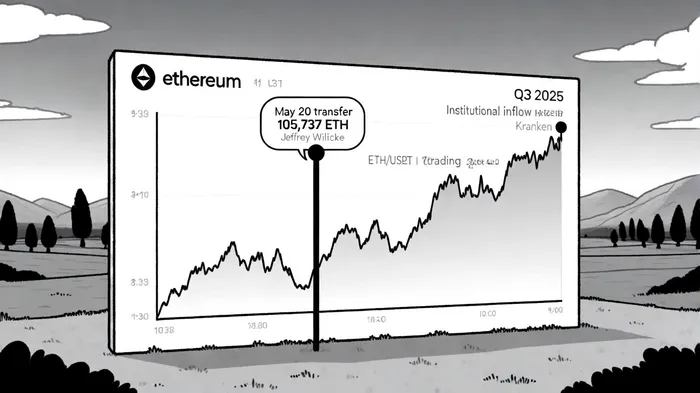






Comentarios
Aún no hay comentarios