
Why Early Bitcoin Investors Are Shifting to XRP and What It Means for the Crypto Market
The crypto market's evolution in 2025 has been marked by a seismic shift in institutional sentiment, with early BitcoinBTC-- adopters increasingly reallocating capital to XRPXRP--. This migration is not merely speculative but reflects a calculated response to regulatory clarity, utility-driven value propositions, and the maturation of crypto infrastructure. As institutional investors refine their risk-rebalance strategies, the interplay between Bitcoin's dominance and XRP's niche utility is reshaping the landscape of digital asset adoption.
Regulatory Clarity and the Rise of XRP ETFs
The cornerstone of this shift lies in regulatory developments. According to the U.S. SEC's 2025 approval, spot Bitcoin and EthereumETH-- ETFs catalyzed institutional onboarding, but the same framework also enabled the launch of XRP-specific ETFs, such as those from Canary Capital and Bitwise as reported in analysis. These products addressed a critical pain point for institutional investors: the operational complexity of holding XRP directly. By offering regulated, custodied exposure, XRP ETFs have bridged the gap between institutional mandates and the token's cross-border payment utility.
Data from the Bybit Q3 2025 Asset Allocation Report reveals a stark reallocation trend: stablecoin holdings plummeted as investors pivoted to altcoins like XRP and SolanaSOL-- (SOL) according to the report. 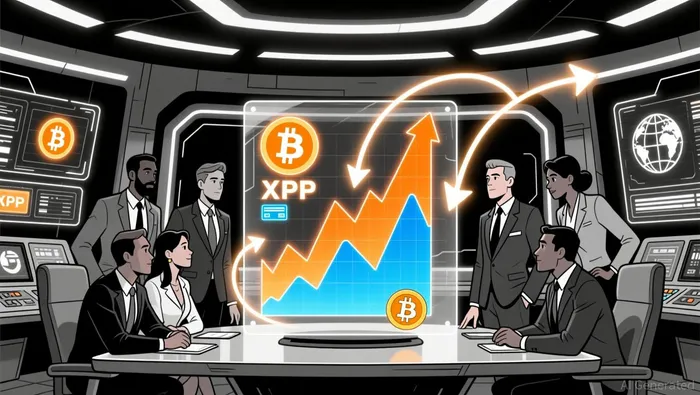 XRP's appeal is rooted in its role as a settlement asset for high-volume transactions, with institutions drawn to its low fees and energy efficiency as highlighted in analysis. This utility-driven narrative contrasts sharply with Bitcoin's status as a "digital gold" store of value, creating a complementary dynamic in institutional portfolios.
Risk Rebalancing: Diversification and Macro Hedges
Institutional risk-rebalance strategies in 2025 emphasize diversification across asset classes and use cases. While BlackRock's IBIT ETF dominates with $100 billion in assets under management, investors are layering in XRP to hedge against macroeconomic risks such as dollar debasement and inflation as noted in institutional reports. The key distinction lies in allocation size: Bitcoin typically occupies a 5–10% core position according to analysis, whereas XRP is often deployed as a tactical exposure to payment infrastructure and settlement efficiency as detailed in market analysis.
This bifurcation is evident in ETF performance. A single day in 2025 saw $903 million in outflows from Bitcoin ETFs and $261 million from Ethereum ETFs, while XRP ETFs attracted inflows as the token rebounded above $2.00 according to market data. The divergence underscores a strategic recalibration: institutions are reducing exposure to speculative volatility (Bitcoin's historical trait) and increasing bets on utility-driven assets with clear revenue streams (XRP's cross-border payment use case) as observed in institutional analysis.
Market Maturity and the Institutionalization of Crypto
The broader crypto market's maturation is reflected in its integration into traditional finance. Jurisdictions like the UAE and Singapore have implemented frameworks that facilitate tokenized real-world assets and institutional custody solutions, reducing friction for capital deployment. XRP's regulatory resolution in 2025 further solidified its legitimacy, enabling asset managers to include it in diversified portfolios without the legal uncertainties that plagued earlier altcoins.
For early Bitcoin investors, this shift represents a pragmatic evolution. Bitcoin remains a foundational asset, but its role is increasingly complemented by tokens like XRP that address specific market gaps. As one analyst notes, "The 2025 market isn't about choosing between Bitcoin and XRP-it's about allocating capital to assets that align with distinct risk-return profiles and macro narratives" according to market commentary.
Implications for the Crypto Market
The institutional pivot to XRP signals a broader trend: the crypto market is transitioning from a speculative arena to a utility-driven ecosystem. This shift will likely accelerate innovation in cross-border payment solutions, interoperability protocols, and tokenized infrastructure. For retail investors, the takeaway is clear: diversification into utility-focused tokens is no longer a niche strategy but a core component of a matured crypto portfolio.
As the dust settles on 2025's regulatory and market developments, one thing is certain: the crypto market's future will be defined by assets that solve real-world problems, not just those that capture speculative fervor.






Comentarios
Aún no hay comentarios