
Why Early Access to Apeing Outperforms Chasing Established Meme Coins Like BONK and FLOKI
In the rapidly evolving memeMEME-- coin market, timing and structure often dictate outcomes more than hype alone. Apeing, a 2025 breakout project, has redefined early-stage participation through its whitelist model, creating a stark contrast to the consolidation phases of established meme coins like BONKBONK-- and FLOKIFLOKI--. This analysis explores how Apeing's strategic design-centered on controlled access, pricing asymmetry, and cultural alignment-positions it as a superior investment opportunity for those prioritizing timing and structural advantages.
Structural Advantages: Whitelist-Driven Scarcity and Pricing Asymmetry
Apeing's Phase 1 pricing is locked at $0.0001, with a projected listing price of $0.001, offering a 10,000% potential upside for early participants. This structured approach creates scarcity by limiting early allocations, a tactic historically linked to outsized returns in meme coin launches. Unlike speculative "apeing out" behavior-where investors jump into projects without structured access-Apeing's whitelist system ensures controlled distribution, reducing bot activity and phishing risks while rewarding patient, informed participants.
In contrast, BONK and FLOKI lack such formalized mechanisms. BONK recently declined 1.6% to $0.000008415, while FLOKI slipped 0.55% to $0.00004197, reflecting stabilization phases rather than structural weakness. According to market analysis, these tokens, though culturally relevant, are increasingly viewed as projects in transition, with their liquidity and community strength unable to offset the lack of asymmetric upside.
Market Timing: Capturing Momentum Before Broad Adoption
Meme coins thrive on narrative-driven momentum, and Apeing's launch strategy is designed to capture this at its peak. By locking in early access, the project rewards investors who act before broader market attention drives up demand. This aligns with historical patterns where early-stage positioning outperforms late entries.
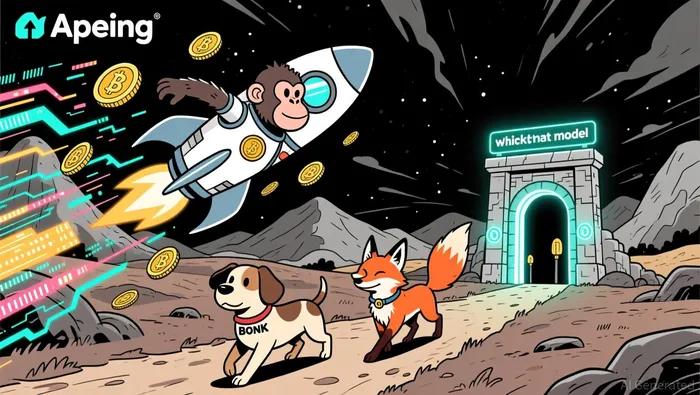
BONK and FLOKI, meanwhile, are in consolidation phases. While they maintain active trading volumes, their price action lacks the explosive potential seen in Apeing's structured rollout. For instance, BONK's recent 1.6% drop underscores a cooling of momentum without structural collapse, but it also highlights the diminishing urgency for new entrants. Similarly, FLOKI's 0.55% decline signals a shift in market focus toward projects with clearer growth trajectories.
Cultural and Community Alignment: Beyond Price Action
Apeing's success is not purely financial; its culture-first branding and structured onboarding resonate with traders seeking asymmetric opportunities in a market often defined by hesitation and noise. The project's emphasis on transparency-such as publicly disclosed Phase 1 pricing-builds trust in an ecosystem where scams and volatility are rampant.
BONK and FLOKI, while culturally significant, lack this structured narrative. Their communities remain active but are increasingly fragmented as attention shifts to newer projects like Apeing, which offers a clear roadmap and limited early supply. According to market analysis, this cultural pivot is critical: meme coins depend on community-driven narratives, and Apeing's organized approach ensures it remains at the forefront of this dynamic.
Conclusion: Strategic Positioning for Asymmetric Returns
For investors prioritizing timing and structural advantages, Apeing's early access model presents a compelling case. Its whitelist system, pricing asymmetry, and cultural alignment create a framework where early adopters can capitalize on controlled growth before broader market adoption. In contrast, BONK and FLOKI, while still relevant, are in phases of consolidation where late-stage speculation offers limited upside.
As the meme coin market matures, projects like Apeing-designed to reward patience and informed participation-will likely outperform those relying on legacy hype. For traders seeking to navigate this space effectively, the lesson is clear: structure and timing matter more than ever.







Comentarios
Aún no hay comentarios