
dYdX's Strategic Expansion and Token Utility Enhancements: A Catalyst for DEX Dominance
Protocol Upgrades: Accelerating Performance and Accessibility
dYdX's Q3 2025 protocol upgrades represent a critical step in optimizing its infrastructure for scalability and user experience. The introduction of Designated Proposers has reduced end-to-end trading latency, enabling faster order execution-a vital feature for competitive trading environments, as noted in the Coinlaw analysis. Complementing this, the Order Gateway has enhanced the reliability of order submission and cancellations, addressing a common pain point for DEX users, according to the Coinlaw analysis.
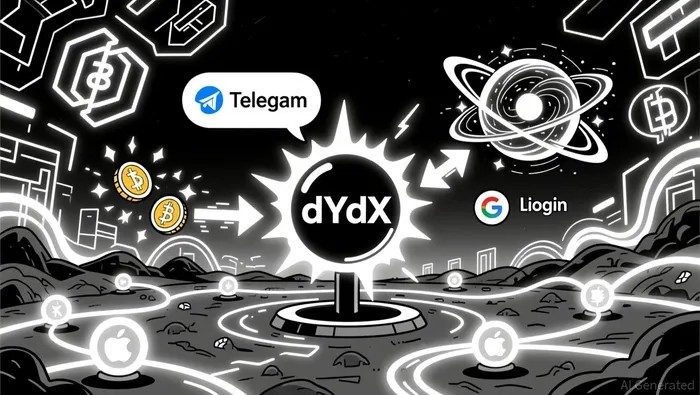
Cross-platform accessibility has also been prioritized. The launch of Telegram Trading in September 2025 allows users to manage their dYdX accounts seamlessly across web and mobile platforms, broadening the user base to include Telegram's 800 million active users, per the Coinlaw analysis. Meanwhile, Social Login functionality-enabling instant sign-ins via Google, Apple, or Passkey-reduces onboarding friction, a key barrier for mainstream adoption, according to the Coinlaw analysis.
These upgrades are supported by robust user support metrics. The dYdX Chain User Support Team achieved a 97% customer satisfaction rate and a 62% resolution rate in Q3 2025, with automated bots resolving common issues efficiently, according to the dYdX Chain Q3 User Support Report. Such service quality reinforces trust, a critical factor in retaining users in a competitive DEX market.
Community Governance and Ecosystem Development
dYdX's governance model has evolved to prioritize community-driven innovation. The dYdX Grants Program, launched via a 2023 governance vote, has allocated resources to 14 new grants in 2025, focusing on infrastructure improvements, research, and data tools, according to the dYdX Grants Program Update. This initiative notNOT-- only decentralizes decision-making but also aligns incentives between the foundation and developers, fostering a sustainable ecosystem.
A notable technical upgrade-v9.1.0-restored IBC compatibility with Cosmos-based chains, refined TWAP handling, and improved fee logic, as reported in the CryptoCrew Validators Governance Update. These changes enhance interoperability, particularly with OsmosisOSMO--, where users can now swap USDCUSDC-- ↔ DYDX directly on the dYdX web interface, according to the Coinlaw analysis. Osmosis, a DeFi app-chain leveraging IBC, acts as a liquidity hub, enabling DYDX to tap into Cosmos's 40+ interconnected blockchains, as detailed in the Osmosis research article. This integration expands the token's utility beyond dYdX's native chain, creating a flywheel effect where increased liquidity drives higher demand for DYDX.
Tokenomics: Balancing Supply, Demand, and Utility
The DYDX token's utility framework has been restructured to align with dYdX's growth ambitions. With a max supply of 1 billion tokens, ~78% of the supply is unlocked as of mid-2025, but ~30% is staked, offering stakers a 3.57% APR, according to the Coinlaw analysis. This staking mechanism not only secures the network but also incentivizes long-term token holding, countering short-term speculative pressure.
Fee structures further reinforce token value. Annualized fees generated $19.64 million in H1 2025, with ~25% of tokens allocated to user trading rewards, according to the Coinlaw analysis. Additionally, the buy-back program has burned 24 million tokens (~$15.7 million) by mid-2025, reducing circulating supply and mitigating inflation, according to the Coinlaw analysis. These strategies create a deflationary tailwind, particularly as dYdX's trading volume approaches $1.4 trillion cumulatively, according to the Coinlaw analysis.
Market Share and Long-Term Positioning
dYdX's execution-driven roadmap has translated into tangible market share gains. Daily trading volume averages $200 million, with open interest reaching $175–200 million in recent quarters, according to the Coinlaw analysis. The platform's integration with Osmosis and Telegram, coupled with its staking and buy-back mechanisms, positions it to outperform centralized exchanges and less interoperable DEXs.
Looking ahead, dYdX's focus on cross-chain utility-via IBC and Cosmos-addresses a critical gap in the DeFi ecosystem. As Osmosis becomes a central hub for decentralized finance, the DYDX token's role in facilitating cross-chain swaps and staking will likely drive demand from both retail and institutional users, as described in the Osmosis research article.
Conclusion: A Compelling Investment Thesis
For DeFi investors, dYdX's strategic expansion and tokenomics framework present a compelling case. The platform's execution on Q3 2025 upgrades, combined with community governance and cross-chain integrations, addresses key pain points in the DEX space. Meanwhile, its tokenomics model-balancing supply reduction, staking incentives, and fee-driven utility-creates a robust foundation for long-term value accrual. As the DEX derivatives market matures, dYdX is well-positioned to dominate through innovation, interoperability, and disciplined execution.






Comentarios
Aún no hay comentarios